

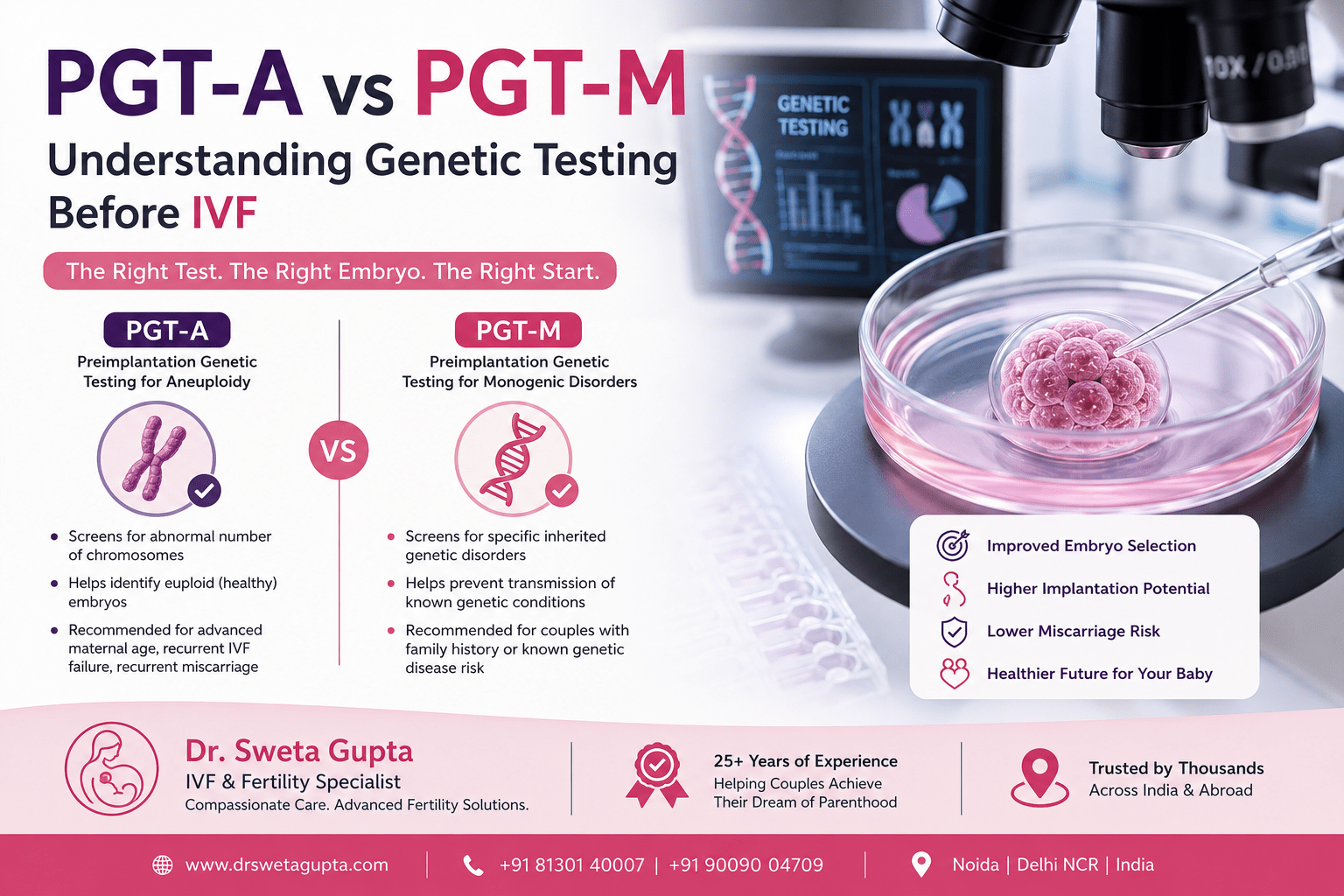
Advances in reproductive medicine have transformed the way fertility specialists approach IVF treatment. Today, couples undergoing IVF have access to sophisticated genetic screening technologies that can help improve embryo selection, reduce the risk of inherited disorders, and support informed reproductive decisions.
Among the most discussed technologies in modern IVF are PGT-A (Preimplantation Genetic Testing for Aneuploidy) and PGT-M (Preimplantation Genetic Testing for Monogenic Disorders).
Many couples searching for IVF treatment in India often ask:
- What is PGT-A?
- What is PGT-M?
- Which genetic test is right for us?
- Does genetic testing improve IVF success rates?
- Is PGT testing necessary for every IVF cycle?
This comprehensive guide by Dr. Sweta Gupta, one of India’s leading IVF and Fertility Specialists, explains the differences between PGT-A and PGT-M, their benefits, limitations, indications, and how genetic testing can play a crucial role in successful fertility treatment.
Understanding Genetic Testing in IVF
Before discussing PGT-A and PGT-M separately, it is important to understand why genetic testing is performed during IVF.
During a standard IVF cycle:
- Eggs are retrieved.
- Fertilization occurs in the laboratory.
- Embryos develop for several days.
- One or more embryos are transferred to the uterus.
Traditionally, embryo selection was based primarily on appearance and development. However, visually healthy embryos may still carry genetic abnormalities that cannot be identified through microscopy alone.
Genetic testing provides additional information regarding embryo health before transfer.
Why Genetic Testing Matters
Genetic abnormalities are one of the leading causes of:
- Failed implantation
- Recurrent miscarriage
- Chromosomal disorders
- IVF failure
- Birth defects
Genetic testing helps fertility specialists select embryos with a higher probability of resulting in a healthy pregnancy.
What is PGT?
PGT stands for Preimplantation Genetic Testing.
It is performed during an IVF cycle before embryo transfer.
Main Types of PGT
There are three primary categories:
PGT-A
Testing for chromosomal abnormalities.
PGT-M
Testing for specific inherited genetic disorders.
PGT-SR
Testing for structural chromosomal rearrangements.
This article focuses specifically on PGT-A and PGT-M.
What is PGT-A?
PGT-A stands for:
Preimplantation Genetic Testing for Aneuploidy
The purpose of PGT-A is to determine whether an embryo contains the correct number of chromosomes.
A normal human embryo should contain:
- 46 chromosomes
- 23 inherited from the mother
- 23 inherited from the father
When embryos contain extra or missing chromosomes, they are known as aneuploid embryos.
Why Chromosome Abnormalities Matter
Chromosomal abnormalities are common even in healthy individuals.
They become increasingly frequent with advancing maternal age.
Aneuploid embryos may result in:
- Implantation failure
- Early miscarriage
- Failed IVF cycles
- Genetic syndromes
Examples of Chromosomal Conditions
- Down Syndrome (Trisomy 21)
- Edwards Syndrome (Trisomy 18)
- Patau Syndrome (Trisomy 13)
- Turner Syndrome
PGT-A helps identify embryos with abnormal chromosome numbers before transfer.
Who Should Consider PGT-A?
PGT-A may be recommended for:
Women Above 35 Years
The risk of chromosomal abnormalities increases significantly after age 35.
Recurrent IVF Failure
Couples experiencing multiple unsuccessful IVF cycles may benefit from PGT-A.
Recurrent Miscarriage
Chromosomal abnormalities are a major cause of recurrent pregnancy loss.
Advanced Maternal Age
PGT-A can help improve embryo selection in older patients.
Multiple Embryos Available
When several embryos are available, PGT-A can assist in identifying the most viable embryo for transfer.
How PGT-A Works
Step 1: IVF Cycle
Egg retrieval and fertilization are performed.
Step 2: Blastocyst Development
Embryos grow to Day 5 or Day 6 blastocyst stage.
Step 3: Embryo Biopsy
A few cells are removed from the outer layer of the embryo.
Step 4: Genetic Analysis
Cells are analyzed in a specialized genetics laboratory.
Step 5: Embryo Classification
Embryos are classified as:
Euploid
Normal chromosome number.
Aneuploid
Abnormal chromosome number.
Mosaic
Mixture of normal and abnormal cells.
Step 6: Embryo Transfer
The most appropriate embryo is selected for transfer.
Benefits of PGT-A
Improved Embryo Selection
Genetic testing provides additional information beyond visual grading.
Reduced Miscarriage Risk
Many miscarriages are caused by chromosomal abnormalities.
Fewer Failed Transfers
Selecting genetically normal embryos may improve implantation efficiency.
Better Decision-Making
Patients receive more information regarding embryo quality.
Limitations of PGT-A
While valuable, PGT-A is not a guarantee of pregnancy.
Important limitations include:
- Not all embryos survive biopsy
- False-positive or false-negative results may occur
- PGT-A does not test for all diseases
- Pregnancy success depends on multiple factors
What is PGT-M?
PGT-M stands for:
Preimplantation Genetic Testing for Monogenic Disorders
Unlike PGT-A, which evaluates chromosome number, PGT-M identifies specific inherited genetic diseases.
PGT-M is designed for couples who have a known risk of passing a genetic condition to their children.
What Are Monogenic Disorders?
Monogenic disorders are caused by mutations in a single gene.
Examples include:
Thalassemia
A common inherited blood disorder.
Sickle Cell Disease
A genetic blood condition.
Cystic Fibrosis
An inherited disorder affecting lungs and digestive function.
Huntington Disease
A progressive neurological disorder.
Muscular Dystrophy
A group of inherited muscle disorders.
Fragile X Syndrome
A genetic condition affecting development and cognition.
Who Should Consider PGT-M?
PGT-M may be appropriate when:
One Partner Has a Genetic Disorder
Known inherited conditions may be passed to offspring.
Both Partners Are Carriers
Carrier screening may reveal shared genetic risks.
Family History of Genetic Disease
Families with inherited disorders may benefit from testing.
Previous Child Affected by Genetic Condition
PGT-M can help reduce recurrence risk.
PGT-A vs PGT-M: Key Differences
| Feature | PGT-A | PGT-M |
|---|---|---|
| Purpose | Chromosome screening | Specific disease screening |
| Detects | Extra or missing chromosomes | Single-gene mutations |
| Used For | IVF success optimization | Preventing inherited disease |
| Recommended For | Older women, recurrent IVF failure | Known genetic disease risk |
| Evaluates | Chromosome number | Specific gene mutations |
| Embryo Selection | Based on chromosome normality | Based on disease-free status |
(Continue with sections on PGT-SR, IVF success rates, risks, ethical considerations, genetic counseling, misconceptions, future of embryo genetics, 25+ FAQs, and consultation CTA.)
Does PGT-A Improve IVF Success Rates?
One of the most frequently asked questions by IVF patients is whether PGT-A improves IVF success rates.
The answer depends on individual circumstances.
PGT-A does not create healthier embryos, nor does it improve embryo quality. Instead, it helps identify embryos that already have a normal chromosome number.
Potential Benefits of PGT-A
Reduced Miscarriage Risk
Chromosomal abnormalities are responsible for a large percentage of early pregnancy losses.
By selecting chromosomally normal embryos, miscarriage rates may be reduced in selected patients.
Improved Implantation Potential
Euploid embryos generally have a better chance of implantation than aneuploid embryos.
More Efficient Embryo Selection
When multiple embryos are available, PGT-A can help identify which embryo may be most appropriate for transfer.
Better Information for Decision-Making
Patients receive additional information regarding embryo health, which can support treatment planning.
Important Reality About PGT-A
PGT-A is not a guarantee of pregnancy.
Successful pregnancy still depends on:
- Embryo quality
- Endometrial receptivity
- Maternal health
- Hormonal balance
- Lifestyle factors
- Age of the patient
Does PGT-M Improve IVF Success Rates?
PGT-M serves a different purpose than PGT-A.
The primary goal of PGT-M is not necessarily to improve IVF success rates but rather to reduce the risk of passing specific inherited diseases to future children.
Benefits of PGT-M
Prevents Transmission of Known Genetic Conditions
Families with inherited disorders can significantly reduce the risk of transmitting these conditions.
Reduces Emotional Burden
Couples may avoid difficult decisions later in pregnancy by identifying affected embryos before transfer.
Supports Informed Family Planning
Parents can proceed with greater confidence knowing embryos have been screened for a known condition.
How Embryo Biopsy is Performed
Many patients worry that embryo biopsy may damage embryos.
Modern embryo biopsy techniques are highly advanced and are generally performed by experienced embryologists.
The Process
Blastocyst Development
Embryos are cultured until Day 5 or Day 6.
Cell Removal
A small number of cells are removed from the trophectoderm (the portion that eventually forms the placenta).
Preservation of Inner Cell Mass
The cells destined to become the baby are generally not disturbed.
Genetic Analysis
The sampled cells are sent for specialized testing.
Is Embryo Biopsy Safe?
When performed in experienced laboratories, embryo biopsy is considered a routine component of modern genetic testing protocols.
However, patients should understand that no procedure is entirely without limitations.
Understanding Mosaic Embryos
One of the most complex topics in IVF genetics is embryo mosaicism.
What is a Mosaic Embryo?
A mosaic embryo contains a mixture of:
- Normal cells
- Abnormal cells
This means the embryo is neither completely euploid nor completely aneuploid.
Why Mosaic Embryos Matter
Mosaic results may create uncertainty regarding:
- Implantation potential
- Pregnancy outcomes
- Miscarriage risk
Can Mosaic Embryos Result in Healthy Babies?
In selected situations, mosaic embryos have resulted in healthy pregnancies and births.
However, treatment decisions should always be made with expert fertility and genetic counseling.
PGT-A and Advanced Maternal Age
Maternal age is one of the strongest factors influencing embryo chromosomal health.
Chromosomal Abnormalities Increase With Age
Approximate trends show:
Under 35 Years
Lower percentage of aneuploid embryos.
Age 35–37
Gradual increase in chromosomal abnormalities.
Age 38–40
Significant increase in abnormal embryos.
Above 40 Years
A substantial proportion of embryos may be chromosomally abnormal.
This is one reason why fertility specialists may discuss PGT-A more frequently with older IVF patients.
PGT Testing and Recurrent Miscarriage
Recurrent pregnancy loss is emotionally devastating for couples.
In many cases, chromosomal abnormalities may contribute to repeated miscarriages.
How PGT-A May Help
PGT-A can identify embryos with abnormal chromosome numbers before transfer.
This may help fertility specialists understand whether embryo chromosomal health is contributing to pregnancy loss.
Comprehensive Evaluation Still Matters
Miscarriage can also result from:
- Uterine abnormalities
- Hormonal issues
- Autoimmune conditions
- Blood clotting disorders
- Endocrine disorders
A complete fertility assessment remains essential.
PGT Testing and Recurrent IVF Failure
Repeated unsuccessful IVF cycles can be frustrating and emotionally exhausting.
Potential causes include:
Embryo Factors
Chromosomal abnormalities may affect implantation.
Uterine Factors
The uterine environment plays a critical role.
Immunological Factors
In selected cases, immune-related conditions may contribute.
Hormonal Factors
Hormonal imbalances may impact implantation success.
Genetic testing can provide additional information during evaluation.
Common Myths About PGT-A and PGT-M
Myth 1: PGT Guarantees Pregnancy
Reality:
No fertility treatment can guarantee pregnancy.
Myth 2: PGT Creates Better Embryos
Reality:
PGT identifies embryos with certain genetic characteristics. It does not improve embryo quality.
Myth 3: Every IVF Patient Needs PGT
Reality:
PGT is not necessary for all patients.
Recommendations depend on medical history and fertility goals.
Myth 4: PGT Can Detect Every Disease
Reality:
No genetic test can identify every possible condition.
Myth 5: PGT Eliminates All Pregnancy Risks
Reality:
Pregnancy outcomes depend on many factors beyond genetics.
Risks and Limitations of Genetic Testing
Patients should understand both benefits and limitations.
Possible Limitations
- Cost considerations
- No guarantee of pregnancy
- Potential inconclusive results
- Limited embryo availability
- Mosaic findings requiring counseling
Importance of Genetic Counseling
Before undergoing PGT-A or PGT-M, patients should receive detailed counseling regarding:
- Expected benefits
- Limitations
- Potential outcomes
- Ethical considerations
Future of Genetic Testing in IVF
Reproductive genetics continues to evolve rapidly.
Emerging technologies may improve:
- Embryo assessment
- Genetic analysis
- Implantation prediction
- Personalized fertility treatment
Artificial intelligence and advanced genomic technologies are expected to play an increasingly important role in future IVF care.
Why Choose Dr. Sweta Gupta for Advanced IVF Consultation?
When considering advanced fertility treatments such as IVF with genetic testing, experience and expertise are essential.
International Qualifications
- MD (Obs & Gynae, Delhi)
- MRCOG (London)
- DFSRH (UK)
- FRCOG (London)
- MSc (Reproduction & Development, Bristol, UK)
- Fellowship in Reproductive Medicine & ART (London)
More Than 25 Years of Experience
Dr. Sweta Gupta has extensive experience in:
- IVF Treatment
- ICSI
- Recurrent IVF Failure
- Recurrent Miscarriage
- Fertility Preservation
- Advanced Reproductive Medicine
Personalized Treatment Planning
Every couple receives individualized fertility guidance based on:
- Medical history
- Fertility goals
- Age
- Reproductive health
- Genetic risk factors
Frequently Asked Questions About PGT-A and PGT-M
What is the difference between PGT-A and PGT-M?
PGT-A screens for chromosome abnormalities, while PGT-M tests for specific inherited genetic disorders.
Is PGT testing mandatory during IVF?
No. Genetic testing is recommended only when medically appropriate.
Can PGT-A detect Down Syndrome?
PGT-A can identify chromosome abnormalities associated with conditions such as Down syndrome.
Can PGT-M prevent inherited diseases?
PGT-M helps identify embryos affected by specific inherited genetic disorders before transfer.
Is embryo biopsy painful?
No. Embryos do not experience pain, and the procedure occurs in the laboratory.
Does PGT improve implantation rates?
In selected patients, genetic testing may assist in identifying embryos with greater implantation potential.
Can PGT determine gender?
Certain genetic information may reveal chromosomal sex, but regulations and ethical guidelines vary by country.
Is PGT recommended after recurrent miscarriage?
In selected situations, fertility specialists may discuss genetic testing as part of a broader evaluation.
How accurate is PGT testing?
Modern genetic testing technologies are highly advanced, though no test is 100% perfect.
Is PGT-A useful for younger women?
Recommendations depend on individual circumstances and fertility history.
Book Your Advanced Fertility Consultation
Couples considering IVF, ICSI, PGT-A, or PGT-M should consult an experienced fertility specialist to understand the most appropriate options for their situation.
Dr. Sweta Gupta
Best IVF & Fertility Specialist in India
SG Clinic
3D-5L, Wave City Center,
Sector 32, Noida – 201301
📞 8130140007
📞 9009004709
Final Thoughts
Genetic testing has revolutionized modern IVF by providing valuable information about embryo health before transfer. Understanding the differences between PGT-A and PGT-M allows couples to make informed reproductive decisions and discuss personalized treatment options with their fertility specialist. Whether the goal is improving embryo selection or reducing the risk of inherited disease, genetic testing can play an important role in advanced fertility care when used appropriately.