

Advances in reproductive medicine have transformed the way fertility treatments are performed. One of the most significant breakthroughs in modern IVF is Frozen Embryo Transfer (FET). Today, FET has become an integral part of fertility treatment, offering flexibility, personalized care, and excellent pregnancy outcomes for many couples.
Years ago, IVF treatment primarily relied on transferring fresh embryos during the same treatment cycle. However, improvements in embryo freezing technology—particularly vitrification—have made frozen embryo transfer a highly effective option in selected clinical situations.
Many patients preparing for IVF ask questions such as:
- What is Frozen Embryo Transfer (FET)?
- Is FET better than fresh embryo transfer?
- How successful is Frozen Embryo Transfer?
- When do doctors recommend FET?
- Is a frozen embryo as healthy as a fresh embryo?
- How should I prepare before FET?
- What can improve implantation after frozen embryo transfer?
The answers depend on individual medical history, embryo quality, uterine preparation, and overall fertility health.
As an internationally trained fertility specialist with 25+ years of experience, Dr. Sweta Gupta believes that successful IVF treatment begins with understanding every step of the fertility journey. Every couple has unique reproductive goals, and every treatment plan should be personalized to maximize the chances of a healthy pregnancy.
Understanding IVF Before Learning About Frozen Embryo Transfer
To understand Frozen Embryo Transfer, it is helpful to know how an IVF cycle works.
A typical IVF treatment includes:
- Ovarian stimulation
- Egg retrieval
- Fertilization using IVF or ICSI
- Embryo development
- Embryo transfer
- Pregnancy test
During embryo development, one or more high-quality embryos may be available for immediate transfer, while additional healthy embryos can be frozen for future use.
These frozen embryos are later used in a Frozen Embryo Transfer (FET) cycle.
What Is Frozen Embryo Transfer (FET)?
Frozen Embryo Transfer (FET) is an IVF procedure in which a previously frozen embryo is thawed and transferred into the uterus during a carefully prepared menstrual cycle.
Unlike fresh embryo transfer, embryo freezing allows doctors to separate the embryo transfer from the ovarian stimulation cycle.
This provides greater flexibility and, in many cases, allows the uterus to be prepared under more favorable conditions.
Thanks to modern freezing techniques, frozen embryos can remain safely preserved for years while maintaining excellent survival rates after thawing.
What Is Embryo Freezing?
Embryo freezing is the process of preserving embryos at extremely low temperatures.
The embryos are stored in liquid nitrogen at approximately −196°C, where all biological activity is effectively paused.
When the patient is ready for embryo transfer, the embryo is thawed and prepared for transfer into the uterus.
This process is known as cryopreservation.
What Is Vitrification?
Modern IVF laboratories use a technique called vitrification.
Vitrification is an ultra-rapid freezing method that minimizes ice crystal formation within the embryo.
This technology has significantly improved embryo survival after thawing compared with older slow-freezing methods.
Today, vitrification is considered the standard method for embryo cryopreservation in most advanced fertility centers.
Why Are Embryos Frozen During IVF?
There are several reasons why fertility specialists may recommend freezing embryos.
Additional Healthy Embryos
If multiple good-quality embryos are available after IVF, one embryo may be transferred while the remaining embryos are frozen for future attempts.
Delayed Embryo Transfer
Sometimes it is medically preferable to postpone embryo transfer until the uterus is optimally prepared.
Preimplantation Genetic Testing (PGT)
When embryos undergo genetic testing, freezing is typically required while laboratory analysis is completed.
Medical Reasons
Embryo freezing may also be recommended if hormonal levels or uterine conditions are not ideal during the stimulation cycle.
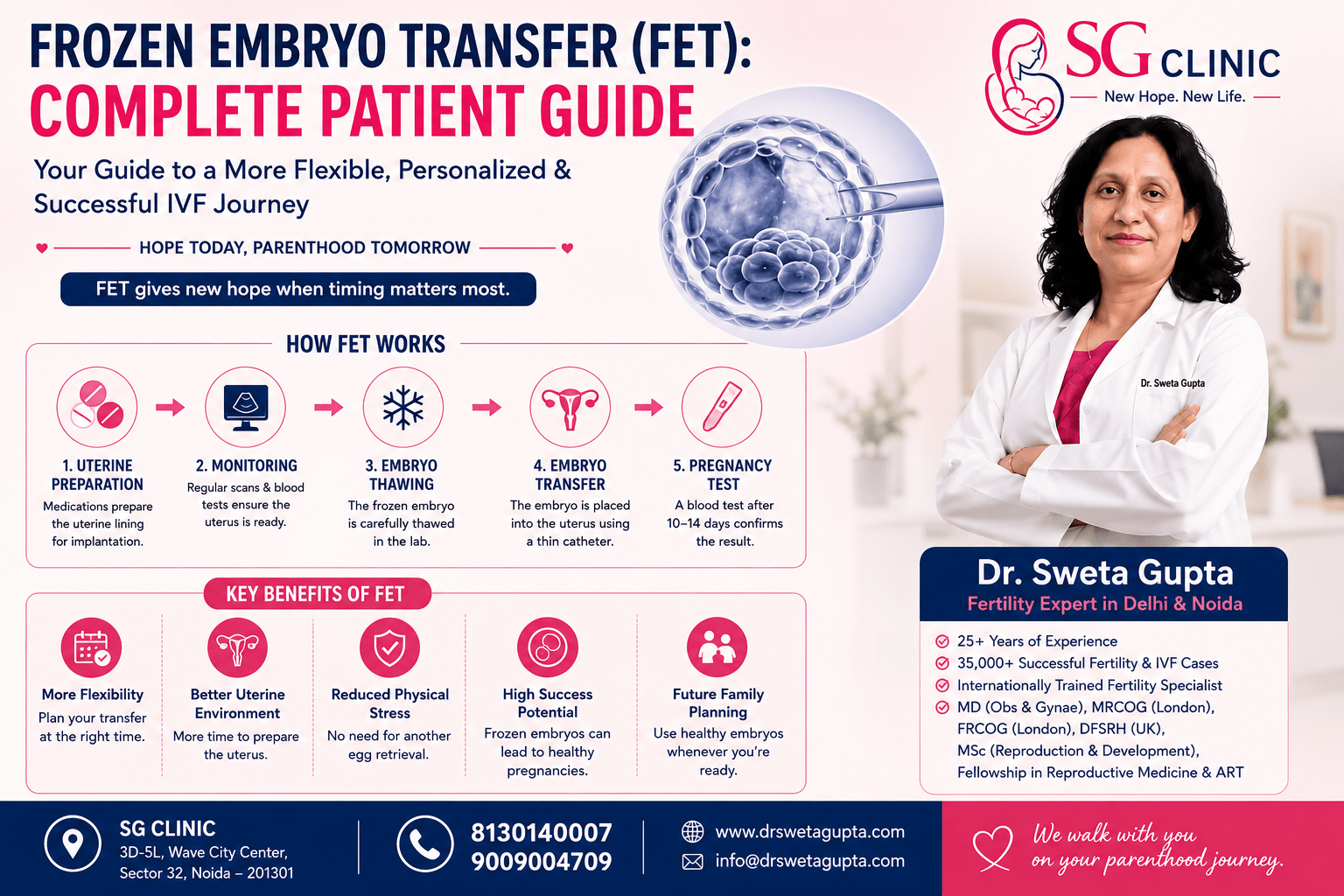
How Does Frozen Embryo Transfer Work?
Although simpler than a complete IVF cycle, FET still involves careful planning.
Step 1: Initial Consultation
Your fertility specialist reviews:
- Previous IVF cycle
- Embryo quality
- Medical history
- Hormonal profile
- Ultrasound findings
A personalized treatment plan is then created.
Step 2: Preparing the Uterus
The endometrium (uterine lining) must be prepared to support implantation.
This may occur naturally or with hormonal medications, depending on the treatment plan.
Step 3: Monitoring
Ultrasound scans assess endometrial thickness and appearance.
Blood tests may also be performed to evaluate hormone levels.
Step 4: Embryo Thawing
The selected frozen embryo is thawed in the embryology laboratory.
The embryologist carefully evaluates embryo survival before transfer.
Step 5: Embryo Transfer
The embryo is placed into the uterus using a thin catheter under ultrasound guidance.
The procedure is generally quick and does not require anesthesia.
Step 6: Pregnancy Test
Approximately 10–14 days after transfer, a blood test measures hCG levels to determine whether implantation has occurred.
Fresh Embryo Transfer vs Frozen Embryo Transfer
One of the most common questions couples ask is whether fresh or frozen embryo transfer is better.
The answer depends on individual clinical circumstances.
Fresh Embryo Transfer
Fresh embryos are transferred during the same IVF cycle in which eggs are retrieved.
Frozen Embryo Transfer
Frozen embryos are transferred during a later cycle after cryopreservation and thawing.
Comparison Table
| Feature | Fresh Embryo Transfer | Frozen Embryo Transfer |
|---|---|---|
| Transfer Timing | Same IVF Cycle | Future Cycle |
| Embryo Storage | No | Yes |
| Uterine Recovery | Limited | More Time for Recovery |
| Suitable for PGT | Less Common | Common |
| Flexibility | Lower | Higher |
| Personalized Timing | Limited | Greater |
Neither approach is universally superior. The choice depends on individual patient factors and your fertility specialist’s recommendation.
Who May Benefit from Frozen Embryo Transfer?
Frozen Embryo Transfer may be recommended in several situations.
Women with High Ovarian Response
Patients at risk of Ovarian Hyperstimulation Syndrome (OHSS) may benefit from delaying embryo transfer until the body has recovered.
Patients Undergoing PGT
Embryos are generally frozen after biopsy while genetic testing is completed.
Elevated Hormone Levels
Very high estrogen or progesterone levels during stimulation may affect endometrial receptivity. Delaying transfer may improve synchronization between the embryo and the uterus.
Fertility Preservation
Patients preserving fertility before medical treatments such as chemotherapy may later use frozen embryos.
Previous IVF Cycles
Frozen embryos from earlier IVF cycles can be transferred without repeating ovarian stimulation and egg retrieval.
Benefits of Frozen Embryo Transfer
Greater Flexibility
Embryos can be transferred when the uterus is optimally prepared rather than during the stimulation cycle.
Reduced Physical Stress
Patients do not need another egg retrieval procedure when using previously frozen embryos.
Opportunity for Personalized Treatment
The endometrium can be prepared more carefully, allowing individualized treatment planning.
Efficient Use of Existing Embryos
Frozen embryos provide additional opportunities for pregnancy without repeating the entire IVF process.
Supports Family Planning
Couples may choose to use frozen embryos months or even years after the original IVF cycle.
Does Frozen Embryo Transfer Have Good Success Rates?
Success depends on many factors—not simply whether the embryo is fresh or frozen.
Important factors include:
Female Age
Egg quality naturally declines with age, making maternal age one of the strongest predictors of success.
Embryo Quality
High-quality embryos generally have better implantation potential.
Uterine Receptivity
A healthy, well-prepared endometrium is essential for implantation.
Embryology Laboratory Standards
Proper freezing, storage, thawing, and embryo handling require experienced embryologists and advanced laboratory facilities.
Overall Health
Medical conditions such as thyroid disorders, diabetes, obesity, or uterine abnormalities can influence treatment outcomes.
Types of Frozen Embryo Transfer Cycles
There are several approaches to preparing the uterus for FET.
Natural Cycle FET
This approach follows the woman’s natural menstrual cycle.
Ovulation occurs naturally, and embryo transfer is timed accordingly.
It may be suitable for women with regular ovulation.
Modified Natural Cycle FET
Ovulation occurs naturally but may be supported with medication to improve timing and predictability.
Hormone Replacement Therapy (HRT) Cycle
Women receive estrogen and progesterone medications to prepare the uterine lining.
This allows greater control over transfer timing and is commonly used for women with irregular menstrual cycles.
The most appropriate protocol is selected based on individual fertility evaluation.
Preparing the Uterus Before Frozen Embryo Transfer
A receptive uterine lining is one of the most important requirements for successful implantation.
Preparation may include:
Hormonal Medications
Estrogen and progesterone help prepare and support the endometrium.
Ultrasound Monitoring
Regular scans assess endometrial thickness and appearance.
Blood Tests
Hormone levels may be monitored to ensure the uterus is developing appropriately.
Lifestyle Guidance
Patients are encouraged to maintain a healthy lifestyle, follow medication schedules, and attend all appointments.
What Happens on the Day of Frozen Embryo Transfer?
Embryo transfer is generally straightforward and minimally invasive.
The embryologist first confirms that the embryo has thawed successfully.
Using ultrasound guidance, the fertility specialist gently places the embryo into the uterus through a soft catheter.
The procedure usually takes only a few minutes, and most patients can return home the same day.
After transfer, medications are continued as advised until pregnancy testing.
Factors That Influence Frozen Embryo Transfer (FET) Success
Although Frozen Embryo Transfer has become an important part of modern IVF treatment, achieving pregnancy depends on multiple medical and biological factors. No single factor determines success. Instead, it is the combination of embryo quality, uterine receptivity, patient health, and personalized treatment planning that contributes to the outcome.
Maternal Age
Age remains one of the strongest predictors of IVF success.
As women age, the number and quality of eggs naturally decline, increasing the likelihood of chromosomal abnormalities. Even when embryos are frozen, the age at which the eggs were retrieved plays an important role in embryo quality.
Embryo Quality
Healthy embryos with good developmental potential generally have a higher chance of implantation.
Embryo quality depends on several factors, including:
- Egg quality
- Sperm quality
- Fertilization process
- Embryo development
- Laboratory conditions
Endometrial Receptivity
A healthy uterine lining is essential for successful implantation.
During FET preparation, fertility specialists monitor:
- Endometrial thickness
- Endometrial pattern
- Hormone levels
- Ovulation timing (for natural cycles)
Proper synchronization between the embryo and the uterine lining is one of the most important goals of an FET cycle.
Embryology Laboratory Standards
Modern embryo freezing relies on:
- Advanced vitrification techniques
- Experienced embryologists
- High-quality incubators
- Strict quality control
Laboratory expertise directly influences embryo survival after thawing.
Lifestyle Factors
Patients are encouraged to:
- Maintain a healthy weight
- Eat a balanced diet
- Exercise moderately
- Avoid smoking
- Limit alcohol intake
- Manage stress
- Get adequate sleep
These measures support overall reproductive health but should complement—not replace—medical treatment.
Tips to Prepare for Frozen Embryo Transfer
While there is no guaranteed way to improve implantation, healthy habits and adherence to medical advice can help optimize conditions for treatment.
Follow Medication Instructions Carefully
Take estrogen, progesterone, or any prescribed medications exactly as directed.
Attend All Monitoring Appointments
Ultrasound scans and blood tests help your fertility specialist determine the ideal timing for embryo transfer.
Maintain a Nutritious Diet
A balanced diet rich in:
- Fruits
- Vegetables
- Whole grains
- Lean proteins
- Healthy fats
supports general health during fertility treatment.
Stay Hydrated
Adequate hydration supports overall well-being throughout the IVF process.
Manage Stress
Although stress alone does not cause infertility, emotional well-being is an important part of the fertility journey.
Relaxation techniques may include:
- Meditation
- Yoga
- Breathing exercises
- Walking
- Counseling
- Support groups
Get Enough Sleep
Aim for consistent, good-quality sleep before and after embryo transfer.
What Happens After Frozen Embryo Transfer?
After the embryo is transferred, many couples wonder what happens next.
Implantation
If the embryo successfully attaches to the uterine lining, implantation begins over the following days.
Hormonal Support
Progesterone and other medications are usually continued to support the uterine lining.
Waiting Period
The time between embryo transfer and pregnancy testing is often referred to as the “two-week wait.”
Although emotionally challenging, it is important to continue medications and follow your doctor’s instructions during this period.
Pregnancy Test
A blood test measuring beta-hCG is usually performed approximately 10–14 days after embryo transfer to determine whether implantation has occurred.
Common Myths About Frozen Embryo Transfer
Myth 1: Frozen Embryos Are Less Healthy Than Fresh Embryos
Fact: Modern vitrification techniques have significantly improved embryo survival after thawing. Frozen embryos can lead to healthy pregnancies and births.
Myth 2: Frozen Embryos Cannot Implant Successfully
Fact: Frozen embryo transfer is a well-established part of IVF treatment and is widely used around the world.
Myth 3: Every IVF Cycle Should Include Frozen Embryo Transfer
Fact: FET is recommended in selected situations. The decision should be individualized based on medical factors.
Myth 4: Frozen Embryos Lose Their Quality Over Time
Fact: Properly cryopreserved embryos remain in a suspended biological state during storage. The duration of storage itself does not necessarily reduce embryo quality.
Myth 5: Bed Rest Improves Implantation
Fact: Extended bed rest has not been shown to improve implantation. Most patients can return to normal daily activities, following their doctor’s advice.
Risks and Limitations of Frozen Embryo Transfer
Frozen Embryo Transfer is generally considered safe, but like any medical procedure, it has limitations.
Implantation Failure
Even high-quality embryos may not implant.
Pregnancy Loss
Miscarriage can occur after natural conception or IVF for many different reasons, including chromosomal abnormalities.
Multiple Pregnancy
If more than one embryo is transferred, the chance of twins or higher-order pregnancies increases.
Ectopic Pregnancy
Although uncommon, implantation outside the uterus is possible after IVF.
Emotional Challenges
Waiting for pregnancy results can be emotionally stressful. Counseling and emotional support may help couples navigate this period.
Frozen Embryo Transfer After Preimplantation Genetic Testing (PGT)
Patients undergoing PGT usually have embryos frozen after biopsy while genetic analysis is completed.
Once results are available, a genetically screened embryo can be selected for transfer during a later FET cycle.
This approach allows:
- Time for laboratory analysis
- Personalized uterine preparation
- Flexibility in treatment planning
PGT is recommended only for selected patients based on medical history and individual risk factors.
Frozen Embryo Transfer After a Previous IVF Failure
Experiencing an unsuccessful IVF cycle can be emotionally difficult.
For couples with frozen embryos remaining from a previous IVF cycle, FET offers another opportunity without repeating ovarian stimulation or egg retrieval.
Before proceeding, the fertility specialist may review:
- Previous embryo development
- Uterine evaluation
- Hormonal profile
- Lifestyle factors
- Medical history
This reassessment helps guide future treatment decisions.
Emotional Well-Being During Frozen Embryo Transfer
The emotional aspects of fertility treatment are often overlooked but are just as important as medical care.
Patients may experience:
- Hope
- Anxiety
- Excitement
- Fear
- Uncertainty
Support from family, friends, counselors, or fertility support groups can be valuable throughout the process.
At SG Clinic, patient-centered care includes open communication, education, and emotional support at every stage of treatment.
Why Choose Dr. Sweta Gupta for Frozen Embryo Transfer?
Selecting the right fertility specialist is one of the most important decisions in your parenthood journey.
International Qualifications
Dr. Sweta Gupta has advanced training in reproductive medicine, including:
- MD (Obs & Gynae, Delhi)
- MRCOG (London)
- DFSRH (UK)
- FRCOG (London)
- MSc (Reproduction & Development, Bristol, UK)
- Fellowship in Reproductive Medicine & ART (London)
25+ Years of Experience
With more than two decades of experience, Dr. Sweta Gupta has helped thousands of couples through personalized fertility treatment.
Comprehensive Fertility Services
- Fertility Evaluation
- IVF
- ICSI
- IUI
- Frozen Embryo Transfer (FET)
- Preimplantation Genetic Testing (PGT)
- Recurrent Pregnancy Loss Management
- Fertility Preservation
- Male & Female Infertility Care
Individualized Treatment Plans
Every treatment recommendation is based on:
- Age
- Fertility diagnosis
- Embryo quality
- Medical history
- Reproductive goals
Frequently Asked Questions About Frozen Embryo Transfer
What is Frozen Embryo Transfer (FET)?
FET is an IVF procedure where a previously frozen embryo is thawed and transferred into the uterus during a prepared cycle.
Is FET painful?
No. The embryo transfer procedure is generally quick and causes minimal discomfort.
Are frozen embryos healthy?
With modern vitrification techniques, frozen embryos can remain viable for future use and have resulted in many healthy pregnancies.
Is FET better than fresh embryo transfer?
The most appropriate option depends on your individual medical condition. Your fertility specialist will recommend the best approach for you.
How long does a Frozen Embryo Transfer cycle take?
The timeline varies depending on the type of FET cycle and individual treatment plan.
Can frozen embryos survive thawing?
Most embryos preserved with modern vitrification techniques survive the thawing process successfully, although survival cannot be guaranteed.
Is bed rest necessary after embryo transfer?
Routine prolonged bed rest is generally not recommended. Follow your fertility specialist’s specific advice.
Can I work after Frozen Embryo Transfer?
Many patients resume normal daily activities. Discuss any job-specific concerns with your doctor.
Can FET be performed years after embryo freezing?
Yes. Frozen embryos can be stored for extended periods according to applicable regulations and clinic policies.
When should I take a pregnancy test?
A blood test is typically performed 10–14 days after embryo transfer, based on your treatment protocol.
Final Thoughts
Frozen Embryo Transfer (FET) has transformed modern fertility treatment by offering greater flexibility, personalized care, and the opportunity to use previously frozen embryos without repeating ovarian stimulation and egg retrieval.
While FET has become a valuable option for many couples, success depends on a combination of factors, including embryo quality, uterine preparation, laboratory standards, and individualized medical care.
The best fertility treatment plan is always one that is tailored to your unique reproductive health and developed in partnership with an experienced fertility specialist.
Book Your Fertility Consultation
If you are planning IVF or would like to learn whether Frozen Embryo Transfer (FET) is the right option for your fertility journey, schedule a consultation with Dr. Sweta Gupta, an internationally trained fertility specialist with over 25 years of experience.
Contact Details
Dr. Sweta Gupta
Best Fertility Expert in Delhi & Noida
SG Clinic
3D-5L, Wave City Center,
Sector 32, Noida – 201301
📞 8130140007
📞 9009004709