

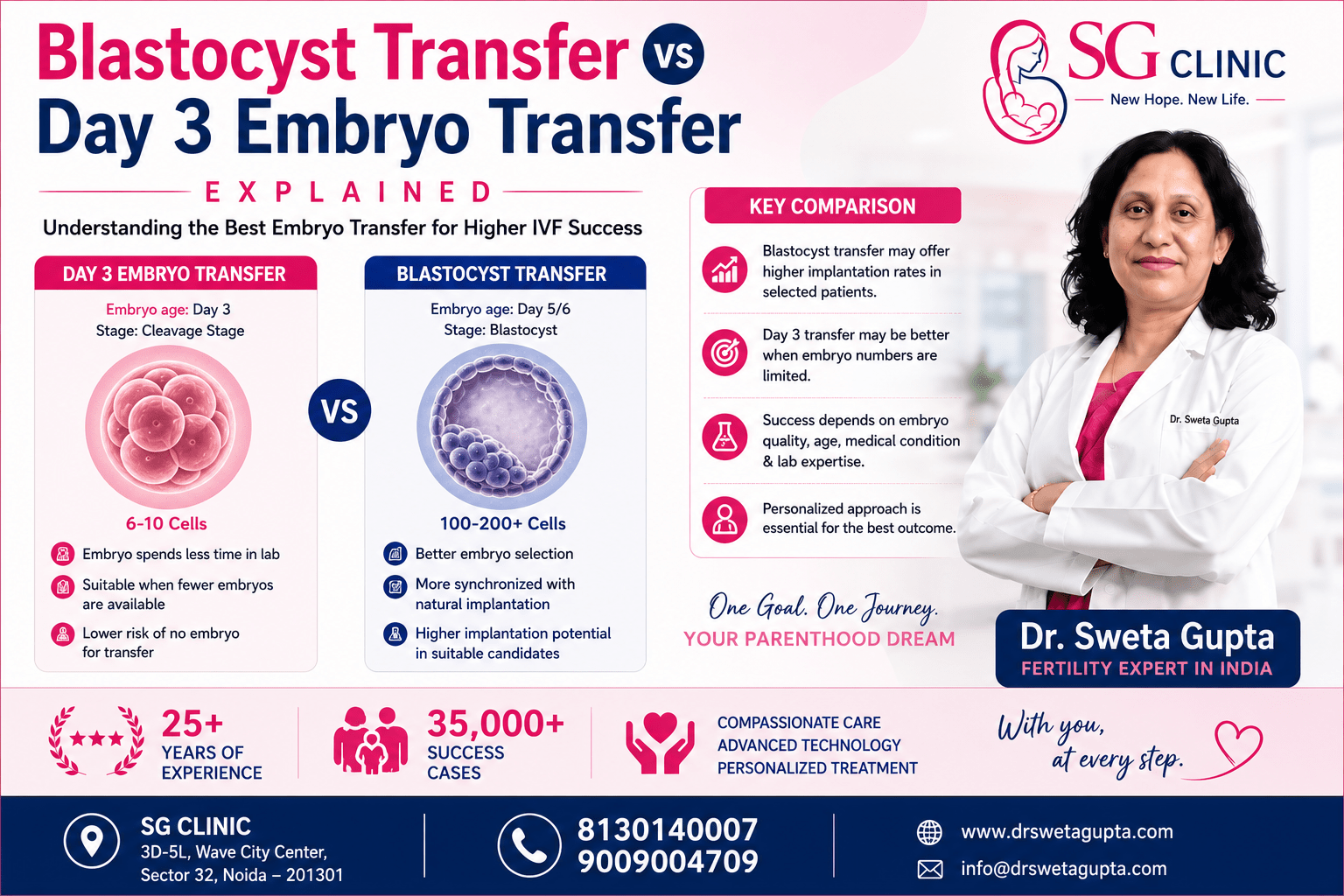
Embryo transfer is one of the most exciting and emotionally significant stages of an IVF (In Vitro Fertilization) journey. After days of ovarian stimulation, egg retrieval, fertilization, and embryo development, the next crucial decision is when the embryo should be transferred into the uterus.
One of the most common questions couples ask is:
- Should I choose a Day 3 embryo transfer or a Blastocyst (Day 5) transfer?
- Which embryo transfer has a higher success rate?
- Is blastocyst transfer always better?
- Why do some fertility specialists recommend Day 3 embryos?
- Does waiting until Day 5 improve pregnancy chances?
The answer isn’t the same for every couple.
The ideal embryo transfer strategy depends on multiple factors, including:
- Maternal age
- Number of embryos available
- Embryo quality
- Previous IVF history
- Ovarian reserve
- Male infertility factors
- Laboratory conditions
As an internationally trained fertility specialist with 25+ years of experience, Dr. Sweta Gupta believes that embryo transfer decisions should always be individualized rather than following a one-size-fits-all approach.
In this comprehensive guide, you’ll learn everything about Blastocyst Transfer vs Day 3 Embryo Transfer, including how embryos develop, differences in success rates, advantages, disadvantages, patient selection, and how fertility specialists determine the most suitable embryo transfer strategy.
Why Embryo Transfer Is One of the Most Important Steps in IVF
Many couples assume that IVF success depends only on egg retrieval or fertilization.
In reality, embryo transfer is equally important.
Even excellent-quality embryos require:
- Healthy embryo development
- Proper uterine preparation
- Correct timing
- Experienced embryology team
- Personalized transfer planning
A carefully selected embryo transferred at the right stage can significantly improve the chances of implantation.
Understanding Embryo Development During IVF
To understand the difference between Day 3 and Blastocyst transfer, it is important to understand how embryos grow inside the IVF laboratory.
After fertilization, embryos divide continuously over several days.
Day 0 – Fertilization
The egg is fertilized using either:
- Conventional IVF
- ICSI (Intracytoplasmic Sperm Injection)
The fertilized egg is called a zygote.
Day 1
The embryologist confirms whether fertilization has occurred normally.
Normally fertilized embryos show two pronuclei (2PN).
Day 2
The embryo usually contains approximately:
- 2 to 4 cells
Cell division continues rapidly.
Day 3
The embryo generally develops into an 8-cell embryo.
This stage is commonly referred to as the cleavage stage embryo.
At this point, fertility specialists may choose to transfer the embryo into the uterus or continue laboratory culture.
Day 4
The embryo develops into a morula.
Individual cells begin merging together.
Day 5
The embryo becomes a blastocyst.
A blastocyst contains:
- Inner Cell Mass (future baby)
- Trophectoderm (future placenta)
- Fluid-filled cavity
This represents a more advanced stage of embryo development.
Day 6
Some embryos develop into blastocysts slightly later.
These may still be suitable for transfer or freezing depending on their quality.
What Is a Day 3 Embryo Transfer?
A Day 3 embryo transfer involves placing embryos into the uterus approximately three days after fertilization.
At this stage, embryos usually contain:
- 6–10 cells
- Active cell division
- Early developmental characteristics
Historically, Day 3 transfer was the standard IVF practice before improvements in embryo culture technology allowed embryos to be grown reliably to the blastocyst stage.
Today, Day 3 transfer continues to play an important role for selected patients.
How Is a Day 3 Embryo Transfer Performed?
The process includes:
Embryo Assessment
The embryologist evaluates:
- Cell number
- Cell symmetry
- Fragmentation
- Overall embryo quality
Embryo Selection
One or more suitable embryos are selected.
Transfer Procedure
Using a thin catheter, the embryo is gently placed into the uterine cavity under ultrasound guidance.
The procedure is generally quick and does not require surgery.
Advantages of Day 3 Embryo Transfer
Although blastocyst transfer has become increasingly common, Day 3 transfer still offers several advantages.
Less Time in the Laboratory
Embryos spend fewer days outside the body.
Some fertility specialists believe this may benefit selected embryos.
Helpful When Few Embryos Are Available
If only a small number of embryos develop after fertilization, transferring on Day 3 may avoid the possibility that no embryos survive to Day 5.
Suitable for Poor Ovarian Reserve
Women with diminished ovarian reserve often produce fewer eggs.
Day 3 transfer may be considered when embryo numbers are limited.
Reduced Risk of Having No Transfer
In some IVF cycles, embryos stop developing before reaching the blastocyst stage.
Day 3 transfer ensures that embryos are transferred before this possibility.
Limitations of Day 3 Embryo Transfer
Like every medical approach, Day 3 transfer has certain limitations.
Limited Embryo Selection
Embryologists have less information about long-term embryo development.
Lower Developmental Assessment
Some embryos appearing healthy on Day 3 may stop growing naturally before Day 5.
Blastocyst culture helps identify embryos that continue normal development.
Potentially Lower Implantation Efficiency
In selected patients, blastocyst-stage embryos may demonstrate higher implantation potential because they have already reached an advanced developmental milestone.
What Is Blastocyst Transfer?
Blastocyst transfer involves placing embryos into the uterus approximately five or six days after fertilization.
At this stage, embryos have undergone several additional days of development.
A blastocyst contains:
Inner Cell Mass
This group of cells develops into the fetus.
Trophectoderm
These cells eventually form the placenta.
Blastocoel
A fluid-filled cavity that develops inside the embryo.
Blastocyst transfer is widely used in modern IVF programs due to advances in embryo culture systems.
Why Is Blastocyst Transfer Popular?
Advances in IVF laboratories now allow embryos to grow safely for longer periods.
This provides fertility specialists with additional information about embryo development before transfer.
Only embryos capable of continuing development reach the blastocyst stage.
Advantages of Blastocyst Transfer
Better Embryo Selection
Embryologists can observe embryo development for several additional days.
This helps identify embryos that continue growing normally.
Improved Synchronization With the Uterus
In natural conception, embryos usually enter the uterus at the blastocyst stage.
Blastocyst transfer more closely mimics this timing.
Greater Confidence in Embryo Development
Embryos reaching Day 5 have successfully progressed through several important developmental stages.
Useful for Single Embryo Transfer
Blastocyst transfer often supports the use of elective single embryo transfer, reducing the likelihood of multiple pregnancy while maintaining good pregnancy potential in appropriate patients.
Limitations of Blastocyst Transfer
Although blastocyst transfer has many advantages, it is not appropriate for every IVF cycle.
Risk of No Blastocyst Formation
Some embryos stop developing before Day 5.
Patients with very few embryos may have no embryos available for transfer.
Requires High-Quality IVF Laboratory
Extended embryo culture depends heavily on:
- Advanced incubators
- Skilled embryologists
- Strict laboratory protocols
Not Ideal for Every Patient
Women producing very few embryos may benefit from individualized decision-making rather than routine blastocyst culture.
Blastocyst Transfer vs Day 3 Transfer: Quick Comparison
| Feature | Day 3 Transfer | Blastocyst Transfer |
|---|---|---|
| Embryo Age | Day 3 | Day 5–6 |
| Development Stage | Cleavage Stage | Blastocyst |
| Cell Count | 6–10 Cells | 100–200+ Cells |
| Laboratory Culture | Shorter | Longer |
| Embryo Selection | Earlier | More Advanced |
| Suitable For | Fewer Embryos | Multiple Good-Quality Embryos |
| Single Embryo Transfer | Less Common | More Common |
| Extended Development Assessment | Limited | Yes |
Does Blastocyst Transfer Always Have Higher Success Rates?
This is one of the biggest misconceptions in fertility treatment.
Many people believe:
“Blastocyst transfer always gives higher IVF success.”
This statement is not entirely correct.
The answer depends on:
- Age
- Number of embryos
- Embryo quality
- Cause of infertility
- Laboratory expertise
- Previous IVF history
For some couples, blastocyst transfer may be the preferred option because it allows additional embryo selection.
For others—especially those with very few embryos—transferring on Day 3 may be a reasonable approach.
The goal is not simply to wait until Day 5 but to choose the strategy most appropriate for the individual patient.
Who Is a Good Candidate for Day 3 Embryo Transfer?
Day 3 transfer may be considered in selected situations, including:
Women With Few Available Embryos
Patients producing a limited number of embryos may benefit from earlier transfer.
Poor Ovarian Reserve
Reduced ovarian reserve often results in fewer eggs and embryos.
Previous Poor Blastocyst Development
If embryos repeatedly fail to reach Day 5 in prior IVF cycles, Day 3 transfer may be discussed.
Individualized Clinical Decision
Every fertility journey is unique. The decision should be based on a comprehensive evaluation rather than a fixed protocol.
Who Is a Good Candidate for Blastocyst Transfer?
Blastocyst transfer may be suitable for patients who:
- Produce multiple good-quality embryos
- Have a favorable ovarian response
- Are considering single embryo transfer
- May require preimplantation genetic testing (PGT), which is typically performed at the blastocyst stage
- Have access to an experienced IVF laboratory with advanced embryo culture systems
How Are Day 3 and Blastocyst Embryos Graded?
Embryo grading is one of the most important aspects of IVF treatment. It helps embryologists evaluate how well an embryo is developing before transfer or freezing. While grading provides valuable information, it is only one factor among many that influence IVF success.
Day 3 Embryo Grading
Day 3 embryos, also known as cleavage-stage embryos, are assessed based on several characteristics:
Number of Cells
A healthy Day 3 embryo typically has 6–10 cells, with 8 cells often considered an ideal stage of development. However, normal variation exists, and slightly fewer or more cells do not automatically indicate poor quality.
Cell Symmetry
Embryologists evaluate whether the cells are similar in size and shape. More symmetrical embryos are generally considered to have better developmental potential.
Fragmentation
Small fragments of cellular material can appear around the embryo. Mild fragmentation is common, but extensive fragmentation may be associated with reduced developmental potential.
Multinucleation
Each cell should ideally contain a single nucleus. The presence of multiple nuclei in one cell may influence the embryo’s developmental assessment.
Blastocyst Grading
Blastocyst embryos are graded using a more detailed system because they have reached a more advanced stage of development.
Three components are evaluated:
Degree of Expansion
This indicates how fully the blastocyst has expanded and developed.
Inner Cell Mass (ICM)
The ICM forms the fetus. A well-defined, compact ICM is generally considered a positive feature.
Trophectoderm (TE)
The trophectoderm develops into the placenta. A healthy trophectoderm may support successful implantation and placental development.
Does a Higher Embryo Grade Guarantee Pregnancy?
No.
A beautifully graded embryo does not guarantee implantation, and a lower-graded embryo can still result in a healthy pregnancy.
Successful implantation depends on multiple factors, including:
- Embryo genetics
- Uterine receptivity
- Maternal health
- Hormonal balance
- Age
- Lifestyle factors
Embryo grading should always be interpreted alongside the overall clinical picture.
Blastocyst Transfer Success Rate vs Day 3 Transfer
Many couples ask whether blastocyst transfer has a higher success rate than Day 3 embryo transfer.
Current evidence suggests that blastocyst transfer may improve implantation efficiency in selected patients because embryos have demonstrated continued development to Day 5.
However, success depends on several individual factors, including:
Female Age
Women under 35 often have a higher proportion of healthy embryos, while chromosomal abnormalities increase with age.
Number of Embryos Available
Patients with several good-quality embryos may benefit from extended culture to the blastocyst stage. Those with only one or two embryos may be advised to consider Day 3 transfer based on individual circumstances.
IVF Laboratory Quality
Blastocyst culture requires advanced laboratory conditions and experienced embryologists. Laboratory quality plays a major role in embryo development.
Overall Reproductive Health
Conditions affecting the uterus, hormonal balance, or general health also influence implantation and pregnancy outcomes.
Fresh Blastocyst Transfer vs Frozen Blastocyst Transfer (FET)
Modern IVF programs often freeze blastocysts and transfer them in a later cycle.
What Is Frozen Embryo Transfer (FET)?
During FET, a previously frozen embryo is thawed and transferred into the uterus after the endometrium has been prepared.
Advantages of FET
- Greater flexibility in treatment planning
- Time for the body to recover after ovarian stimulation
- Opportunity to optimize the uterine lining
- Suitable for embryos undergoing Preimplantation Genetic Testing (PGT)
The choice between a fresh and frozen transfer depends on individual clinical circumstances and should be discussed with the treating fertility specialist.
Blastocyst Transfer and Preimplantation Genetic Testing (PGT)
When PGT is recommended, embryos are usually cultured to the blastocyst stage.
Why Is PGT Performed at the Blastocyst Stage?
At Day 5 or Day 6, a small sample of cells can be taken from the trophectoderm (the future placenta) while preserving the inner cell mass that develops into the baby.
PGT may be considered for selected couples, such as those with:
- Advanced maternal age
- Recurrent miscarriage
- Recurrent IVF failure
- Known inherited genetic disorders
PGT is not recommended for every IVF patient, and the decision should be individualized.
Myths About Blastocyst and Day 3 Embryo Transfer
Myth 1: Blastocyst Transfer Is Always Better
Fact: Blastocyst transfer can be beneficial in selected patients, but it is not the best choice for every IVF cycle.
Myth 2: Day 3 Embryos Cannot Result in Healthy Babies
Fact: Many healthy babies have been born following Day 3 embryo transfer. It remains an important treatment option in selected cases.
Myth 3: Waiting Until Day 5 Guarantees Pregnancy
Fact: Blastocyst transfer does not guarantee implantation or pregnancy. Many other factors influence the outcome.
Myth 4: Every Embryo Will Reach the Blastocyst Stage
Fact: Some embryos naturally stop developing before Day 5. This is one reason why treatment strategies are individualized.
Myth 5: Embryo Grade Is the Only Factor That Matters
Fact: Embryo grade is important, but uterine receptivity, genetics, age, and overall health are equally significant.
Risks and Limitations of Embryo Transfer
No Implantation
Even healthy embryos may not implant. This does not necessarily indicate a problem with the embryo itself.
Multiple Pregnancy
Transferring more than one embryo increases the likelihood of twins or higher-order pregnancies. Single embryo transfer is often recommended when appropriate.
Ectopic Pregnancy
Although uncommon, implantation outside the uterus can occur after IVF.
Emotional Impact
The waiting period after embryo transfer can be emotionally challenging. Counseling and support can be valuable during this stage.
Latest Advances in Embryology
Modern IVF laboratories continue to evolve with technologies that support embryo assessment and individualized treatment.
Time-Lapse Embryo Monitoring
Embryos can be continuously observed without removing them from the incubator, allowing embryologists to assess developmental patterns.
Artificial Intelligence (AI)
AI-assisted embryo assessment is being explored to support embryo selection. It is intended to complement—not replace—the expertise of embryologists.
Advanced Culture Systems
Improved incubators and culture media provide a stable environment for embryo development.
Vitrification
Rapid freezing techniques help preserve embryos effectively for future Frozen Embryo Transfer (FET) cycles.
How Fertility Specialists Decide Between Day 3 and Blastocyst Transfer
Rather than following a fixed protocol, experienced fertility specialists evaluate each couple individually.
Key considerations include:
- Woman’s age
- Ovarian reserve (AMH and antral follicle count)
- Number and quality of embryos
- Previous IVF history
- Male fertility factors
- Uterine health
- Laboratory capabilities
- Patient preferences and treatment goals
This personalized approach helps determine the most appropriate embryo transfer strategy.
Why Choose Dr. Sweta Gupta for IVF Treatment?
Choosing the right fertility specialist is one of the most important decisions in your parenthood journey.
International Qualifications
Dr. Sweta Gupta has advanced training in reproductive medicine, including:
- MD (Obs & Gynae, Delhi)
- MRCOG (London)
- DFSRH (UK)
- FRCOG (London)
- MSc (Reproduction & Development, Bristol, UK)
- Fellowship in Reproductive Medicine & ART (London)
25+ Years of Experience
With more than 25 years of experience in fertility and reproductive medicine, Dr. Sweta Gupta has helped thousands of couples navigate their IVF journey with evidence-based, personalized care.
Comprehensive Fertility Services
- Fertility Assessment
- IVF
- ICSI
- IUI
- Frozen Embryo Transfer (FET)
- Preimplantation Genetic Testing (PGT)
- PCOS Management
- Recurrent Pregnancy Loss Care
- Male and Female Infertility Evaluation
Frequently Asked Questions
Which is better: Blastocyst Transfer or Day 3 Embryo Transfer?
The best option depends on your individual fertility profile, the number of embryos available, and your fertility specialist’s recommendation.
Does Blastocyst Transfer improve IVF success?
For selected patients, blastocyst transfer may improve embryo selection and implantation efficiency, but it is not universally superior.
Can Day 3 embryos lead to healthy pregnancies?
Yes. Many healthy babies have been born following Day 3 embryo transfer.
Why do some embryos stop growing before Day 5?
Embryo development is a natural process, and not all embryos continue developing to the blastocyst stage.
Is Blastocyst Transfer painful?
The embryo transfer procedure is generally quick and does not require surgery. Most patients experience little to no discomfort.
Can frozen blastocysts be as successful as fresh transfers?
Many patients achieve successful pregnancies with frozen blastocyst transfers, depending on their individual circumstances.
Is PGT possible with Day 3 embryos?
PGT is typically performed at the blastocyst stage because the embryo has developed enough cells for biopsy.
How many embryos are usually transferred?
Current practice often favors transferring a single embryo in suitable patients to reduce the risk of multiple pregnancies.
How long after embryo transfer should I take a pregnancy test?
Your fertility specialist will advise the appropriate timing, usually around 10–14 days after transfer.
Can lifestyle influence implantation?
Maintaining a healthy lifestyle, following medical advice, and attending scheduled follow-ups support overall reproductive health.
Final Thoughts
Choosing between Blastocyst Transfer and Day 3 Embryo Transfer is not about selecting the newest or most popular technique—it’s about selecting the approach that best fits your unique fertility journey.
For some couples, Day 3 transfer provides an excellent opportunity to proceed with embryo transfer when embryo numbers are limited. For others, blastocyst transfer allows additional embryo selection and may support advanced procedures such as genetic testing.
The most important factor is receiving individualized guidance from an experienced fertility specialist who carefully evaluates your medical history, fertility investigations, and treatment goals.
Book Your Fertility Consultation
If you’re planning IVF and would like expert guidance on embryo transfer options, consult Dr. Sweta Gupta, a fertility specialist with over 25 years of experience in reproductive medicine.
Dr. Sweta Gupta
Best Fertility Expert in Delhi & Noida
SG Clinic
3D-5L, Wave City Center, Sector 32, Noida – 201301
📞 8130140007
📞 9009004709