

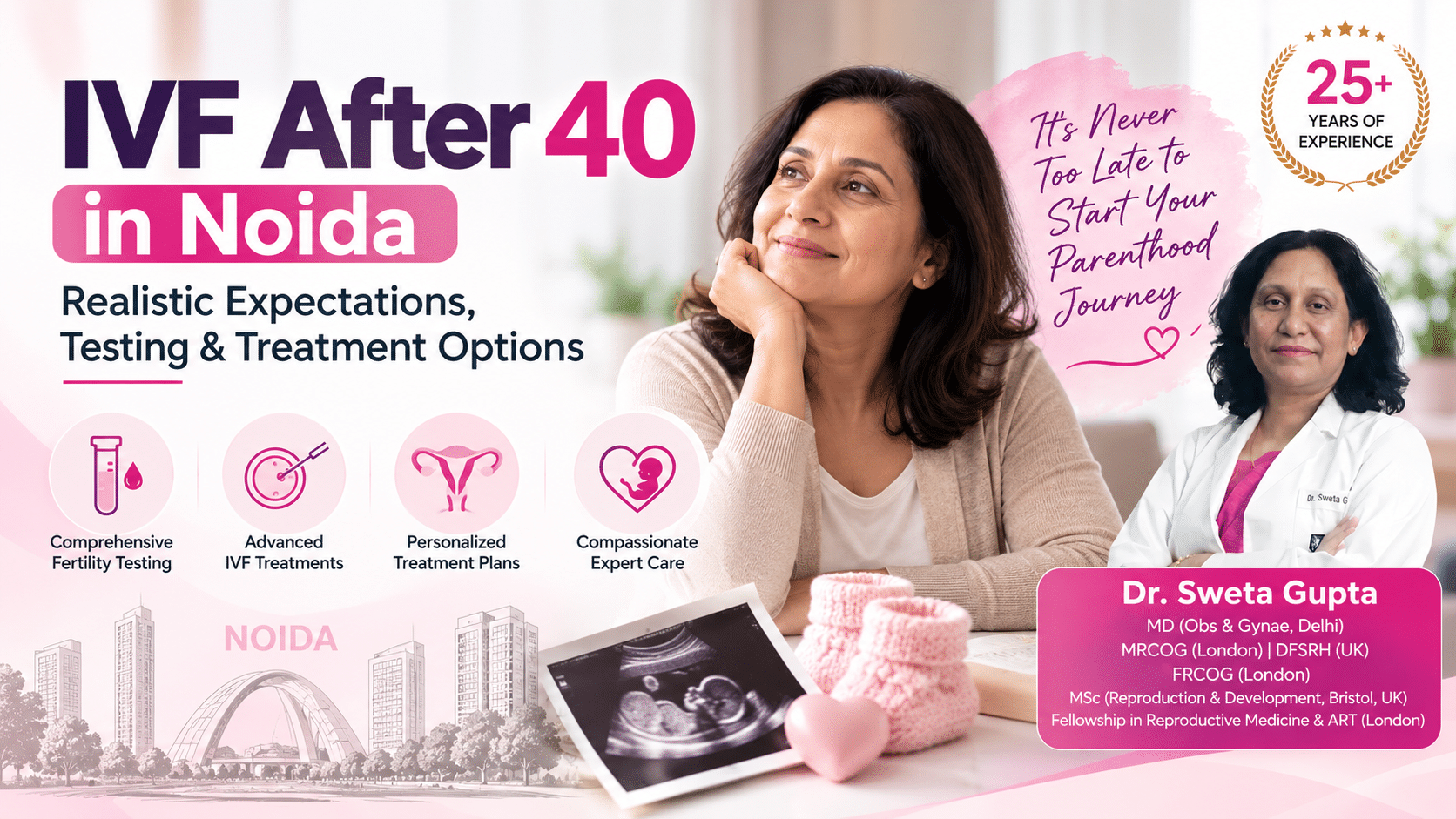
IVF after 40 in Noida is possible, but fertility treatment should be personalized because female fertility and egg quality decline with age. A fertility specialist may evaluate AMH, antral follicle count, ultrasound findings, reproductive anatomy, tubal status and sperm parameters before recommending treatment. Depending on the assessment, options may include IVF using the patient’s own eggs, donor-egg IVF, embryo-related testing and frozen embryo transfer. Women over 40 are generally advised to seek fertility evaluation sooner rather than waiting for an extended period.
About Dr. Sweta Gupta
Dr. Sweta Gupta is an IVF and reproductive medicine specialist practicing at SG Clinic, Sector 32, Noida. She has 25+ years of experience and qualifications including MD (Obs & Gynae), MRCOG (London), DFSRH (UK), FRCOG (London), MSc in Reproduction & Development from Bristol, UK, and Fellowship in Reproductive Medicine & ART, London.
📍 SG Clinic, 3D-5L, Wave City Center, Sector 32, Noida – 201301
📞 8130140007 | 9009004709
Trying to conceive after 40 can still be possible, but fertility treatment should be approached with realistic expectations and individualized medical planning. Female fertility declines with age because both the number of available eggs and, importantly, egg quality decrease over time. The decline becomes more pronounced during the late 30s and 40s. For women over 40, fertility evaluation and treatment should generally not be unnecessarily delayed.
At SG Clinic, Noida, Dr. Sweta Gupta provides fertility and reproductive medicine consultation for women and couples seeking guidance about conception, IVF, recurrent pregnancy loss, diminished ovarian reserve and other fertility concerns.
Dr. Sweta Gupta
MD (Obs & Gynae, Delhi) | MRCOG (London) | DFSRH (UK) | FRCOG (London) | MSc (Reproduction & Development, Bristol, UK) | Fellowship in Reproductive Medicine & ART (London)
IVF After 40: What Should You Realistically Expect?
IVF after 40 is not the same as IVF at a younger age. The most important factor is age-related egg quality, although ovarian reserve, sperm quality, uterine health, medical conditions and previous fertility history also influence treatment outcomes.
According to ACOG, the chance of natural conception per menstrual cycle is less than 10% by age 40. ACOG also notes that the risk of chromosome abnormalities and pregnancy loss increases with maternal age.
This does not mean that pregnancy after 40 is impossible. Rather, it means that an individualized fertility assessment can help determine the most appropriate treatment pathway.
Key factors that matter after 40
- Age and reproductive history
- Ovarian reserve
- Egg quality
- Number of eggs retrieved during IVF
- Embryo development
- Sperm quality
- Fallopian tube and uterine health
- Endometriosis, fibroids or other reproductive conditions
- Previous IVF or pregnancy history
- General health and pregnancy-related risk factors
Why Does Fertility Decline After 40?
Women are born with a finite number of eggs, and both egg quantity and quality decrease with age. The remaining eggs are also more likely to have chromosome abnormalities as reproductive age increases.
This is one reason why IVF after 40 may involve:
Fewer eggs → fewer embryos → fewer chromosomally suitable embryos → potentially fewer opportunities for embryo transfer.
However, ovarian reserve tests alone cannot determine whether a woman will or will not become pregnant. ASRM specifically states that ovarian reserve testing should complement—not replace—assessment based on age, medical history and diagnosis.
Fertility Testing After 40
A fertility consultation after 40 usually starts with a detailed medical and reproductive history followed by targeted investigations.
1. AMH Test
Anti-Müllerian Hormone (AMH) can provide information about ovarian reserve and may help estimate how the ovaries could respond to stimulation during IVF.
However, AMH is primarily an indicator related to egg quantity/ovarian response, not a direct measure of egg quality.
A low AMH does not automatically mean that pregnancy is impossible. ASRM recommends interpreting ovarian reserve results in the context of the woman’s age and complete clinical picture.
2. Antral Follicle Count (AFC)
An ultrasound examination can count antral follicles in the ovaries.
AFC may help the fertility specialist estimate ovarian response to stimulation and plan an IVF protocol.
3. FSH and Estradiol
Depending on the clinical situation, hormone testing such as FSH and estradiol may be used as part of ovarian reserve assessment.
4. Pelvic Ultrasound
Ultrasound can assess:
- Uterus
- Endometrial lining
- Ovaries
- Antral follicles
- Fibroids
- Ovarian cysts
- Other structural abnormalities
5. Fallopian Tube Assessment
Tests such as HSG or sonohysterography may be recommended to evaluate the reproductive tract and, where appropriate, tubal patency.
6. Semen Analysis
Fertility assessment should not focus only on the woman.
A semen analysis evaluates important parameters such as sperm concentration, movement and morphology. ASRM recommends parallel evaluation of the male partner when applicable.
7. Additional Testing When Indicated
Depending on medical history, your doctor may recommend additional investigations, such as:
- Thyroid evaluation
- Prolactin testing when clinically indicated
- Diabetes/metabolic assessment
- Genetic or carrier screening
- Assessment for recurrent pregnancy loss
- Uterine cavity evaluation
Not every patient needs every fertility test. Testing should be based on the individual’s history and clinical findings.
IVF Treatment Options After 40
There is no single IVF protocol that is appropriate for every woman over 40. Treatment is individualized according to ovarian reserve, previous treatment response, medical history and reproductive goals.
1. IVF With Your Own Eggs
IVF using a woman’s own eggs remains an option for some women over 40.
The process generally involves:
Ovarian stimulation → egg retrieval → fertilization → embryo culture → embryo assessment → embryo transfer
However, the number and quality of eggs and embryos may be lower with increasing age.
For perspective, UK HFEA data reported a 2022 birth rate of approximately 10% per fresh embryo transferred among patients aged 40–42, while the corresponding figure for ages 43–44 was approximately 5%. These are population-level UK figures, not an individualized prediction for a patient in Noida, and outcomes vary by treatment type, clinic, patient characteristics and other factors.
2. Donor Egg IVF
For some women, particularly when ovarian reserve or egg quality is significantly reduced, donor-egg IVF may be discussed.
The reason donor eggs can change the treatment outlook is that egg age is an important determinant of embryo chromosome status and reproductive potential. ACOG notes that use of younger donor eggs has produced similar live-birth rates across maternal age groups in cited studies.
The decision to use donor eggs is highly personal and should be discussed carefully with a fertility specialist.
3. Embryo Genetic Testing
In selected IVF situations, preimplantation genetic testing (PGT) may be discussed.
PGT is not automatically appropriate for every patient. The potential benefits, limitations, possible outcomes and whether it is appropriate for the individual should be discussed with the treating fertility specialist.
4. Embryo Freezing and Frozen Embryo Transfer
Embryos created during IVF may sometimes be frozen for later transfer.
The decision to freeze and transfer embryos depends on the clinical circumstances and treatment plan.
Is IVF After 40 Successful?
IVF can result in pregnancy after 40, but success rates generally decrease as maternal age increases, particularly when using the patient’s own eggs.
It is important not to judge an individual’s chances from a single number found online.
Two women who are both 41 may have very different fertility profiles based on:
- AMH
- AFC
- Previous IVF response
- Number of mature eggs retrieved
- Embryo development
- Sperm parameters
- Uterine health
- Previous pregnancies
- Other medical conditions
Therefore, a fertility specialist should assess the complete picture before discussing an individualized treatment plan.
Pregnancy Risks After 40
Pregnancy at an older maternal age is associated with increased risks of certain complications.
These can include increased risks of:
- Miscarriage
- Chromosomal abnormalities
- Gestational diabetes
- High blood pressure and preeclampsia
- Certain pregnancy complications
ACOG notes that the risk of aneuploidy and spontaneous abortion increases with maternal age.
ACOG also reports that approximately 1 in 3 pregnancies in women over 40 end in miscarriage, with chromosome abnormalities accounting for many early pregnancy losses.
This is why pregnancy planning after 40 should include appropriate prenatal care and discussion of available genetic screening and diagnostic options.
When Should You See an IVF Specialist After 40?
If you are 40 or older and planning pregnancy, it is reasonable to seek a fertility evaluation rather than waiting for many months before asking for help.
ASRM states that women over 40 may warrant more immediate fertility evaluation and treatment.
You should consider an early consultation particularly if you have:
- Irregular periods
- Previous IVF failure
- Previous miscarriage
- Endometriosis
- Fibroids
- Previous ovarian surgery
- Known low ovarian reserve
- Previous chemotherapy or radiation
- Male-factor infertility
- Difficulty conceiving despite regular attempts
IVF After 40 in Noida: Why an Individualized Plan Matters
Searching online for “IVF after 40 success rate” can provide general statistics, but population averages cannot tell you exactly what will happen in your individual case.
At a fertility consultation, the doctor can review your:
Age + AMH/AFC + menstrual history + ultrasound + partner’s semen analysis + previous pregnancy/IVF history + medical conditions
and use these factors to discuss possible treatment pathways.
The objective is not simply to start IVF quickly, but to understand your reproductive situation and make an informed treatment decision.
Consult Dr. Sweta Gupta for IVF & Fertility Care in Noida
If you are over 40 and considering pregnancy or IVF, an early consultation can help you understand your fertility status and available treatment options.
Dr. Sweta Gupta has 25+ years of experience in Obstetrics, Gynaecology and Reproductive Medicine.
Qualifications
- MD (Obs & Gynae), Delhi
- MRCOG (London)
- DFSRH (UK)
- FRCOG (London)
- MSc – Reproduction & Development, Bristol, UK
- Fellowship in Reproductive Medicine & ART, London
SG Clinic, Noida
📍 3D-5L, Wave City Center, Sector 32, Noida – 201301
📞 8130140007 | 9009004709
If you are considering IVF after 40, discuss your ovarian reserve, fertility testing, treatment options and pregnancy planning with a qualified fertility specialist.
FAQs: IVF After 40
1. Can I get pregnant naturally after 40?
Yes, natural pregnancy can still occur after 40, but fertility is lower than at younger ages. ACOG states that by age 40, the chance of pregnancy in an individual menstrual cycle is less than 10%.
2. Is IVF possible after 40?
Yes. IVF may be considered after 40, although outcomes depend on factors including age, ovarian reserve, egg quality, sperm quality, embryo development and uterine health.
3. What tests are needed before IVF after 40?
Depending on the individual case, testing may include AMH, AFC ultrasound, FSH/estradiol, pelvic ultrasound, assessment of the uterus and tubes, semen analysis and other tests when clinically indicated.
4. Does AMH tell me whether I can get pregnant?
No. AMH primarily provides information about ovarian reserve and expected ovarian response. It should not be interpreted as a standalone test of fertility or egg quality.
5. What is the IVF success rate after 40?
There is no single success rate applicable to every woman over 40. Success varies by age, egg source, ovarian reserve, embryo development, sperm factors, treatment protocol and clinic-specific factors. Published population statistics should therefore be used as general context rather than an individual prediction.
6. Can donor eggs be considered after 40?
Yes. Donor-egg IVF may be discussed when ovarian reserve or egg quality is significantly reduced or when clinically appropriate. Donor eggs can substantially change the age-related treatment outlook because the age of the egg is an important factor in embryo reproductive potential.
7. Does IVF prevent miscarriage after 40?
IVF cannot eliminate the risk of miscarriage. Age-related chromosome abnormalities are an important contributor to miscarriage, and pregnancy-loss risk increases with maternal age.
8. Should I wait before consulting an IVF specialist after 40?
ASRM states that women over 40 may warrant more immediate fertility evaluation and treatment rather than waiting for the longer periods recommended for younger age groups.
9. Is IVF with my own eggs possible at 42 or 43?
It may be possible for some women, but egg quantity and quality generally decline with age. Your ovarian reserve and previous treatment response should be assessed before determining an appropriate treatment strategy.
10. Where can I consult for IVF after 40 in Noida?
You can consult Dr. Sweta Gupta at SG Clinic, Sector 32, Noida for an individualized fertility assessment and discussion of IVF and other reproductive treatment options.