

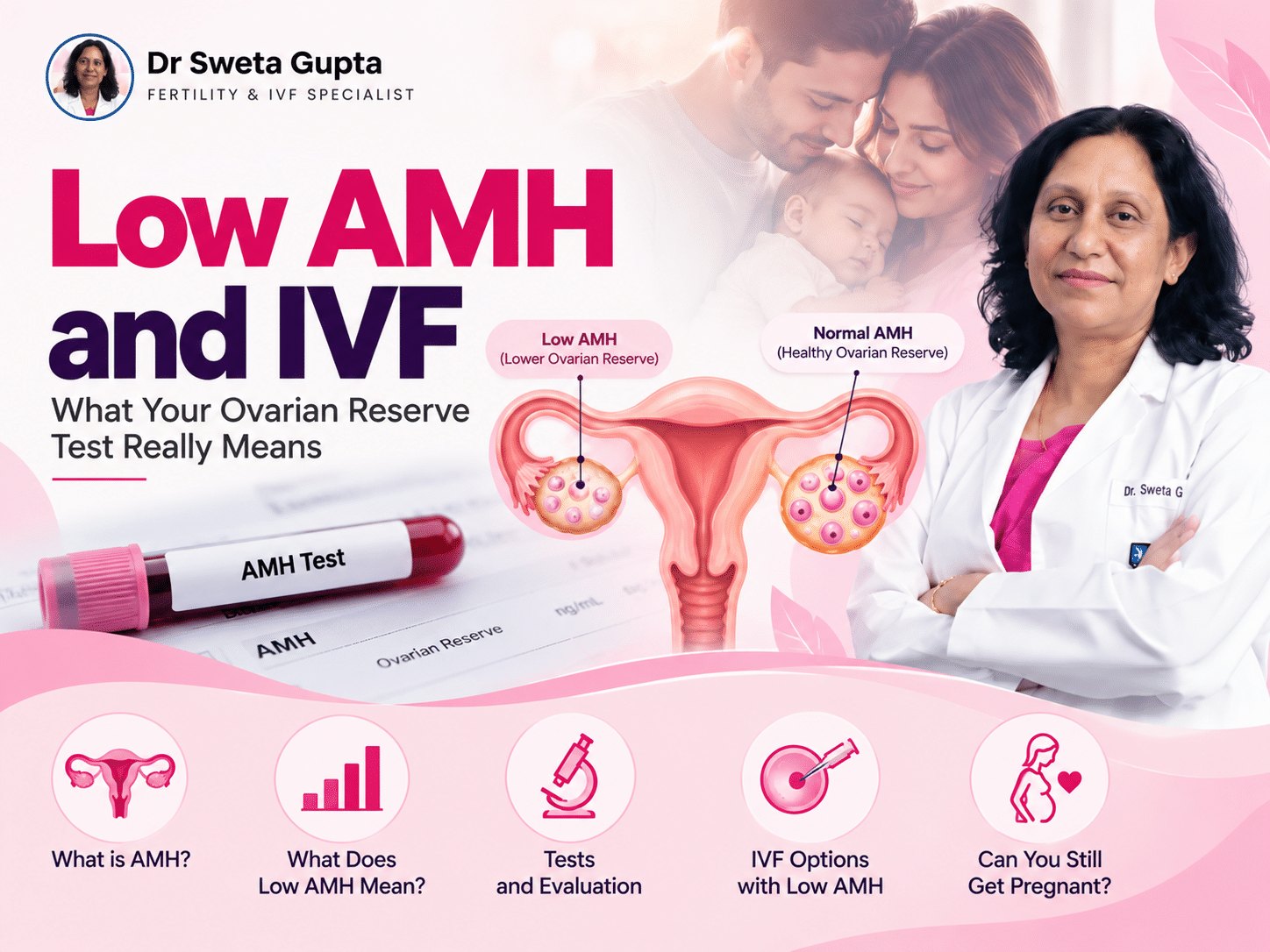
A low AMH level can be worrying, especially when you are planning a pregnancy or preparing for IVF treatment. However, low AMH does not automatically mean that you cannot conceive naturally, that you are infertile, or that IVF will not work. AMH, or Anti-Müllerian Hormone, is a blood marker that helps doctors estimate ovarian reserve—the remaining pool of small developing follicles in the ovaries.
A low AMH result may indicate that the ovaries could produce fewer eggs in response to fertility medication during IVF. It does not directly measure egg quality, confirm whether you can become pregnant, or predict your individual chance of having a baby.
Your age, antral follicle count (AFC), menstrual and reproductive history, previous treatment response, sperm health and uterine condition all matter when planning fertility treatment.
Dr. Sweta Gupta, an internationally trained fertility specialist, explains what a low AMH result really means, which tests may be needed, when IVF is considered and what treatment options may be available.
Quick answer: Women with low AMH can sometimes conceive naturally and may also be candidates for IVF. The right treatment depends on age, ovarian reserve, overall fertility assessment and individual circumstances—not AMH alone.
What Is AMH and Why Is It Important for Female Fertility?
AMH stands for Anti-Müllerian Hormone. It is produced by granulosa cells surrounding small developing follicles in the ovaries.
During each menstrual cycle, a group of follicles begins developing. Usually, one follicle becomes dominant and releases an egg during ovulation. AMH levels provide an indirect indication of the number of small follicles available in the ovaries.
Doctors use AMH testing as one part of ovarian reserve assessment, particularly when planning fertility treatment.
AMH is useful because it can help a fertility specialist:
- Estimate the likely response to ovarian stimulation during IVF.
- Identify women who may produce fewer eggs during an IVF cycle.
- Help plan an individualised medication protocol.
- Assess ovarian reserve alongside ultrasound findings.
- Discuss realistic expectations before starting treatment.
However, AMH is not a complete fertility test. It cannot independently tell you whether an egg will fertilise, whether an embryo will develop normally or whether a pregnancy will result.
What Is Considered a Low AMH Level?
AMH is generally measured in nanograms per millilitre (ng/mL) or picomoles per litre (pmol/L). Different laboratories and testing methods may use different reference ranges.
The following table provides broad educational ranges sometimes used in clinical discussions. These are not universal diagnostic cut-offs or individual predictions.
| AMH level (ng/mL) | General interpretation |
|---|---|
| Below 0.5 | Very low AMH; may indicate a reduced ovarian response |
| 0.5–1.0 | Low AMH; possible reduced ovarian reserve |
| 1.0–3.5 | Often considered a broadly typical range, depending on age and laboratory |
| Above 3.5 | Higher AMH; may be associated with a higher follicle count and, in some cases, PCOS |
Important: A result should always be interpreted using the laboratory’s reference range, the testing method, age and ultrasound findings. A particular AMH number does not establish infertility or determine whether IVF is necessary.
Does a low AMH level mean poor egg quality?
No. AMH mainly provides information about ovarian reserve and expected egg quantity. It does not directly measure egg quality.
Age is an important factor when assessing egg quality and reproductive outcomes. A younger woman with low AMH may have a different fertility outlook from an older woman with the same AMH result.
For example, two women may both have an AMH level of 0.6 ng/mL, but their age, AFC, medical history and previous response to fertility medication may lead to different treatment recommendations.
What Does Your AMH Test Really Tell You?
An AMH result is most useful when interpreted as part of a complete fertility assessment.
| What AMH can help estimate | What AMH cannot tell you on its own |
|---|---|
| Approximate ovarian reserve | Whether you can conceive naturally |
| Expected response to IVF stimulation | Exact egg quality |
| Possibility of a lower or higher egg yield | Whether an embryo will implant |
| Need for individualised IVF planning | Whether IVF will definitely succeed |
| Potential ovarian response to medication | Exact timing of menopause |
The American Society for Reproductive Medicine (ASRM) explains that AMH and AFC are useful predictors of ovarian response and egg yield during IVF, but are poor independent predictors of reproductive potential. This distinction is important when discussing a low AMH report.
Why Does AMH Become Low?
Ovarian reserve naturally changes over time. Several factors may be associated with lower AMH levels.
1. Increasing age
Age is one of the most important factors affecting ovarian reserve. As women get older, the number of remaining follicles generally declines.
AMH levels often decrease with age, although the rate of decline varies between individuals.
2. Genetic and individual differences
Some women naturally have lower ovarian reserve than others of the same age. Family history and individual biological variation may contribute.
3. Previous ovarian surgery
Certain ovarian procedures, particularly surgery involving endometriomas or removal of ovarian tissue, may affect ovarian reserve.
4. Endometriosis
Endometriosis, especially when it affects the ovaries, may be associated with reduced ovarian reserve. The condition itself and some surgical treatments can influence ovarian function.
5. Chemotherapy and radiation treatment
Some cancer treatments can damage ovarian follicles and reduce ovarian reserve. Women who may undergo chemotherapy or pelvic radiation should discuss fertility preservation with their treating team before treatment whenever possible.
6. Certain ovarian conditions
Some medical conditions can affect ovarian function and hormone levels. A specialist may investigate possible causes based on symptoms, medical history and ultrasound findings.
7. Previous ovarian procedures or medical history
The effect of previous procedures, medications and reproductive conditions should be reviewed individually. A low result does not always identify a single underlying cause.
Can You Get Pregnant Naturally With Low AMH?
Yes, natural pregnancy may still be possible with low AMH.
A low AMH level does not automatically mean that ovulation has stopped or that natural conception is impossible. Women with low AMH may continue to have regular menstrual cycles and ovulate.
However, the chances of conception depend on more than AMH.
Important factors include:
- Female age.
- Whether ovulation is occurring.
- Duration of trying to conceive.
- Fallopian tube health.
- Sperm concentration and movement.
- Uterine health.
- Other reproductive or medical conditions.
ASRM guidance notes that ovarian reserve tests should not be used alone to predict natural fertility in women without a diagnosis of infertility.
Should you keep trying naturally or consider IVF?
That decision depends on your age, fertility history and test results.
For example:
- A younger woman with low AMH, regular ovulation and no other identified fertility problem may not need immediate IVF solely because of her AMH result.
- A woman aged 35 or older who has been trying for several months may benefit from an earlier fertility assessment.
- A woman with very low AMH, previous ovarian surgery or a history of poor ovarian response may need timely specialist advice.
- If both partners have fertility-related concerns, the treatment plan should consider both rather than focusing only on AMH.
The goal is to avoid unnecessary delays while also avoiding treatment that is not medically indicated.
Can IVF Work With Low AMH?
Yes. IVF may still be an option for women with low AMH.
However, low AMH can indicate that the ovaries may produce fewer eggs following ovarian stimulation. This may affect the number of eggs retrieved and the number of embryos available for transfer.
The treatment plan should be individualised according to the patient’s age, AMH, AFC, previous ovarian response and overall fertility profile.
What happens during IVF when AMH is low?
The IVF process generally includes:
- Initial fertility assessment: The doctor reviews AMH, AFC, FSH, medical history and previous treatment.
- Individualised stimulation protocol: Medication is selected according to the expected ovarian response.
- Follicle monitoring: Ultrasound and, when appropriate, blood tests help monitor follicular development.
- Egg retrieval: Mature eggs are collected when the follicles are ready.
- Fertilisation: Eggs are fertilised with sperm through conventional IVF or ICSI, depending on the clinical indication.
- Embryo development: Embryos are monitored in the laboratory.
- Embryo transfer: A suitable embryo may be transferred into the uterus, either in the same cycle or in a later frozen transfer cycle.
Not every egg will be mature, fertilise or develop into an embryo. The number of eggs retrieved does not directly determine whether a pregnancy will occur.
Does low AMH reduce IVF success rates?
Low AMH can be associated with fewer eggs retrieved and a lower expected ovarian response. However, AMH alone cannot accurately predict an individual’s chance of pregnancy or live birth.
Age, embryo development, sperm factors, uterine health, treatment protocol and laboratory factors also influence outcomes.
A fertility specialist should explain the expected response and possible limitations using the complete clinical picture rather than quoting a success percentage based only on AMH.
What Other Tests Are Needed Along With AMH?
AMH should not be interpreted in isolation. A fertility specialist may recommend additional tests to understand ovarian reserve and identify other factors affecting conception.
| Test | What it helps assess |
|---|---|
| AMH blood test | Estimates ovarian reserve |
| Antral Follicle Count (AFC) | Counts small follicles visible on ultrasound |
| FSH | Helps assess ovarian function when measured at the appropriate cycle stage |
| Estradiol (E2) | Adds context to early-cycle hormone assessment |
| Pelvic ultrasound | Examines ovaries, uterus and possible abnormalities |
| Thyroid testing | Assesses thyroid function when clinically indicated |
| Prolactin | May be checked when symptoms or history suggest a hormonal issue |
| Semen analysis | Evaluates male reproductive factors |
| Tubal assessment | Checks fallopian tube patency when relevant to the treatment plan |
When should AMH be tested?
AMH can generally be measured at any point during the menstrual cycle because it is less affected by cycle timing than some other reproductive hormones.
However, hormonal contraceptive use may lower AMH measurements in some women. The doctor should know about current medication and contraceptive use when interpreting the report.
FSH and estradiol are usually measured together during the early follicular phase, often around menstrual cycle days 2–4, when indicated.
What Is the Difference Between Low AMH and Diminished Ovarian Reserve?
These terms are related, but they are not exactly interchangeable.
Low AMH refers to a laboratory finding in which the AMH level is below the expected range for the relevant age group or laboratory reference.
Diminished ovarian reserve (DOR) describes a reduced ovarian response or a lower expected egg quantity compared with women of a similar age.
A low AMH result may support a diagnosis of diminished ovarian reserve, but the doctor also considers AFC, age, FSH, medical history and previous ovarian response.
Diminished ovarian reserve does not automatically mean that a woman cannot become pregnant.
Can Low AMH Be Increased Naturally?
Many women search for ways to increase AMH through diet, supplements, exercise or lifestyle changes. It is important to understand that there is currently no proven diet or supplement that reliably restores the number of eggs remaining in the ovaries or reverses age-related ovarian reserve decline.
Healthy habits can support general reproductive and metabolic health, but they should not be presented as a guaranteed way to increase AMH.
1. Follow a balanced diet
Include a variety of vegetables, fruits, whole grains, pulses, nuts, seeds and suitable protein sources. A balanced diet supports overall health, but no specific food has been proven to restore ovarian reserve.
2. Maintain a healthy body weight
Both underweight and obesity can affect reproductive health. A sustainable weight-management plan may support overall hormonal and metabolic health.
3. Avoid smoking
Smoking is associated with adverse reproductive effects and may contribute to earlier ovarian ageing. Avoid smoking and exposure to tobacco where possible.
4. Limit alcohol and avoid recreational drugs
Discuss alcohol use and other substances with your fertility specialist, particularly when planning pregnancy or IVF.
5. Manage stress and sleep
Adequate sleep, physical activity and stress-management practices can support general well-being during fertility treatment. They should not be described as treatments that increase ovarian reserve.
6. Do not take fertility supplements without medical advice
Supplements such as DHEA, CoQ10 and other antioxidant products are frequently discussed online. Evidence of benefit varies, and they are not established treatments for restoring ovarian reserve. DHEA in particular should not be self-prescribed.
Discuss any supplement with your fertility specialist before starting it, especially if you are preparing for IVF.
What Treatment Options Are Available for Women With Low AMH?
There is no single treatment for every woman with low AMH. The approach depends on age, ovarian reserve, reproductive goals, fertility history and other test results.
| Treatment option | When it may be discussed |
|---|---|
| Natural conception with monitoring | When other fertility factors are reassuring and natural conception remains reasonable |
| Ovulation-related treatment | When an ovulation problem is identified |
| IUI | In selected cases where the fallopian tubes are suitable and other factors support its use |
| IVF | When IVF is appropriate based on age, diagnosis, duration of infertility or previous treatment |
| IVF with ICSI | When sperm-related factors or previous fertilisation history justify ICSI |
| Fertility preservation | When medically or personally appropriate, following counselling about age-related outcomes |
| Donor eggs | May be discussed when use of the patient’s own eggs is unlikely to offer a reasonable chance or after individual counselling |
Is IVF with your own eggs possible with very low AMH?
It may be possible, depending on age, ovarian response, medical history and the overall clinical assessment.
A low AMH result may mean fewer eggs are expected during stimulation. The specialist should discuss the possibility of cycle cancellation, low egg yield, no embryo available for transfer and the potential need for more than one treatment cycle.
Treatment decisions should be based on informed counselling and the patient’s preferences.
When might donor eggs be considered?
Donor eggs may be discussed in selected situations, including certain cases of severely reduced ovarian reserve, advanced reproductive age or repeated unsuccessful treatment. This is an individual decision that requires detailed medical and legal counselling.
It is not automatically required because AMH is low.
Low AMH and Age: Why Both Matter
Age is one of the strongest factors influencing reproductive success. AMH helps estimate ovarian reserve, while age provides important information about reproductive outcomes and egg quality.
Consider the following illustrative comparison:
| Factor | Woman A | Woman B |
|---|---|---|
| Age | 29 years | 39 years |
| AMH | 0.6 ng/mL | 0.6 ng/mL |
| Possible interpretation | Low ovarian reserve for age; further assessment needed | Low ovarian reserve with additional age-related fertility considerations |
| Next step | Review AFC, ovulation and other fertility factors | Timely assessment and discussion of treatment options |
The same AMH value can have different implications for two women. This is why a treatment recommendation should never be made using a single number.
What Does the Latest Medical Guidance Say About AMH and IVF?
Evidence-based fertility guidance makes an important distinction between predicting egg quantity and predicting pregnancy.
American Society for Reproductive Medicine (ASRM)
ASRM’s committee opinion on ovarian reserve testing explains that AMH and AFC can help predict ovarian response and the number of eggs likely to be retrieved during IVF.
However, these tests are poor independent predictors of reproductive potential. Extremely low AMH should not automatically be used to refuse IVF treatment.
ASRM guidance on fertility evaluation
ASRM also explains that age is a major predictor of reproductive potential and that ovarian reserve testing should support, rather than replace, clinical counselling.
European Society of Human Reproduction and Embryology (ESHRE)
The 2025 ESHRE ovarian stimulation guideline recommends using AMH or AFC to help predict low or high ovarian response to stimulation.
It does not recommend using these ovarian reserve markers to predict pregnancy or live birth.
What does this mean for patients? AMH is a useful planning tool, not a final verdict on fertility. It helps the specialist anticipate how the ovaries may respond to medication, but it cannot independently determine whether IVF will result in a baby.
When Should You Consult a Fertility Specialist for Low AMH?
Consider consulting a fertility specialist if:
- Your AMH result is below the laboratory’s expected range.
- You are planning pregnancy and have concerns about ovarian reserve.
- You are 35 or older and have been trying to conceive.
- You have irregular or absent menstrual cycles.
- You have a history of endometriosis or ovarian surgery.
- You have undergone chemotherapy or radiation treatment.
- You have experienced an unexpectedly low response during previous IVF treatment.
- You have had repeated unsuccessful fertility treatment.
- You want to understand fertility preservation options.
For women under 35, fertility evaluation is generally recommended after 12 months of trying to conceive. For women aged 35 or older, evaluation is generally recommended after six months. Earlier assessment is appropriate when there are known fertility concerns or risk factors.
Why Consult Dr. Sweta Gupta for Low AMH and IVF Guidance?
Dr. Sweta Gupta is an internationally trained fertility specialist with qualifications and training in obstetrics and gynaecology, reproductive medicine and assisted reproductive technology.
Her qualifications include:
- MD in Obstetrics and Gynaecology, Delhi.
- MRCOG, London.
- FRCOG, London.
- DFSRH, UK.
- MSc in Reproduction and Development, University of Bristol, UK.
- Fellowship in Reproductive Medicine and Assisted Reproductive Technology, London.
For women concerned about low AMH, a fertility consultation can help explain what the report means in the context of age, AFC, menstrual history, previous treatment and other fertility factors.
The objective is to understand the likely ovarian response, discuss whether natural conception or assisted reproductive treatment may be appropriate, and develop a plan based on individual needs.
Patients searching for the best IVF doctor in India should compare recognised qualifications, relevant experience, treatment transparency, laboratory standards and individualised medical guidance rather than relying on promotional rankings or guaranteed-success claims.
Clinic: SG Clinic, 3D-5L, Wave City Center, Sector 32, Noida, Uttar Pradesh 201301
Appointment contact: 8130140007 / 9009004709
Please confirm current consultation availability and clinic details before visiting.
Frequently Asked Questions About Low AMH and IVF
1. Can I get pregnant naturally with AMH below 1?
Yes, natural pregnancy may still be possible with AMH below 1 ng/mL. AMH is primarily a marker of ovarian reserve and expected ovarian response to stimulation. It does not independently determine whether natural conception is possible.
2. Is AMH 0.5 considered very low?
An AMH level of 0.5 ng/mL is generally considered low in many clinical contexts. However, interpretation depends on age, laboratory method, AFC and medical history. It does not automatically mean pregnancy is impossible.
3. Can IVF succeed with AMH below 0.5?
IVF may still be possible with AMH below 0.5. The ovaries may produce fewer eggs during stimulation, and the possibility of cycle cancellation or a lower embryo yield may be higher. Age and the complete fertility assessment are important when discussing expected outcomes.
4. What is the minimum AMH required for IVF?
There is no universal minimum AMH level below which IVF is automatically impossible. A fertility specialist assesses age, AFC, previous ovarian response and other medical factors before discussing treatment.
5. Does low AMH mean early menopause?
No. Low AMH may indicate reduced ovarian reserve, but it cannot independently diagnose menopause or predict the exact age at which menopause will occur.
6. Can AMH levels increase with diet?
No particular food or diet has been proven to reliably increase ovarian reserve or restore the number of remaining eggs. A balanced diet supports general health, but it should not be considered a treatment for low AMH.
7. Can CoQ10 or DHEA improve low AMH?
These supplements are sometimes discussed in fertility care, but evidence of benefit is variable and they are not established treatments for restoring ovarian reserve. DHEA should not be taken without specialist advice.
8. Does low AMH affect egg quality?
AMH does not directly measure egg quality. Age is an important factor in assessing egg quality and reproductive outcomes. A low AMH result mainly provides information about expected ovarian response and egg quantity.
9. Should I repeat my AMH test?
A repeat test may be considered if the result is unexpected, inconsistent with other findings or potentially affected by medication or laboratory factors. Repeated testing without a clinical reason may not add useful information. Discuss the need for retesting with your doctor.
10. Can women with low AMH have regular periods?
Yes. Women with diminished ovarian reserve can continue to have regular menstrual cycles and may continue to ovulate. Regular periods do not necessarily mean ovarian reserve is normal.
11. Is low AMH common in women under 30?
Low AMH can occur in younger women, although it is less expected than in older age groups. If a young woman has a low result, the doctor should review the test method, medical history, AFC and possible contributing factors.
12. Is IVF always necessary for low AMH?
No. Low AMH alone does not mean IVF is necessary. Some women may continue trying naturally or may benefit from other treatment options, depending on their age, diagnosis, duration of infertility and partner evaluation.
Final Takeaway: Low AMH Is Information, Not a Fertility Verdict
A low AMH result can provide important information about ovarian reserve and help a fertility specialist plan treatment. However, it does not independently determine your ability to conceive naturally or your chance of IVF success.
The most meaningful assessment combines age, AMH, antral follicle count, medical history, ovulation, sperm health and other relevant investigations.
If your AMH report is low, do not panic or make treatment decisions based on a single number. Seek an individual fertility assessment and discuss the options that are appropriate for your circumstances.