

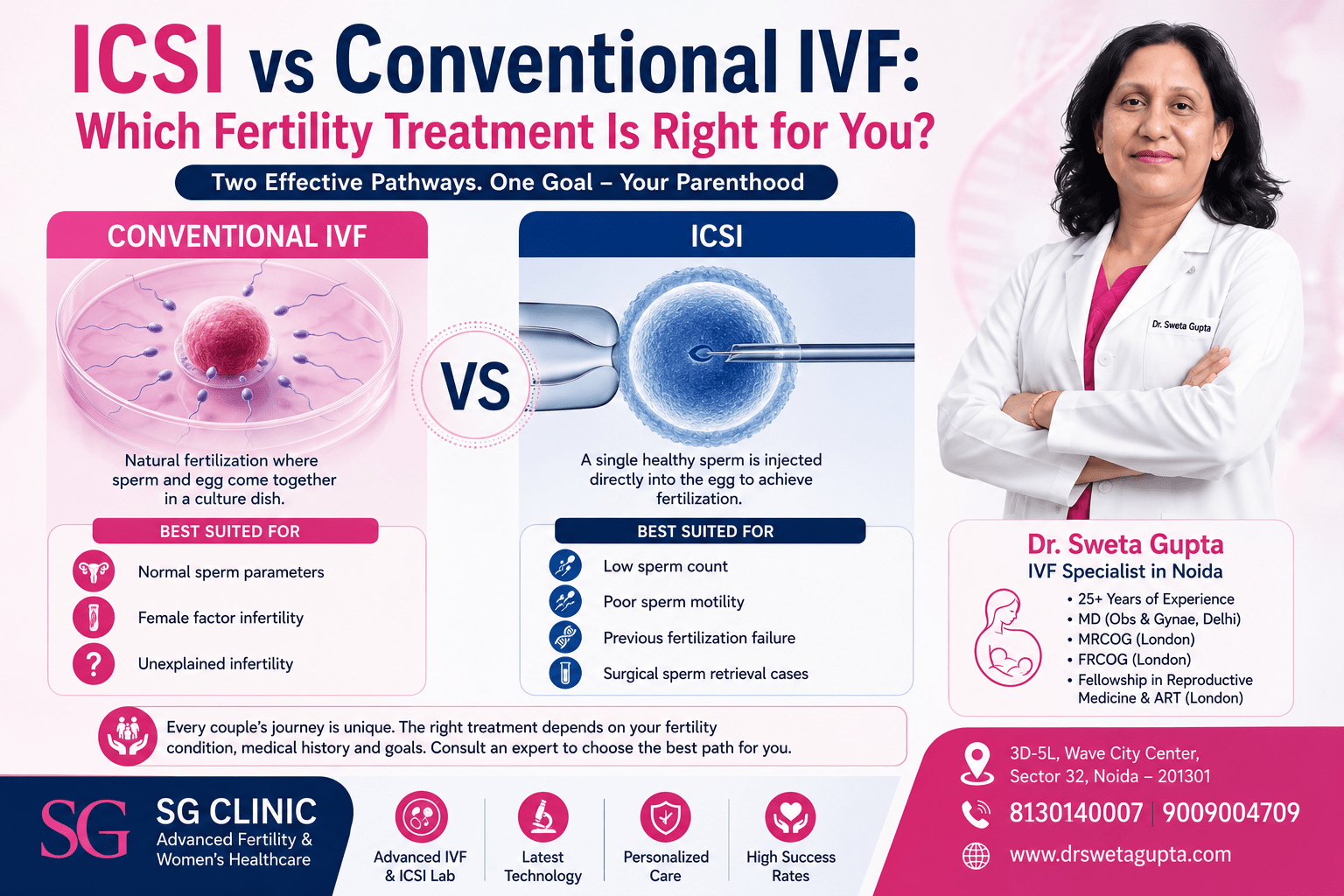
Choosing the right fertility treatment is one of the most important decisions a couple makes on the journey to parenthood. With continuous advancements in reproductive medicine, treatments such as Conventional IVF (In Vitro Fertilization) and ICSI (Intracytoplasmic Sperm Injection) have helped millions of couples worldwide overcome infertility and achieve successful pregnancies.
However, many patients visiting a fertility clinic often ask:
- What is the difference between IVF and ICSI?
- Which treatment has a higher success rate?
- Is ICSI better than conventional IVF?
- Which treatment is suitable for male infertility?
- Can ICSI improve fertilization?
- Does every IVF patient need ICSI?
The answer is not the same for every couple. The most appropriate fertility treatment depends on several factors, including age, ovarian reserve, sperm quality, previous IVF history, and the underlying cause of infertility.
As an internationally trained IVF Specialist in Noida, Dr. Sweta Gupta believes that every fertility journey deserves a personalized approach. Rather than recommending a single treatment for all patients, she carefully evaluates each couple’s medical history and fertility profile before creating an individualized treatment plan.
This comprehensive guide explains the differences between ICSI and Conventional IVF, their advantages, limitations, indications, success factors, and how fertility specialists decide which treatment is best for individual couples.
Understanding Infertility Before Choosing a Fertility Treatment
Before comparing IVF and ICSI, it is important to understand why couples experience infertility.
Infertility is generally defined as the inability to conceive after:
- 12 months of regular unprotected intercourse for women under 35 years.
- 6 months for women aged 35 years or older.
Infertility affects both men and women equally. Research suggests that approximately one-third of infertility cases are related to female factors, one-third to male factors, and the remaining cases involve combined or unexplained infertility.
Common Causes of Female Infertility
Female infertility may occur due to several medical conditions, including:
Ovulation Disorders
Women with irregular ovulation or absent ovulation may find it difficult to conceive naturally.
Polycystic Ovary Syndrome (PCOS)
PCOS is one of the most common hormonal disorders affecting fertility.
Endometriosis
Endometriosis may affect the ovaries, fallopian tubes, and pelvic organs, reducing fertility.
Blocked Fallopian Tubes
Damage or blockage in the fallopian tubes can prevent the egg and sperm from meeting naturally.
Diminished Ovarian Reserve
As women age, both the number and quality of eggs decline.
Uterine Conditions
Fibroids, polyps, and congenital uterine abnormalities may also affect implantation and pregnancy.
Common Causes of Male Infertility
Male infertility contributes to nearly half of infertility cases.
Some common causes include:
Low Sperm Count
Fewer sperm reduce the probability of fertilization.
Poor Sperm Motility
Sperm must swim effectively to reach and fertilize the egg.
Abnormal Sperm Morphology
Abnormal sperm shape may reduce fertilization potential.
Azoospermia
Complete absence of sperm in the ejaculate.
Varicocele
Enlarged veins in the scrotum may affect sperm production.
Genetic Disorders
Certain inherited conditions may impair male fertility.
Understanding the underlying cause of infertility helps fertility specialists determine whether conventional IVF or ICSI is the most suitable treatment.
What Is Conventional IVF?
Conventional IVF (In Vitro Fertilization) is one of the most established fertility treatments in reproductive medicine.
In this procedure, eggs and sperm are combined in a specialized laboratory dish, allowing fertilization to occur naturally.
The strongest sperm penetrates the egg on its own, closely mimicking natural fertilization.
Conventional IVF has been used successfully for decades and has helped millions of couples worldwide achieve parenthood.
How Does Conventional IVF Work?
The conventional IVF process involves several carefully planned steps.
Step 1: Ovarian Stimulation
Special fertility medications stimulate the ovaries to produce multiple mature eggs rather than the single egg produced during a normal menstrual cycle.
Step 2: Monitoring
Ultrasound scans and blood tests monitor follicle development and hormone levels.
Step 3: Egg Retrieval
Once the eggs reach maturity, they are collected using a minimally invasive procedure performed under sedation.
Step 4: Sperm Collection
A semen sample is collected and processed to isolate healthy, motile sperm.
Step 5: Fertilization
Thousands of sperm are placed around each mature egg in a laboratory dish.
The sperm compete naturally to fertilize the egg.
Step 6: Embryo Development
Successfully fertilized eggs develop into embryos over five to six days.
Step 7: Embryo Transfer
One or more healthy embryos are transferred into the uterus.
Step 8: Pregnancy Test
Approximately two weeks later, a blood test confirms whether implantation has occurred.
What Is ICSI?
ICSI stands for Intracytoplasmic Sperm Injection.
It is an advanced IVF laboratory technique developed primarily for couples experiencing male infertility.
Unlike conventional IVF, where fertilization occurs naturally in a culture dish, ICSI involves injecting a single healthy sperm directly into the egg using specialized microscopic equipment.
This technique significantly improves the chances of fertilization when sperm-related problems are present.
Today, ICSI is one of the most commonly performed assisted reproductive techniques worldwide.
How Does ICSI Work?
Although ICSI follows the same initial IVF process, the fertilization step differs.
Step 1: Egg Retrieval
Mature eggs are collected from the ovaries.
Step 2: Sperm Preparation
The embryologist carefully examines the sperm sample under high-powered microscopy.
Step 3: Selection of a Healthy Sperm
A single sperm with the best appearance and movement is selected.
Step 4: Microinjection
Using an extremely fine glass needle, the embryologist injects one sperm directly into the center of the egg.
Step 5: Embryo Culture
Fertilized eggs develop into embryos over several days.
Step 6: Embryo Transfer
Healthy embryos are transferred to the uterus during the appropriate stage of treatment.
Conventional IVF vs ICSI: The Fundamental Difference
The primary difference lies in how fertilization occurs.
Conventional IVF
- Thousands of sperm surround each egg.
- Fertilization occurs naturally.
- The healthiest sperm penetrates the egg without assistance.
ICSI
- Only one carefully selected sperm is used.
- The sperm is injected directly into the egg.
- Fertilization is assisted by an embryologist.
Both methods use the same ovarian stimulation, egg retrieval, embryo culture, and embryo transfer process.
IVF vs ICSI Comparison Table
| Feature | Conventional IVF | ICSI |
|---|---|---|
| Fertilization Method | Natural fertilization in laboratory dish | Single sperm injected directly into egg |
| Number of Sperm Required | Thousands | One healthy sperm |
| Best For | Normal sperm parameters | Male factor infertility |
| Laboratory Technique | Standard IVF | Advanced micromanipulation |
| Fertilization Assistance | No | Yes |
| Common Indications | Tubal factor, unexplained infertility | Low sperm count, poor motility, previous fertilization failure |
When Is Conventional IVF Recommended?
Conventional IVF may be suitable when sperm parameters are within the normal range and there is no significant male infertility.
Tubal Blockage
Women with blocked or damaged fallopian tubes may benefit from IVF because fertilization occurs outside the body.
Ovulation Disorders
Patients with ovulation problems that have not responded to simpler treatments may be candidates.
Endometriosis
Moderate to severe endometriosis can reduce natural fertility, making IVF an effective option.
Unexplained Infertility
When routine fertility investigations are normal but pregnancy has not occurred, conventional IVF may be considered.
Fertility Preservation
Couples using frozen eggs or embryos may also undergo conventional IVF depending on individual circumstances.
When Is ICSI Recommended?
ICSI was originally developed to address severe male infertility but is now used in a wider range of clinical situations.
Low Sperm Count
When sperm concentration is significantly reduced, ICSI can improve the likelihood of fertilization.
Poor Sperm Motility
If sperm struggle to swim effectively, direct injection into the egg bypasses this challenge.
Abnormal Sperm Morphology
Poor sperm shape may interfere with natural fertilization.
Surgical Sperm Retrieval
Men undergoing sperm retrieval procedures such as PESA, TESA, or micro-TESE often require ICSI because only a limited number of sperm are available.
Previous IVF Fertilization Failure
If fertilization failed during a previous conventional IVF cycle, ICSI may be recommended in subsequent attempts.
Frozen Sperm Samples
ICSI is commonly used when working with frozen sperm to maximize fertilization potential.
Does ICSI Have a Higher Success Rate Than Conventional IVF?
This is one of the most frequently asked questions by couples considering fertility treatment.
The answer depends on why infertility is occurring.
For couples with severe male factor infertility, ICSI generally provides better fertilization outcomes because it bypasses many sperm-related barriers.
However, when sperm quality is normal, current evidence does not consistently show that ICSI results in higher live birth rates than conventional IVF solely because of the technique itself. Treatment outcomes depend on multiple factors, including the woman’s age, egg quality, embryo development, uterine health, and the underlying cause of infertility.
This is why experienced fertility specialists recommend ICSI only when there is a clear medical indication rather than using it routinely for every IVF cycle.
Success Factors That Influence Both IVF and ICSI
Regardless of whether conventional IVF or ICSI is chosen, several factors influence treatment outcomes.
Female Age
Age remains one of the strongest predictors of IVF success.
Egg Quality
Healthy eggs are essential for embryo development.
Sperm Quality
Even with ICSI, sperm health continues to influence embryo quality.
Embryo Development
High-quality embryos have a greater chance of implantation.
Endometrial Receptivity
A healthy uterine lining supports successful implantation.
Lifestyle Factors
Maintaining a healthy weight, avoiding smoking, limiting alcohol consumption, and managing stress may contribute to better reproductive health.
Can ICSI Be Combined with Advanced Genetic Testing?
Yes. When clinically appropriate, ICSI may be combined with Preimplantation Genetic Testing (PGT-A or PGT-M).
This approach may be considered for selected couples, such as those with recurrent miscarriage, advanced maternal age, previous IVF failures, or a known risk of inherited genetic conditions.
Genetic testing does not replace IVF or ICSI but may provide additional information about embryo genetics before transfer.
Benefits of Conventional IVF
Conventional IVF has been successfully used for several decades and remains one of the most effective fertility treatments for many couples.
Natural Fertilization Process
Unlike ICSI, fertilization occurs naturally in the laboratory, allowing the healthiest sperm to penetrate the egg without direct intervention.
Proven Clinical Success
Millions of healthy babies have been born worldwide through conventional IVF, making it a well-established treatment option.
Suitable for Couples with Normal Sperm Parameters
When semen analysis is normal, conventional IVF often provides excellent fertilization outcomes.
Lower Laboratory Manipulation
Since sperm are not injected into the egg, the procedure involves less laboratory intervention during fertilization.
Benefits of ICSI
ICSI has revolutionized fertility treatment, particularly for couples facing male infertility.
Higher Fertilization Rates in Male Factor Infertility
ICSI bypasses many barriers that prevent sperm from naturally fertilizing the egg.
Helpful After Previous Fertilization Failure
Couples who experienced failed fertilization during conventional IVF may benefit from ICSI in future cycles.
Suitable for Surgical Sperm Retrieval Cases
ICSI allows fertilization even when sperm are obtained through procedures such as:
- TESA
- PESA
- Micro-TESE
Useful with Frozen Sperm Samples
ICSI helps maximize fertilization when limited numbers of sperm are available.
Are There Any Risks Associated with IVF or ICSI?
Both treatments are considered safe when performed by experienced fertility specialists and embryologists.
However, as with any medical procedure, there are potential risks that should be discussed before treatment.
Ovarian Hyperstimulation Syndrome (OHSS)
Some women may respond strongly to fertility medications, leading to enlarged ovaries and fluid retention. Modern stimulation protocols have significantly reduced this risk.
Multiple Pregnancy
If more than one embryo is transferred, the likelihood of twins or higher-order pregnancies increases. Many clinics now recommend single embryo transfer in appropriate cases to reduce this risk.
Egg Retrieval Risks
Egg retrieval is a minimally invasive procedure, but rare complications such as bleeding or infection can occur.
Emotional and Psychological Stress
Fertility treatment can be emotionally demanding. Counseling and emotional support are often valuable throughout the process.
Common Myths About ICSI and Conventional IVF
Myth 1: ICSI Is Better Than IVF for Everyone
Fact: ICSI is primarily recommended when there is a medical indication, particularly male factor infertility. Conventional IVF remains an excellent option for many couples with normal sperm parameters.
Myth 2: IVF and ICSI Always Guarantee Pregnancy
Fact: No fertility treatment can guarantee pregnancy. Success depends on several factors, including age, embryo quality, uterine health, and overall reproductive health.
Myth 3: Only Women Are Responsible for Infertility
Fact: Male factors contribute to approximately half of infertility cases, making evaluation of both partners essential.
Myth 4: IVF Babies Are Different
Fact: Children born through IVF and ICSI generally grow and develop similarly to children conceived naturally. Most lead healthy lives.
Myth 5: Fertility Treatment Should Be Delayed Until Every Other Option Fails
Fact: Early fertility evaluation and timely treatment often improve reproductive outcomes, especially for women over 35 years of age.
IVF and ICSI Success Factors
Success is influenced by much more than the choice of fertilization technique.
Female Age
Age remains one of the strongest predictors of success. Egg quality naturally declines over time, making early consultation beneficial.
Ovarian Reserve
Tests such as AMH and antral follicle count help assess ovarian reserve and guide treatment planning.
Embryo Quality
Healthy embryos have a higher chance of implantation and pregnancy.
Uterine Health
A receptive uterine lining is essential for successful implantation.
Lifestyle
Maintaining a healthy body weight, avoiding tobacco, limiting alcohol, and managing stress support overall reproductive health.
Medical Conditions
Conditions such as thyroid disorders, diabetes, PCOS, or endometriosis should be appropriately managed before and during fertility treatment.
Latest Advances in IVF and ICSI
Reproductive medicine continues to evolve rapidly.
Blastocyst Culture
Embryos are cultured to the blastocyst stage (Day 5 or Day 6), allowing better assessment before transfer.
Time-Lapse Embryo Monitoring
Specialized incubators allow continuous monitoring of embryo development without disturbing culture conditions.
Preimplantation Genetic Testing (PGT)
PGT-A and PGT-M provide additional genetic information about embryos in selected cases.
Frozen Embryo Transfer (FET)
Many clinics now use frozen embryo transfer protocols to optimize endometrial preparation and improve flexibility in treatment planning.
Artificial Intelligence in Embryology
AI-assisted embryo assessment is emerging as a promising tool to support embryo selection.
Choosing the Right Fertility Treatment
The decision between conventional IVF and ICSI should always be individualized.
Conventional IVF May Be Appropriate When:
- Semen analysis is within normal limits.
- Female infertility is the primary concern.
- There is tubal blockage.
- There is unexplained infertility without male factor.
ICSI May Be Appropriate When:
- Severe male factor infertility is present.
- Previous IVF cycles showed poor fertilization.
- Surgical sperm retrieval has been performed.
- Frozen sperm samples are being used.
- Certain advanced reproductive techniques are planned.
An experienced fertility specialist will recommend the most suitable approach after reviewing the complete fertility evaluation.
Why Choose Dr. Sweta Gupta for IVF and ICSI Treatment in Noida?
Choosing the right fertility specialist is one of the most important decisions on your journey to parenthood.
International Qualifications
Dr. Sweta Gupta has received advanced training in reproductive medicine and women’s health, including:
- MD (Obs & Gynae, Delhi)
- MRCOG (London)
- DFSRH (UK)
- FRCOG (London)
- MSc (Reproduction & Development, Bristol, UK)
- Fellowship in Reproductive Medicine & ART (London)
More Than 25 Years of Experience
With over two decades of clinical experience, Dr. Sweta Gupta has guided thousands of couples through fertility treatment.
Personalized Treatment Plans
Every couple receives a tailored treatment strategy based on:
- Medical history
- Fertility investigations
- Age
- Ovarian reserve
- Semen analysis
- Reproductive goals
Comprehensive Fertility Services
Services include:
- Fertility Assessment
- IVF
- ICSI
- IUI
- Fertility Preservation
- Recurrent Pregnancy Loss Management
- PCOS Management
- Male Infertility Evaluation
Frequently Asked Questions
What is the main difference between IVF and ICSI?
Conventional IVF allows sperm to fertilize the egg naturally in the laboratory, whereas ICSI involves injecting a single sperm directly into the egg.
Which treatment has a higher success rate?
Success depends on the underlying cause of infertility. ICSI is often beneficial for severe male factor infertility, while conventional IVF performs well in couples with normal sperm parameters.
Is ICSI painful?
The ICSI procedure is performed on the egg in the laboratory. Patients do not feel the injection process.
Can ICSI improve fertilization?
In selected cases involving male infertility or previous fertilization failure, ICSI may improve fertilization rates.
Is ICSI recommended for every IVF patient?
No. The decision should be individualized based on medical history and fertility evaluation.
Can IVF treat male infertility?
Conventional IVF may not overcome severe male infertility. ICSI is often preferred in these situations.
Can IVF or ICSI guarantee pregnancy?
No fertility treatment can guarantee pregnancy. Outcomes depend on multiple biological and clinical factors.
Does age affect IVF success?
Yes. Female age is one of the strongest factors influencing success rates.
Can IVF and ICSI be combined with genetic testing?
Yes. In selected cases, these treatments may be combined with PGT-A or PGT-M.
How long does one IVF or ICSI cycle take?
A complete treatment cycle generally takes several weeks, though timelines vary depending on individual protocols.
Conclusion
Both Conventional IVF and ICSI are highly effective assisted reproductive technologies that have helped millions of couples worldwide achieve their dream of parenthood.
The choice between these treatments should never be based on trends or assumptions. Instead, it should be guided by a thorough fertility evaluation, evidence-based recommendations, and individualized care.
For couples with normal sperm parameters, conventional IVF often provides excellent results. For those facing severe male infertility, previous fertilization failure, or certain complex fertility challenges, ICSI can be an invaluable treatment option.
The key is choosing an experienced fertility specialist who understands your unique reproductive health needs and develops a treatment plan tailored specifically to you.
Book Your Fertility Consultation with Dr. Sweta Gupta
If you are planning fertility treatment and would like expert guidance on whether Conventional IVF or ICSI is the right choice, schedule a consultation with Dr. Sweta Gupta, one of the leading IVF and Fertility Specialists in Noida.
Contact Details
Dr. Sweta Gupta
MD (Obs & Gynae, Delhi)
MRCOG (London)
DFSRH (UK)
FRCOG (London)
MSc (Reproduction & Development, Bristol, UK)
Fellowship in Reproductive Medicine & ART (London)
SG Clinic
3D-5L, Wave City Center,
Sector 32, Noida – 201301
📞 8130140007
📞 9009004709