

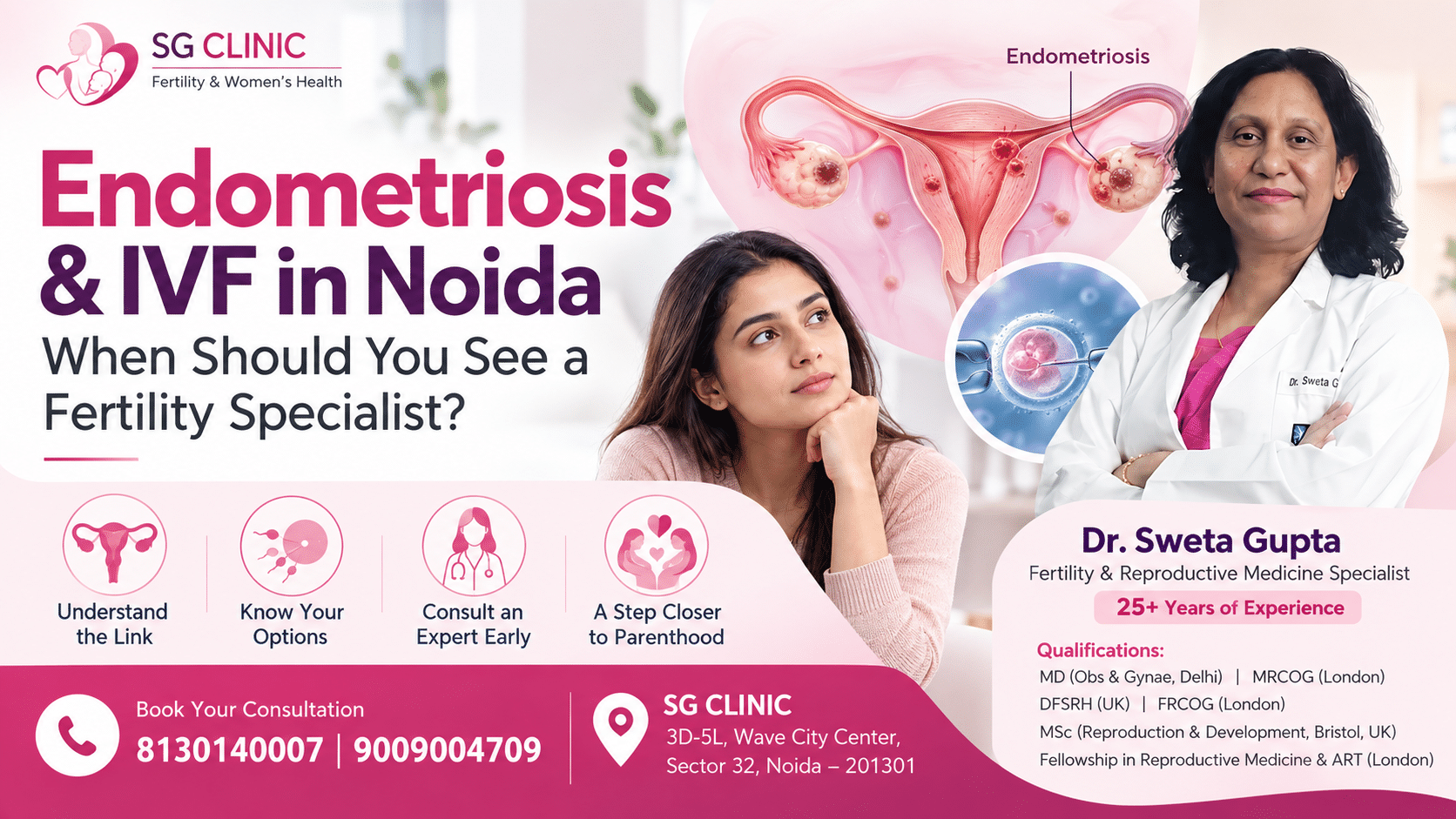
Endometriosis and fertility can be closely connected. For some women, endometriosis may make it more difficult to conceive naturally because it can affect the ovaries, fallopian tubes, pelvic anatomy and other aspects of reproductive function. However, having endometriosis does not automatically mean that IVF is required. The right fertility plan depends on factors such as age, ovarian reserve, severity of endometriosis, duration of infertility, tubal condition, sperm factors and previous treatments.
If you have endometriosis and are trying to conceive, an early consultation with a fertility specialist can help determine whether natural conception, ovulation-based treatment, IUI, surgery, IVF or another approach is appropriate for you.
At SG Clinic, Noida, Dr. Sweta Gupta provides fertility and reproductive medicine consultations for women dealing with endometriosis, infertility and IVF-related concerns.
Table of Contents
- What Is Endometriosis?
- Can Endometriosis Cause Infertility?
- Adhesions and Pelvic Anatomy
- Ovarian Endometriomas
- Ovarian Reserve
- Inflammation
- Age-Related Fertility Changes
- Endometriosis and IVF: Does Every Woman Need IVF?
- When Should You See a Fertility Specialist for Endometriosis?
- What Fertility Tests May Be Recommended?
- Ovarian Reserve Assessment
- Ultrasound
- Tubal Assessment
- Semen Analysis
- Medical and Surgical History
- Is IVF Effective for Women With Endometriosis?
- Does Endometriosis Surgery Need to Be Done Before IVF?
- Endometriosis and IVF in Noida: Why Early Fertility Planning Matters
- Endometriosis and IVF: A Practical Fertility Roadmap
- Frequently Asked Questions About Endometriosis and IVF
- Can I Get Pregnant Naturally If I Have Endometriosis?
- Does Having Endometriosis Mean I Need IVF?
- When Should I See a Fertility Specialist?
- Is IVF Suitable for Severe Endometriosis?
- Should an Endometrioma Be Removed Before IVF?
- Can Endometriosis Affect Ovarian Reserve?
- Can Endometriosis Affect IVF Success?
- Is IUI an Option for Women With Endometriosis?
- Does IVF Cure Endometriosis?
- Should Women Over 35 With Endometriosis Seek Fertility Advice Earlier?
- When Should You Consult an IVF & Fertility Specialist in Noida?
- Key Takeaway: Endometriosis, Fertility & IVF
What Is Endometriosis?
Endometriosis is a chronic condition in which tissue similar to the lining of the uterus grows outside the uterus. It may involve areas such as the ovaries, fallopian tubes, pelvic lining and other pelvic structures.
Some women experience significant symptoms, while others may have few or no obvious symptoms. Common symptoms can include:
- Painful periods
- Chronic pelvic pain
- Pain during sexual intercourse
- Painful bowel movements or urination, particularly around menstruation
- Difficulty conceiving
- Ovarian endometriomas or “chocolate cysts”
Endometriosis can sometimes contribute to infertility through pelvic inflammation, adhesions, ovarian involvement or distortion of pelvic anatomy. However, the relationship between endometriosis and fertility is complex, and the effect can vary considerably from one woman to another.
Can Endometriosis Cause Infertility?
Yes, endometriosis can contribute to infertility, but not every woman with endometriosis will have difficulty becoming pregnant.
Endometriosis may affect fertility through several mechanisms, including:
1. Adhesions and pelvic anatomy
Endometriosis can cause scar tissue and adhesions that may alter the normal relationship between the ovaries, fallopian tubes and surrounding pelvic structures.
2. Ovarian endometriomas
Endometriosis can result in ovarian cysts known as endometriomas. Depending on their size, location and effect on the ovary, they may be relevant when planning fertility treatment.
3. Ovarian reserve
Both endometriosis itself and some surgical treatments involving the ovaries can affect ovarian reserve. Therefore, ovarian function should be considered carefully when developing a fertility plan.
4. Inflammation
Endometriosis is associated with inflammatory changes within the pelvis that may interfere with normal reproductive processes.
5. Age-related fertility decline
Age is an important consideration for all women trying to conceive. When endometriosis and increasing reproductive age occur together, fertility planning may need to be more proactive. ASRM notes that age, duration of infertility, pelvic pain and disease stage should be considered when planning treatment.
Endometriosis and IVF: Does Every Woman Need IVF?
No.
IVF is one of the fertility treatment options for women with endometriosis, but it is not automatically required simply because endometriosis has been diagnosed.
A fertility specialist may consider:
- Trying to conceive naturally
- Ovulation-based treatment in selected cases
- IUI (intrauterine insemination)
- Laparoscopic treatment when clinically indicated
- IVF
- IVF with ICSI when indicated by additional fertility factors
- Fertility preservation in selected patients
The choice depends on the complete fertility picture rather than the endometriosis diagnosis alone. ESHRE’s endometriosis guideline emphasizes individualized management, including consideration of fertility goals and reproductive factors.
When Should You See a Fertility Specialist for Endometriosis?
If you have diagnosed or suspected endometriosis and pregnancy is your goal, you do not necessarily need to wait 12 months before seeking professional advice.
ASRM recommends that infertility evaluation should be initiated without delay when a woman has a condition known to be associated with infertility, including known or suspected endometriosis. For women without such a condition, evaluation is generally initiated after 12 months if under 35, after 6 months at age 35 or older, and more immediately for women over 40.
You should consider consulting a fertility specialist if:
1. You have already been diagnosed with endometriosis
An early fertility assessment can establish your reproductive baseline and help with future planning.
2. You have been trying to conceive without success
Don’t assume that endometriosis is the only reason. Both partners may need evaluation because infertility can involve female, male or combined factors.
3. You are 35 or older
Age becomes an increasingly important factor in fertility planning, so delaying evaluation may reduce available treatment options.
4. You have severe or worsening pelvic pain
Pain does not necessarily indicate the severity of infertility, but significant symptoms warrant appropriate gynecological assessment.
5. You have an ovarian endometrioma
An endometrioma can be relevant to ovarian function and fertility treatment planning.
6. You have undergone previous endometriosis surgery
Previous ovarian surgery can be important when assessing ovarian reserve and deciding on fertility treatment.
7. You have reduced ovarian reserve
If testing suggests diminished ovarian reserve, discussing fertility options early may be particularly important.
8. You have had previous unsuccessful fertility treatment
A fertility specialist can review previous investigations and treatment outcomes before planning the next step.
What Fertility Tests May Be Recommended?
There is no single test that determines whether a woman with endometriosis can become pregnant.
A fertility specialist may assess several factors.
Ovarian reserve assessment
Depending on the clinical situation, testing may include:
- AMH
- Antral follicle count (AFC)
- Other ovarian reserve assessments
Ultrasound
Transvaginal ultrasound can help identify:
- Endometriomas
- Ovarian abnormalities
- Uterine conditions
- Other pelvic findings
Ultrasound can identify some pelvic pathology, including endometriomas, although it cannot diagnose every form of endometriosis.
Tubal assessment
Depending on the patient’s history, a fertility specialist may recommend an assessment of the fallopian tubes.
Semen analysis
Male-factor infertility can contribute to difficulty conceiving, so assessment of the male partner is an important part of a complete fertility evaluation.
Medical and surgical history
Your doctor may review:
- Previous endometriosis diagnosis
- Disease severity
- Previous laparoscopic surgery
- Previous fertility treatments
- Pregnancy history
- Menstrual cycle
- Pelvic pain
- Previous ovarian surgery
This information helps create an individualized treatment plan.
Is IVF Effective for Women With Endometriosis?
IVF can be an important treatment option for endometriosis-associated infertility.
However, IVF outcomes can vary depending on age, ovarian reserve, endometriosis severity, previous ovarian surgery, sperm factors and other individual characteristics.
Older ASRM guidance notes that endometriosis may affect IVF outcomes compared with some other causes of infertility, while IVF can still provide an effective way of maximizing the chance of conception in appropriately selected patients.
Therefore, it is better to ask:
“Is IVF appropriate for my individual fertility situation?”
rather than assuming that endometriosis automatically means IVF is necessary.
Does Endometriosis Surgery Need to Be Done Before IVF?
Not always.
This is an important decision that should be individualized.
Surgery may be considered in certain situations, such as significant pain, specific pelvic pathology or other clinical indications. But removing an endometrioma simply to improve IVF outcomes is not automatically beneficial in every patient.
Previous ASRM guidance notes that evidence is insufficient to show that routine removal of an endometrioma before IVF improves outcomes, and extensive ovarian surgery can potentially reduce ovarian function.
Therefore, the decision should consider:
- Endometrioma size and location
- Symptoms
- Ovarian reserve
- Previous ovarian surgery
- Age
- IVF history
- Accessibility of follicles for egg retrieval
- Overall fertility goals
Endometriosis and IVF in Noida: Why Early Fertility Planning Matters
Women searching for endometriosis treatment and IVF in Noida often have questions about whether they should undergo surgery first, continue trying naturally or proceed directly to assisted reproduction.
There is no universal answer.
A fertility consultation can help evaluate your individual situation and explain the available options.
At SG Clinic in Sector 32, Noida, Dr. Sweta Gupta offers consultation for fertility concerns, IVF and reproductive medicine.
Dr. Sweta Gupta
25+ years of experience
Qualifications include:
- MD (Obstetrics & Gynaecology), Delhi
- MRCOG (London)
- DFSRH (UK)
- FRCOG (London)
- MSc in Reproduction & Development, Bristol, UK
- Fellowship in Reproductive Medicine & ART, London
For women with endometriosis who are planning pregnancy, an individualized assessment can help answer important questions about ovarian reserve, fertility potential and whether assisted reproductive treatment should be considered.
Endometriosis & IVF: A Practical Fertility Roadmap
If you have endometriosis and want to become pregnant, the process may look like this:
Step 1 — Fertility consultation
Discuss your endometriosis history, symptoms and pregnancy goals.
Step 2 — Fertility assessment
Evaluate ovarian reserve, uterus, tubes and other relevant fertility factors.
Step 3 — Review previous treatment
Consider previous surgery, medications and fertility treatments.
Step 4 — Discuss options
Depending on your individual circumstances, options may include natural conception, IUI, surgery or IVF.
Step 5 — Personalized treatment plan
Your fertility specialist can explain the potential benefits, limitations and risks of the recommended approach.
Frequently Asked Questions About Endometriosis and IVF
1. Can I get pregnant naturally if I have endometriosis?
Yes. Many women with endometriosis conceive naturally. However, the likelihood can vary depending on factors such as age, ovarian reserve, disease severity, tubal function and other fertility factors.
2. Does having endometriosis mean I need IVF?
No. Endometriosis does not automatically mean that IVF is required. The appropriate treatment depends on your overall fertility assessment.
3. When should I see a fertility specialist if I have endometriosis?
If you have known or suspected endometriosis and are planning pregnancy, an early fertility consultation can be appropriate. ASRM specifically lists known or suspected endometriosis among conditions for which infertility evaluation should not necessarily be delayed.
4. Is IVF suitable for severe endometriosis?
IVF may be considered for women with moderate or severe endometriosis-associated infertility, particularly when other factors make natural conception difficult or previous treatments have not worked. The decision should be individualized.
5. Should an endometrioma be removed before IVF?
Not necessarily. Routine removal before IVF has not been shown to improve outcomes in every patient, and ovarian surgery can affect ovarian reserve. The decision depends on the individual clinical situation.
6. Can endometriosis affect ovarian reserve?
Endometriosis and particularly interventions involving the ovaries can be relevant to ovarian reserve. Your fertility specialist may recommend ovarian reserve assessment before deciding on treatment.
7. Can endometriosis come back after treatment?
Endometriosis is a chronic condition and may recur after treatment. Follow-up should be individualized according to symptoms, fertility goals and treatment history.
8. Is IUI an option for women with endometriosis?
IUI may be appropriate for selected patients, depending on factors such as disease severity, tubal patency, ovarian reserve, age and sperm parameters. Treatment selection should be individualized.
9. Does IVF cure endometriosis?
No. IVF is a fertility treatment and does not cure endometriosis itself. Endometriosis management and fertility treatment may need to be considered separately but coordinated according to the patient’s goals.
10. Can endometriosis affect IVF success?
Endometriosis may influence IVF outcomes, but individual outcomes vary considerably. Age, ovarian reserve, disease severity, previous surgery and other fertility factors can all be relevant.
11. Should women over 35 with endometriosis seek fertility advice earlier?
Yes, an earlier consultation can be sensible because both endometriosis-related factors and age-related changes in fertility may influence treatment planning. ASRM recommends earlier infertility evaluation from age 35 and immediate evaluation in many women over 40.
12. Can endometriosis be diagnosed through ultrasound alone?
No. Ultrasound can identify findings such as endometriomas and other pelvic abnormalities, but not every type of endometriosis is visible on ultrasound. The diagnostic approach depends on symptoms, examination and imaging, with further evaluation considered when clinically appropriate.
When Should You Consult an IVF & Fertility Specialist in Noida?
If you have endometriosis, an endometrioma, painful periods, unexplained difficulty conceiving, previous fertility treatment or concerns about your reproductive health, consider discussing your fertility goals with a reproductive medicine specialist.
Early assessment does not necessarily mean starting IVF immediately. It can simply provide a clearer understanding of your fertility status and available options.
Consult Dr. Sweta Gupta at SG Clinic, Noida
Dr. Sweta Gupta
Fertility & Reproductive Medicine Specialist
25+ Years of Experience
📍 SG Clinic
3D-5L, Wave City Center, Sector 32, Noida – 201301
📞 Appointments:
8130140007 | 9009004709
Takeaway: Endometriosis does not automatically mean infertility or IVF. The most appropriate approach depends on your age, ovarian reserve, endometriosis severity, tubal status, previous treatment and other fertility factors. A personalized fertility evaluation can help determine when to continue trying naturally and when treatments such as IUI or IVF should be considered.
This article is for general educational information and does not replace an individual medical consultation.