

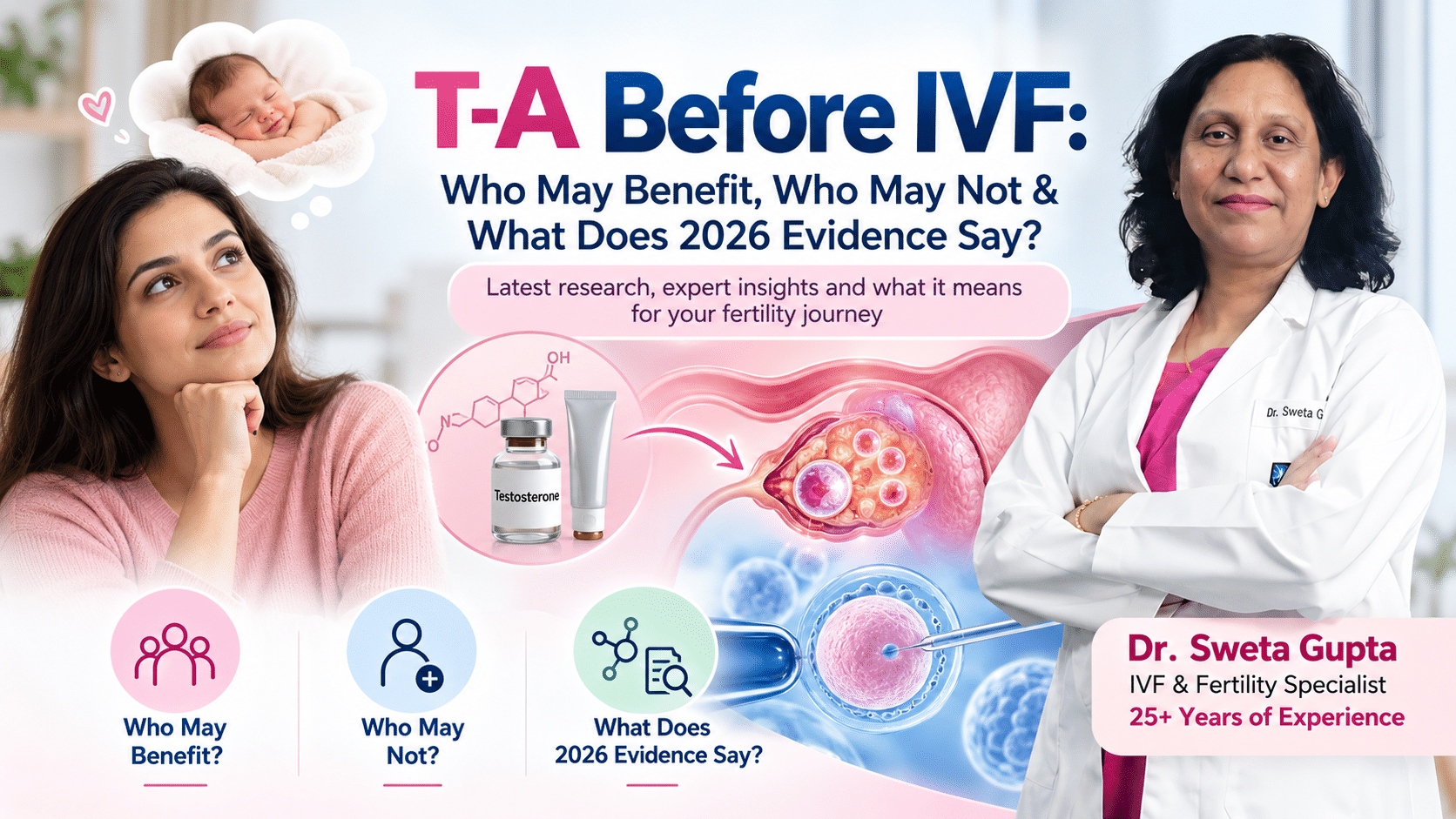
If you are preparing for IVF and have been advised to consider T-A (testosterone/androgen pretreatment), you may naturally wonder: Do I really need it? Can it improve my IVF outcome? Is it useful for low ovarian reserve or poor ovarian response?
The answer is not the same for every woman.
Androgen supplementation—most commonly testosterone or DHEA—has been investigated as a pre-treatment before ovarian stimulation, particularly in women with diminished ovarian reserve (DOR) or a previous poor ovarian response (POR). However, the evidence remains mixed, and the latest 2026 guidance does not support routine testosterone pretreatment for all IVF patients.
Important: “T-A” is not a universally standardized medical abbreviation. In this article, it refers to testosterone/androgen pretreatment before IVF. The exact treatment, dose and duration should only be decided by your fertility specialist.
Table of Contents
- What Is T-A Before IVF?
- Why Is T-A Considered Before IVF?
- Who May Be Considered for T-A Before IVF?
- Who May Not Need T-A Before IVF?
- What Does the 2026 Evidence Say About T-A?
- T-A vs DHEA: Are They the Same?
- Can T-A Improve Egg Quality?
- Can T-A Improve IVF Success Rates?
- What Should Be Checked Before Considering T-A?
- What Are the Possible Side Effects of Testosterone?
- 5 Questions to Ask Your Fertility Doctor Before T-A
- T-A Before IVF: 2026 Evidence-Based Takeaway
- Frequently Asked Questions About T-A Before IVF
- What does T-A mean before IVF?
- Is testosterone necessary before IVF?
- Who may benefit from testosterone before IVF?
- Does testosterone improve egg quality?
- Does T-A increase the number of eggs retrieved?
- Is T-A recommended for women with low AMH?
- Is DHEA the same as testosterone?
- How long before IVF is testosterone usually given?
- Can I take testosterone or DHEA without a prescription?
- What does the latest 2026 evidence say?
- Should every IVF patient use an add-on?
- Can Dr. Sweta Gupta assess whether T-A is suitable for me?
- Expert Fertility Consultation in Noida – Dr. Sweta Gupta
What Is T-A Before IVF?
Testosterone/androgen pretreatment involves giving an androgen hormone before ovarian stimulation begins.
The theory behind this approach is that androgens may influence the development and recruitment of ovarian follicles and potentially improve ovarian response to stimulation.
Depending on the protocol, testosterone may be administered through the skin as a gel or patch, while DHEA is generally taken orally. Treatment has commonly been studied for several weeks before ovarian stimulation.
However, a biological rationale does not automatically mean that a treatment improves the ultimate IVF outcome.
For fertility treatment, the outcomes that matter most include:
- Number of mature eggs retrieved
- Embryo development
- Clinical pregnancy
- Ongoing pregnancy
- Live birth
- Safety and adverse effects
This distinction is important because an intervention may change the number of eggs retrieved without necessarily increasing the chance of having a baby.
Why Is T-A Considered Before IVF?
T-A has mainly been investigated in women who have:
1. Diminished Ovarian Reserve
A woman with diminished ovarian reserve may have a lower ovarian reserve than expected for her age.
Tests such as AMH and antral follicle count (AFC) can help clinicians assess ovarian reserve and anticipate response to stimulation.
However, ovarian reserve tests should not be interpreted as a direct prediction of whether an individual woman will or will not achieve a live birth. The 2025 ESHRE ovarian-stimulation guideline notes that female age and BMI are predictors of pregnancy and live birth, while several baseline hormonal markers are not recommended as standalone predictors of those outcomes.
2. Previous Poor Ovarian Response
Some women produce fewer follicles or retrieve fewer eggs than expected during IVF stimulation.
Testosterone pretreatment has therefore been studied particularly in women classified as poor responders.
The idea is that androgen exposure before stimulation might support follicular development and improve ovarian response.
But this is precisely where individual assessment becomes important.
Who May Be Considered for T-A Before IVF?
T-A should not be viewed as a standard requirement before every IVF cycle.
A fertility specialist may discuss testosterone/androgen pretreatment when a patient has particular clinical circumstances, such as:
- Previous poor ovarian response
- Suspected or documented diminished ovarian reserve
- Repeated cycles producing a very low number of oocytes
- Specific ovarian-stimulation concerns identified during previous IVF
- A treatment plan where the potential benefits and uncertainties have been discussed
The 2024 Cochrane review of 28 studies involving 3,002 women reported that testosterone probably improves successful pregnancy outcomes in women identified as poor responders, whereas DHEA likely has little to no effect in this group. However, the evidence regarding optimal duration and adverse effects remained limited.
That evidence needs to be balanced against newer guidance.
Who May Not Need T-A?
For many women undergoing IVF, there may be no clear reason to add testosterone pretreatment.
This includes patients who:
- Have an expected or normal ovarian response
- Have no history of poor response
- Have adequate ovarian reserve for their clinical situation
- Are being offered testosterone simply as a routine IVF add-on
- Have not been given a clear patient-specific reason for using it
The updated ESHRE ovarian stimulation guideline published in 2026 states that testosterone before ovarian stimulation is probably not recommended for low responders, because evidence remains inconsistent regarding improvements in ovarian response and clinical outcomes. The guideline also highlights insufficient evidence regarding dosage, duration and safety.
So, even in the group where T-A has been studied most extensively, it should not automatically be considered a routine treatment.
What Does the 2026 Evidence Say About T-A?
The evidence landscape is particularly interesting because different reviews have reached somewhat different conclusions.
Cochrane 2024
The Cochrane review found that testosterone pretreatment probably improves the chance of successful pregnancy in women identified as poor responders, while DHEA likely has little or no effect. It also noted uncertainty about the optimal duration of testosterone treatment and limited reporting of adverse events.
ESHRE 2026
The updated ESHRE guideline takes a more cautious position.
It concludes that testosterone before ovarian stimulation is probably not recommended for low responders, because the available evidence is inconsistent and there is insufficient information about dosage, duration and safety.
HFEA evidence review
The UK’s Human Fertilisation and Embryology Authority currently rates the evidence for testosterone supplementation as insufficient to determine effectiveness for improving the chance of a baby, number of eggs retrieved, or outcomes specifically in women with poor ovarian response/diminished ovarian reserve.
What does this mean for patients?
The most accurate interpretation in 2026 is:
T-A is an area of ongoing research—not a universally proven IVF booster.
A patient with a specific indication may be considered differently from someone being offered testosterone routinely.
T-A vs DHEA: Are They the Same?
No.
Both are androgens, but testosterone and DHEA are different hormones and should not be treated as interchangeable.
| Treatment | What it is | Evidence before IVF |
|---|---|---|
| Testosterone | Androgen hormone | Evidence remains uncertain/inconsistent; studied particularly in poor responders |
| DHEA | Androgen precursor | Current evidence does not demonstrate a consistent IVF benefit |
| Routine use in all IVF patients | Not patient-specific | Not supported by current evidence |
The ESHRE 2026 guideline specifically states that DHEA is not recommended for low responders or normal responders based on the available evidence.
Can T-A Increase Egg Quality?
This is one of the most common questions patients ask.
It is important to distinguish egg quantity from egg quality.
A treatment that results in more follicles or retrieved oocytes does not necessarily mean that the eggs will have better chromosomal competence or that live birth will increase.
Currently, there is not enough robust evidence to describe testosterone pretreatment as a proven method of improving egg quality.
Age remains one of the most important factors associated with reproductive outcomes, and ovarian reserve markers should be interpreted within the broader clinical picture.
Can T-A Improve IVF Success Rates?
There is no simple “yes” or “no.”
Some studies suggest potential benefits in selected poor responders, while other evidence does not establish a consistent improvement in live birth.
The 2026 ESHRE position therefore emphasizes caution rather than routine use.
This is an important distinction:
“May help a selected patient” is not the same as “proven to improve IVF success for everyone.”
What Should Be Checked Before Considering T-A?
Before adding any IVF treatment add-on, your fertility specialist should look at the complete clinical picture.
This can include:
Ovarian reserve
- AMH
- Antral follicle count
- Previous ovarian response
Previous IVF history
- Number of follicles
- Number of eggs retrieved
- Mature oocytes
- Fertilisation
- Embryo development
- Blastocyst formation
- Previous pregnancy outcomes
Age
Age is a major factor in reproductive outcomes and should always be considered alongside ovarian reserve.
Other fertility factors
Your doctor may also assess:
- Ovulation
- Uterine anatomy
- Tubal factors where relevant
- Endometriosis
- Male-factor infertility
- Relevant endocrine conditions
- Previous pregnancy history
A personalised IVF plan should address the patient’s overall fertility diagnosis rather than relying on a single test or add-on.
What Are the Possible Side Effects of Testosterone?
Testosterone is not a harmless nutritional supplement.
Reported androgen-related side effects can include:
- Acne or oilier skin
- Increased facial/body hair
- Hair loss
- Voice changes or deepening
- Dizziness
- Other androgenic effects
Safety data in IVF studies have also been limited, and the HFEA notes that adverse-event reporting has not been comprehensive. Testosterone should also not be taken during pregnancy unless specifically directed within appropriate medical care.
Therefore, self-medication with testosterone or DHEA is not advisable.
T-A Before IVF: 5 Questions to Ask Your Fertility Doctor
If T-A has been suggested as part of your IVF plan, ask:
1. Why is T-A being recommended for me specifically?
2. Do I have diminished ovarian reserve or a documented poor response?
3. What benefit are we expecting—more eggs, better response, or improved live birth?
4. What does the latest evidence say for someone with my profile?
5. What are the alternatives if we don’t use T-A?
These questions can help you understand whether the treatment is being recommended because of your individual fertility history or simply as a routine add-on.
T-A Before IVF: Bottom Line for 2026
The evidence surrounding testosterone/androgen pretreatment before IVF has evolved.
Earlier research and the 2024 Cochrane review suggested that testosterone may benefit some women classified as poor responders.
However, 2026 ESHRE guidance does not recommend routine testosterone pretreatment for low responders, citing inconsistent evidence and insufficient information about dosage, duration and safety.
Therefore, T-A should be approached as a patient-specific decision, not as a universal IVF requirement or guaranteed IVF success enhancer.
At SG Clinic, Noida, fertility treatment should be based on your age, ovarian reserve, previous treatment response, fertility diagnosis and reproductive goals.
Frequently Asked Questions About T-A Before IVF
1. What does T-A mean before IVF?
In this context, T-A refers to testosterone/androgen pretreatment before IVF ovarian stimulation. It has mainly been studied in women with diminished ovarian reserve or poor ovarian response.
2. Is testosterone necessary before IVF?
No. Testosterone is not routinely necessary for every IVF patient. Its use depends on the individual’s fertility profile and clinical circumstances.
3. Who may benefit from testosterone before IVF?
Testosterone has primarily been investigated in women with poor ovarian response or diminished ovarian reserve. Some evidence suggests a potential benefit in selected poor responders, but current guidelines do not support routine use.
4. Does testosterone improve egg quality?
There is currently insufficient evidence to describe testosterone pretreatment as a proven method for improving egg quality.
5. Does T-A increase the number of eggs retrieved?
The evidence is inconsistent. Some studies have suggested improved ovarian response, but current evidence is not strong enough to recommend routine testosterone use.
6. Is T-A recommended for women with low AMH?
Not automatically. A low AMH result alone does not mean that testosterone is required. Your AMH should be interpreted alongside age, AFC, previous IVF response and the overall fertility diagnosis.
7. Is DHEA the same as testosterone?
No. Both are androgens, but they are different substances. Current evidence does not support routine DHEA use to improve IVF outcomes.
8. How long before IVF is testosterone usually given?
Studies have used different treatment durations. Testosterone supplementation has commonly been administered for several weeks before ovarian stimulation, but there is no universally established optimal duration.
9. Can I take testosterone or DHEA without a prescription?
You should not self-start hormonal treatment for IVF. The dose, duration, indication and safety considerations should be assessed by your fertility specialist.
10. What does the latest 2026 evidence say?
The 2026 ESHRE guideline states that testosterone before ovarian stimulation is probably not recommended for low responders, because evidence of benefit remains inconsistent and information about dosing, duration and safety is insufficient.
11. Should every IVF patient use an add-on?
No. IVF add-ons should be considered individually and discussed in the context of evidence, potential benefits, risks and costs. HFEA notes that routine proven fertility treatment is effective for many patients without add-ons.
12. Can Dr. Sweta Gupta assess whether T-A is suitable for me?
Yes. A fertility specialist can review your age, AMH, AFC, previous IVF response, medical history and fertility diagnosis to determine whether an androgen pretreatment discussion is appropriate for your situation.
Expert Fertility Consultation in Noida
Dr. Sweta Gupta
IVF & Fertility Specialist | 25+ Years of Experience
SG Clinic
3D-5L, Wave City Center, Sector 32, Noida – 201301
📞 8130140007 | 9009004709
If you are considering IVF and have been advised T-A/testosterone, DHEA or another IVF add-on, discuss the evidence and your individual indication with a qualified fertility specialist before starting treatment.