

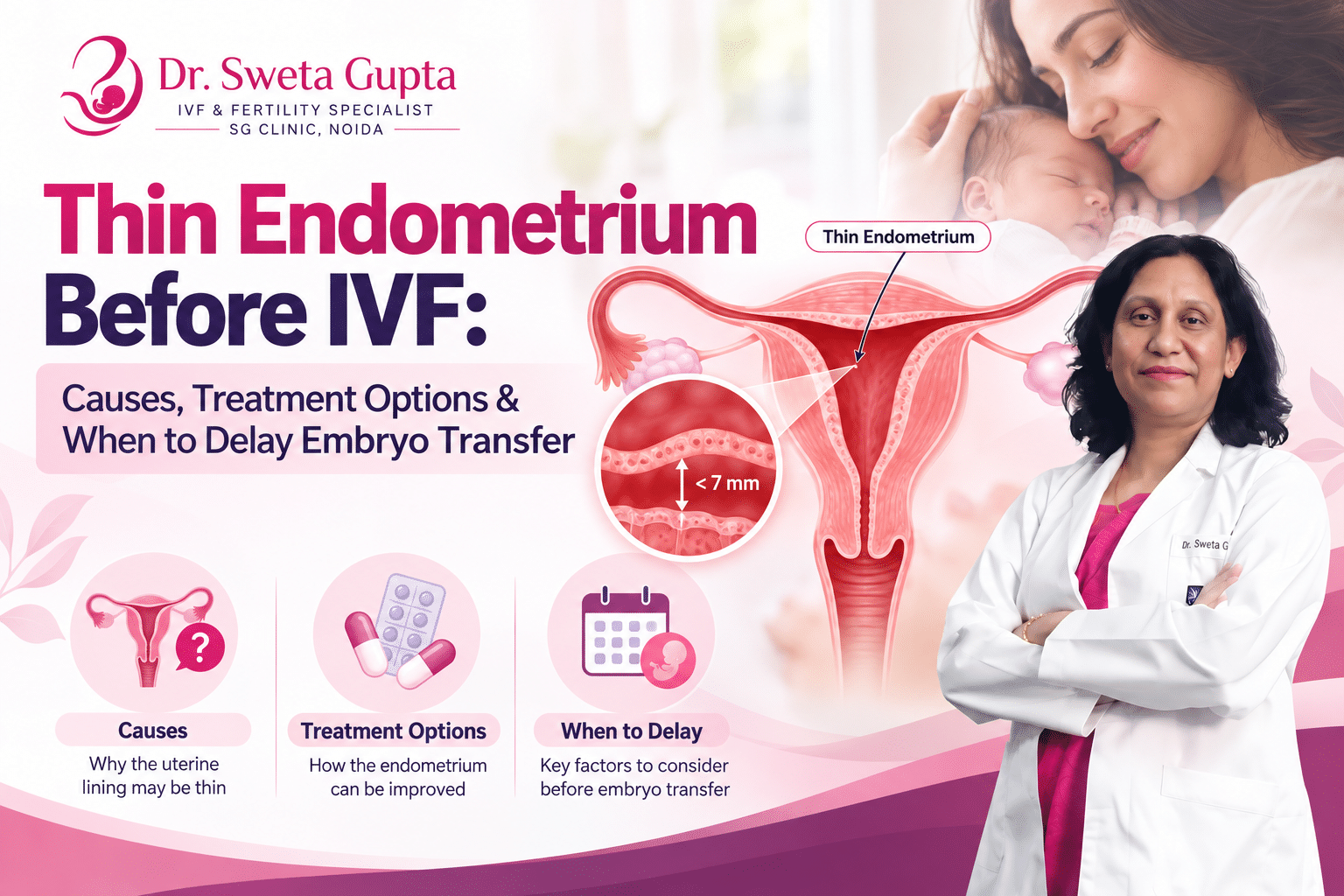
A healthy endometrium—the inner lining of the uterus—is an important part of successful embryo implantation during IVF. When an ultrasound shows that the endometrial lining is thin before embryo transfer, patients often worry that their IVF cycle may not work.
A commonly used clinical reference point is an endometrial thickness of less than 7 mm, although there is no single thickness that can accurately predict whether an embryo will implant or whether a transfer should automatically be cancelled. Recent evidence suggests that endometrial thickness is better understood as a continuous prognostic factor rather than a strict pass/fail cutoff.
The right approach is therefore not simply to ask, “Is my lining 7 mm?” but to understand why the endometrium is thin, how it looks on ultrasound, whether the uterine cavity is normal, how it responds to medication, and what other factors affect the IVF cycle.
Medical note: This article is for general educational information and does not replace an individual fertility assessment. Decisions about delaying or proceeding with embryo transfer should be made with your fertility specialist after reviewing your ultrasound, hormone levels, uterine cavity and complete IVF history.
What Is a Thin Endometrium Before IVF?
The endometrium is the tissue lining the inside of the uterus. During a natural menstrual cycle or an IVF/FET preparation cycle, estrogen stimulates the lining to grow. Progesterone then changes the endometrium into a receptive state that can support implantation.
Endometrial thickness is usually measured using transvaginal ultrasound.
A thin endometrium is often described as an endometrial thickness of below 7 mm, although definitions vary between studies and clinics. Some research has examined 6 mm, 7 mm or other thresholds, which is one reason there is no universal number at which embryo transfer must automatically be cancelled.
Importantly, pregnancies have occurred even with relatively thin endometrial measurements. Therefore, a thin lining does not mean pregnancy is impossible. At the same time, large observational datasets and recent systematic reviews generally show an association between greater endometrial thickness and better reproductive outcomes, particularly at the lower end of the thickness range.
Why Is Endometrial Thickness Important in IVF?
For an embryo to implant, the uterus needs an appropriately developed and receptive endometrium.
Endometrial thickness is only one component of implantation. Other factors include:
- Embryo quality
- Embryo genetic status where testing is performed
- Age and ovarian factors
- Uterine cavity abnormalities
- Endometrial pattern
- Hormonal preparation
- Progesterone exposure and timing
- Presence of intrauterine adhesions or other pathology
- Previous IVF and pregnancy history
Therefore, endometrial thickness should not be interpreted in isolation.
A 2025 systematic review and meta-analysis found an association between increasing endometrial thickness and reproductive outcomes in both fresh and frozen-thawed embryo transfer cycles, but the authors emphasized that the evidence quality was frequently low and that thickness should not be treated as a single critical threshold below which embryo transfer must always be avoided.
Causes of Thin Endometrium Before IVF
There can be several reasons why the uterine lining does not develop adequately.
1. Previous Uterine Procedures
Previous procedures involving the uterus can sometimes affect endometrial development.
Examples include:
- Dilation and curettage (D&C)
- Repeated uterine curettage
- Previous miscarriage procedures
- Certain uterine surgeries
- Previous treatment for retained pregnancy tissue
In some women, these procedures can be associated with intrauterine adhesions (scar tissue), which may interfere with normal endometrial growth.
2. Intrauterine Adhesions
Intrauterine adhesions, sometimes called Asherman’s syndrome, can develop when scar tissue forms inside the uterine cavity.
Possible clues include:
- Very light periods
- Changes in menstrual flow after uterine surgery
- Recurrent implantation failure
- Persistently thin lining
- Difficulty developing the endometrium despite estrogen treatment
When adhesions are suspected, evaluation of the uterine cavity may be appropriate. If significant adhesions are identified, hysteroscopic adhesiolysis may be considered as part of treatment.
3. Inadequate Endometrial Response to Estrogen
Estrogen is important for endometrial proliferation.
Some women simply have a limited response to the estrogen used during a hormone-prepared frozen embryo transfer cycle. Your fertility specialist may therefore review:
- Estrogen dose
- Route of administration
- Duration of estrogen exposure
- Ultrasound response
- Hormonal levels where clinically appropriate
Extending or modifying estrogen treatment is one of the approaches studied for women with persistently thin endometrium, although treatment protocols vary between patients and the evidence for many interventions remains limited.
4. Reduced Uterine Blood Flow
Blood supply contributes to normal endometrial development.
Some studies have investigated interventions intended to improve uterine blood flow in women with thin endometrium. However, treatments such as sildenafil, aspirin and other vascular approaches have not produced sufficiently consistent evidence to support routine use for every patient.
This is why self-medication with aspirin, sildenafil or other drugs is not recommended.
5. Previous Endometrial Damage or Infection
Previous inflammation, infection or damage to the uterine lining may sometimes contribute to poor endometrial development.
The medical history is particularly important when thin lining is:
- Persistent
- Severe
- Associated with menstrual changes
- Present after uterine procedures
- Associated with repeated failed transfers
6. Individual Biological Variation
Sometimes investigations do not identify a clear structural cause.
Endometrial development varies between individuals, and a woman may repeatedly have a thinner lining despite an apparently normal uterine cavity.
This is one reason treatment needs to be individualized rather than based on a single number.
How Is Thin Endometrium Evaluated Before IVF?
If the lining remains thin, your fertility specialist may review several aspects of your cycle.
Transvaginal Ultrasound
Ultrasound can assess:
- Endometrial thickness
- Endometrial pattern
- Uterine anatomy
- Fibroids
- Polyps
- Fluid in the uterine cavity
- Ovarian development
Review of Previous IVF Cycles
Your doctor may compare the endometrial response across previous cycles to determine whether the problem is:
- New
- Persistent
- Related to a particular medication protocol
- Related to a particular cycle type
Uterine Cavity Assessment
Depending on your history, your doctor may recommend a procedure such as hysteroscopy to directly assess the uterine cavity.
This can be particularly relevant when there is suspicion of adhesions, polyps or other intracavitary abnormalities.
Treatment Options for Thin Endometrium Before Embryo Transfer
Treatment depends heavily on the underlying cause.
1. Optimizing Estrogen Therapy
In hormone replacement/FET cycles, estrogen is commonly used to stimulate endometrial growth.
Depending on the patient’s response, a fertility specialist may consider adjusting:
- Dose
- Route
- Duration
- Timing
Research has found that intensified or prolonged estradiol treatment can increase endometrial thickness in some patients, but the evidence is not strong enough to establish one universally superior protocol.
2. Treating Intrauterine Adhesions
If adhesions are responsible for the thin lining, simply increasing estrogen may not address the underlying problem.
In selected patients, hysteroscopic treatment of adhesions may be necessary before attempting another embryo transfer.
The timing of subsequent embryo transfer depends on the extent of adhesions, treatment response and individual clinical circumstances.
3. Treating Uterine Cavity Abnormalities
Polyps, submucosal fibroids or other abnormalities inside the uterine cavity may affect implantation.
If a structural abnormality is identified, treatment may be considered before embryo transfer depending on:
- Size
- Location
- Symptoms
- Previous fertility history
- Impact on the uterine cavity
4. Reviewing the IVF/FET Protocol
Sometimes the strategy is changed rather than simply adding more medications.
Depending on the circumstances, the fertility specialist may consider:
- Another endometrial preparation protocol
- A different estrogen regimen
- Additional time for endometrial development
- Natural or modified-natural FET in suitable ovulatory patients
- Postponing transfer and preparing the lining in another cycle
The appropriate choice depends on ovarian function, menstrual regularity, previous response and other fertility factors.
5. Other Add-On Treatments
A number of treatments have been investigated for thin endometrium, including:
- Sildenafil
- Aspirin
- Granulocyte colony-stimulating factor (G-CSF)
- Platelet-rich plasma (PRP)
- Pentoxifylline and vitamin E
- Growth-factor-based approaches
However, evidence for these treatments is inconsistent, and several have not demonstrated sufficiently reliable improvements in live birth outcomes to justify routine use in every patient. A systematic review found generally low-to-moderate quality evidence and emphasized the lack of robust randomized trials for many proposed therapies.
Therefore, these treatments should not be started simply because an online article recommends them.
Should Embryo Transfer Be Delayed If the Endometrium Is Thin?
This is one of the most important questions in IVF.
There is no universal endometrial thickness at which every embryo transfer should be cancelled.
A 2025 systematic review found that endometrial thickness has a graded association with reproductive outcomes rather than identifying one absolute cutoff below which embryo transfer should never be performed.
Your fertility specialist may consider delaying transfer when:
- The lining remains significantly thin despite preparation.
- There is an opportunity to improve the endometrium in another cycle.
- A uterine cavity abnormality needs treatment.
- Intrauterine adhesions are suspected or diagnosed.
- Hormonal preparation needs to be modified.
- The embryo can safely remain cryopreserved while the uterus is prepared.
- Other clinical factors suggest that postponing transfer may provide a more appropriate opportunity.
A freeze-all strategy followed by a later frozen embryo transfer may therefore be considered in selected situations.
But delaying transfer is not automatically necessary just because the lining is below a particular number.
What Endometrial Thickness Is Suitable for Embryo Transfer?
Many IVF clinics use around 7 mm as a practical reference point, but this should not be interpreted as an absolute requirement.
Research has shown pregnancies can occur with thinner endometrium, while larger datasets generally demonstrate a gradual association between increasing thickness and reproductive outcomes.
In other words:
7 mm is not a magic number.
A decision should consider the entire clinical picture rather than treating the ultrasound measurement as a simple pass/fail test.
Can a Thin Endometrium Still Result in Pregnancy?
Yes.
A thin endometrium does not mean that pregnancy cannot occur.
Published research has reported pregnancies even with relatively thin measurements. However, the probability of successful implantation and live birth may be lower at very low endometrial thickness, and the relationship is not perfectly predictable for an individual woman.
This distinction is important:
Thin endometrium may reduce the probability of success, but it does not make pregnancy impossible.
Can Endometrial Thickness Be Improved Naturally?
A healthy lifestyle supports general reproductive health, but there is no scientifically established diet, food or home remedy that reliably increases endometrial thickness enough to replace medical evaluation and treatment.
Patients undergoing IVF should generally focus on:
- Balanced nutrition
- Adequate protein and micronutrient intake
- Regular physical activity appropriate to their health
- Avoiding smoking
- Limiting alcohol
- Adequate sleep
- Taking prescribed medications correctly
- Attending scheduled ultrasound monitoring
Do not take supplements or medications specifically to “increase uterine lining” without discussing them with your fertility specialist.
Thin Endometrium Before IVF: When Should You Speak to a Fertility Specialist?
You should discuss your endometrial development with your fertility specialist if:
- Your lining repeatedly measures below the expected range.
- Your lining does not respond adequately to estrogen.
- You have a history of D&C or uterine surgery.
- Your periods became unusually light after a uterine procedure.
- You have experienced recurrent implantation failure.
- A previous embryo transfer was cancelled because of thin endometrium.
- Ultrasound suggests a uterine cavity abnormality.
- You have experienced repeated IVF failure despite good-quality embryos.
The goal is not simply to make the lining “thicker.” The goal is to identify and address the factors that may affect endometrial development and implantation.
Frequently Asked Questions About Thin Endometrium Before IVF
1. What is considered a thin endometrium for IVF?
An endometrial thickness of less than 7 mm is commonly used in research and clinical practice to describe a thin endometrium, although definitions vary. There is no universally accepted thickness that automatically means embryo transfer must be cancelled.
2. Is 6 mm endometrium too thin for IVF?
A 6 mm lining is relatively thin, but it does not automatically make IVF or embryo transfer impossible. The decision depends on the clinical circumstances, embryo factors, uterine assessment and how the lining responds to treatment.
3. Is 7 mm endometrium good for embryo transfer?
Around 7 mm is often used as a practical reference point for embryo-transfer preparation, but it is not a guarantee of implantation or pregnancy. Endometrial thickness should be considered alongside other clinical factors.
4. Should IVF be cancelled if the lining is below 7 mm?
Not necessarily. Some clinics may postpone transfer when the lining is persistently thin, particularly when there is an opportunity to investigate or improve the uterine environment. However, current evidence does not support one universal cutoff that mandates cancellation in every patient.
5. Can estrogen increase endometrial thickness?
Yes, estrogen stimulates endometrial growth and is commonly used during hormone-prepared frozen embryo transfer cycles. A fertility specialist may modify the dose, route or duration depending on the response.
6. Can hysteroscopy help with thin endometrium?
Hysteroscopy can help identify abnormalities inside the uterine cavity, including adhesions and some polyps. When intrauterine adhesions are responsible for poor endometrial development, hysteroscopic adhesiolysis may be considered.
7. Can PRP improve a thin endometrium?
PRP has been investigated as a potential treatment for thin endometrium, but evidence remains insufficient to consider it a universally established treatment. Your doctor should discuss potential benefits, limitations and alternatives before considering an add-on treatment.
8. Does a thin endometrium mean I cannot get pregnant?
No. Pregnancy can occur with a thin endometrium. However, lower endometrial thickness has generally been associated with less favorable reproductive outcomes in IVF studies.
9. Can a frozen embryo transfer be done after improving the lining?
Yes. In appropriate patients, an embryo can be frozen while the endometrium is evaluated or prepared during a subsequent cycle. This is one reason frozen embryo transfer can be useful when the uterine environment is not optimal during the initial IVF cycle.
10. How long should I wait before embryo transfer after treating thin endometrium?
There is no single waiting period for everyone. Timing depends on the treatment used, the uterine cavity, endometrial response and individual IVF plan. Your fertility specialist can determine when the uterus is appropriately prepared for transfer.
11. Does endometrial thickness affect frozen embryo transfer success?
Research suggests an association between endometrial thickness and outcomes in frozen embryo transfer, particularly at lower measurements, but the relationship is gradual rather than a simple cutoff. The quality of evidence varies between studies.
12. What should I do if my embryo transfer was cancelled because of thin lining?
Ask your fertility specialist why the lining remained thin and whether further evaluation is appropriate. Depending on your history, this may include reviewing the estrogen protocol, assessing the uterine cavity, checking for adhesions or other abnormalities, and planning a modified FET protocol.
Key Takeaway
Thin endometrium before IVF requires individualized assessment—not panic and not a one-number decision.
An endometrial thickness below 7 mm is commonly considered thin, but current evidence does not establish a universal cutoff at which embryo transfer must always be cancelled. Recent research supports viewing endometrial thickness as one factor among several when planning embryo transfer.
If the lining is persistently thin, the next step is to understand why. Treatment may involve optimizing estrogen preparation, evaluating the uterine cavity, treating adhesions or other abnormalities, or considering a later frozen embryo transfer. Many proposed add-on therapies have been studied, but evidence for routine use remains limited or inconsistent.
Consult Dr. Sweta Gupta for Personalized Fertility Guidance
Dr. Sweta Gupta is an experienced IVF and reproductive medicine specialist at SG Clinic, Noida. She can assess your IVF history, ultrasound findings and endometrial response to develop an individualized treatment plan.
📍 SG Clinic
3D-5L, Wave City Center, Sector 32, Noida – 201301
📞 8130140007 | 9009004709