

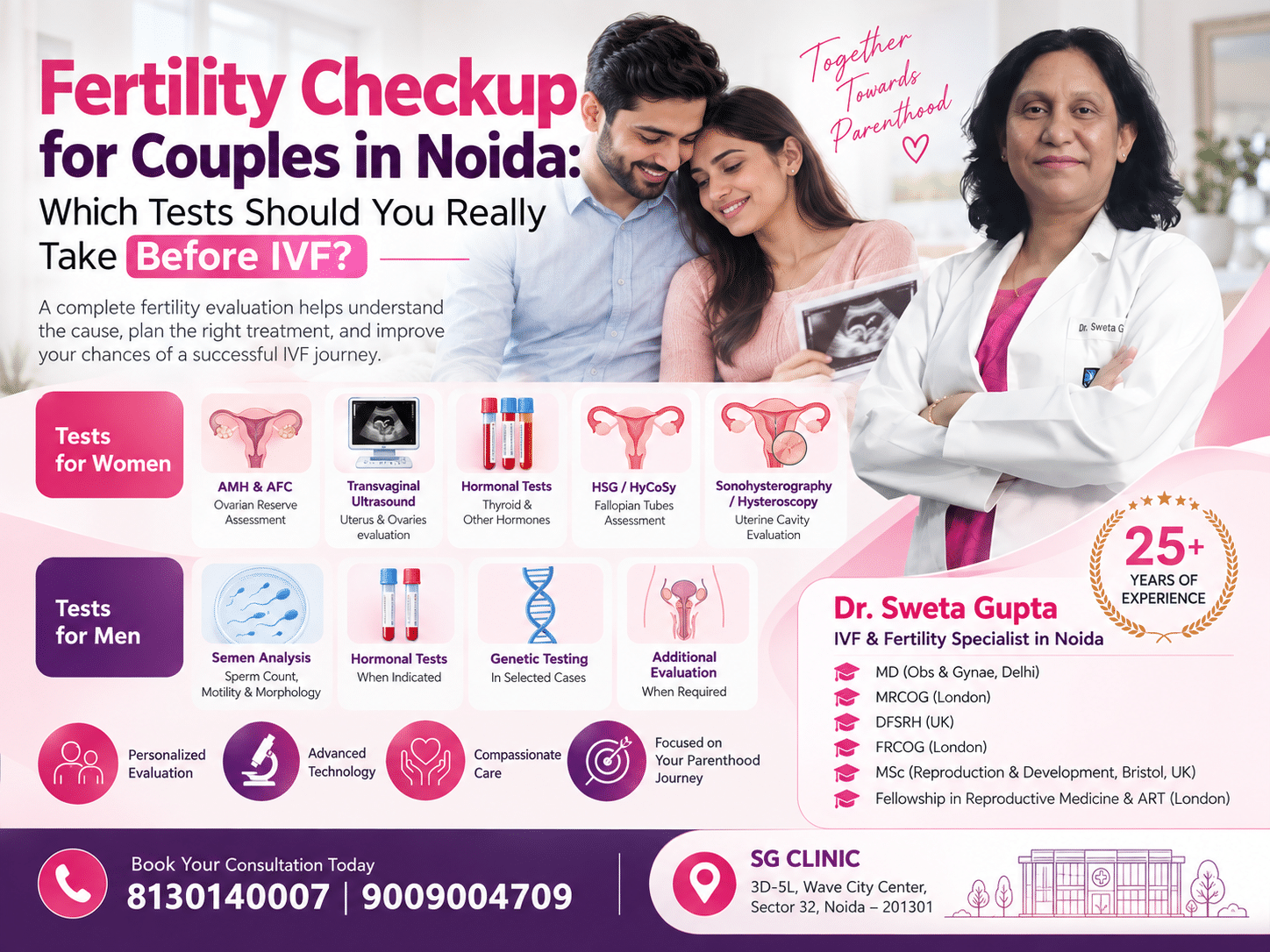
Planning IVF in Noida? Learn which fertility tests are commonly recommended before starting treatment, why both partners should be evaluated, and which tests are only needed in specific situations.
Starting IVF is a major decision, and a proper fertility evaluation can help your fertility specialist understand why conception has been difficult, what factors may affect treatment, and which IVF approach may be appropriate for you.
One important point is often overlooked: fertility evaluation is for both partners—not only the woman. Current professional guidance recommends evaluating male and female partners concurrently, with the male partner typically having a reproductive history and semen analysis as part of the initial assessment.
For couples consulting Dr. Sweta Gupta at SG Clinic, Noida, the exact investigations should be selected according to age, fertility history, menstrual pattern, previous pregnancies or IVF cycles, medical conditions and initial examination findings.
Quick Answer: Which Tests Are Usually Important Before IVF?
For many couples, the pre-IVF evaluation may include:
| Fertility assessment | Common test/assessment | What it helps assess |
|---|---|---|
| Male fertility | Semen analysis | Sperm count, movement and morphology |
| Ovulation | Menstrual history ± targeted testing | Whether ovulation is occurring regularly |
| Ovarian reserve | AMH + Antral Follicle Count (AFC) | Expected ovarian response to stimulation |
| Hormonal evaluation | TSH and other tests when indicated | Thyroid or hormonal factors |
| Pelvic assessment | Transvaginal ultrasound | Uterus, ovaries, follicles and pelvic findings |
| Tubal assessment | HSG or HyCoSy/SHG where appropriate | Whether fallopian tubes are open |
| Uterine cavity | Sonohysterography/hysteroscopy when indicated | Polyps, fibroids, adhesions or cavity abnormalities |
| Medical/pre-IVF investigations | Selected blood tests and screening | Treatment and pregnancy safety |
| Genetic evaluation | Based on history/indication | Certain inherited or chromosomal concerns |
Not every couple needs every test. Professional guidance emphasizes a systematic, individualized evaluation rather than ordering every available fertility test routinely.
Why Should Couples Get a Fertility Checkup Before IVF?
IVF does not eliminate the need to understand the underlying fertility factors.
A fertility assessment can help your doctor evaluate:
- Ovulation
- Ovarian reserve
- Uterine structure
- Fallopian tube status
- Sperm count and quality
- Hormonal factors
- Previous pregnancy or miscarriage history
- Endometriosis or other pelvic conditions
- Previous fertility treatment outcomes
- Medical conditions and medications
- Potential genetic considerations
The goal is not simply to collect a long list of reports. The goal is to identify which findings are clinically relevant and may change the treatment plan.
1. Semen Analysis: One of the Most Important Tests for the Male Partner
Male-factor infertility can contribute to difficulty conceiving, either alone or together with female factors. Therefore, the male partner should generally be evaluated alongside the female partner.
A semen analysis commonly evaluates:
- Sperm concentration/count
- Sperm motility
- Sperm morphology
- Semen volume
- Other semen characteristics
An abnormal result does not automatically mean that natural conception or IVF is impossible. Semen parameters can vary between samples, and results need to be interpreted in the clinical context. If the initial analysis is abnormal, your doctor may recommend repeat testing or additional male fertility evaluation.
When are additional male fertility tests considered?
Depending on the semen report and medical history, a fertility specialist may consider:
- FSH
- Testosterone
- Other reproductive hormones
- Physical examination
- Scrotal evaluation when indicated
- Genetic testing in selected cases, such as severe sperm-production problems
Tests such as sperm DNA fragmentation are not generally recommended as a routine first-line test for every infertile couple; they may be considered in particular clinical situations.
2. AMH Test: What Does It Really Tell You?
AMH (Anti-Müllerian Hormone) is commonly used as an ovarian-reserve marker.
It can help your fertility specialist estimate how the ovaries may respond to ovarian stimulation during IVF.
However, there is an important distinction:
AMH is primarily a marker related to ovarian reserve and expected response to stimulation—it is not a simple “fertility score.”
ASRM notes that ovarian-reserve markers such as AMH and AFC are useful for predicting ovarian response, but they are relatively poor predictors of reproductive potential when considered independently of age.
Therefore, an AMH result should always be interpreted together with:
- Age
- Menstrual history
- Ultrasound findings
- Previous IVF response
- Medical history
- Other fertility factors
3. Antral Follicle Count (AFC)
An AFC is performed through transvaginal ultrasound, usually as part of an ovarian assessment.
The scan allows the fertility specialist to evaluate the number of small antral follicles visible in the ovaries.
AFC and AMH are among the commonly used ovarian-reserve markers and can help with planning ovarian stimulation for IVF.
AMH vs AFC
They provide related but different information.
AMH: Blood test
AFC: Ultrasound assessment
Your fertility specialist may use both along with your age and clinical history rather than relying on a single number.
4. Transvaginal Ultrasound
A transvaginal ultrasound is an important part of many fertility evaluations.
It can help assess:
- Uterus
- Endometrial lining
- Ovaries
- Antral follicles
- Ovarian cysts
- Fibroids
- Adenomyosis-related findings
- Other pelvic abnormalities
It can also provide information relevant to ovulation and ovarian response.
ASRM identifies transvaginal ultrasonography as a useful component of infertility evaluation for assessing ovarian reserve and uterine/adnexal pathology.
5. Ovulation Assessment
Regular menstrual cycles often provide useful information about ovulation.
For women with predictable cycles in the typical range, additional ovulation testing may not always be necessary.
When ovulation is uncertain or cycles are irregular, your doctor may consider targeted investigations such as:
- Progesterone testing
- Ovulation tracking
- Ultrasound monitoring
- Hormonal evaluation
The appropriate test depends on the menstrual history and suspected cause.
6. Thyroid and Other Hormonal Tests
Thyroid disorders can affect reproductive function, so TSH testing may be included when clinically appropriate.
Additional hormonal investigations may be recommended depending on symptoms and menstrual patterns.
For example, prolactin is not recommended as a routine test for every infertility patient, but may be indicated when there is amenorrhea, oligomenorrhea or galactorrhea.
Other hormone tests may be considered when there are signs of:
- Irregular or absent periods
- PCOS
- Hyperandrogenism
- Diminished ovarian function
- Hypothalamic or pituitary disorders
7. HSG: Should You Check the Fallopian Tubes Before IVF?
HSG (Hysterosalpingography) is an imaging test used to evaluate the uterine cavity and whether the fallopian tubes are open.
It can be particularly useful when the fertility specialist needs to assess tubal factors.
Other approaches, including hysterosalpingo-contrast sonography (HyCoSy) or related ultrasound-based techniques, may also be used depending on the patient’s situation and the clinic’s expertise.
Do all IVF patients need HSG?
Not necessarily.
This is an important point.
The relevance of checking tubal patency can depend on:
- Why IVF is being considered
- Previous investigations
- Previous pelvic surgery
- History of ectopic pregnancy
- Endometriosis
- Tubal disease
- Previous IVF/IUI treatment
- Whether the result would change management
Your fertility specialist can determine whether an HSG or another tubal assessment is useful in your case.
8. Uterine Cavity Evaluation
A healthy-looking uterus on a standard ultrasound does not always provide a complete assessment of the uterine cavity.
When clinically indicated, your doctor may recommend:
Sonohysterography
A saline-based ultrasound technique that can help identify abnormalities within the uterine cavity.
Hysteroscopy
A thin camera is introduced through the cervix to directly visualize the uterine cavity.
These investigations may help identify conditions such as:
- Endometrial polyps
- Submucosal fibroids
- Intrauterine adhesions
- Other cavity abnormalities
Not every IVF patient requires hysteroscopy. The decision should be based on symptoms, ultrasound findings, previous history and treatment planning.
9. Genetic Testing: Is It Necessary Before IVF?
Genetic testing is not automatically required for every couple simply because they are undergoing IVF.
However, genetic counselling or testing may become relevant when there is:
- A known inherited disorder in the family
- Previous pregnancy affected by a genetic condition
- Recurrent pregnancy loss in particular circumstances
- Severe male-factor infertility with specific indications
- A known parental genetic variant
- A need to consider specific forms of preimplantation genetic testing
Genetic testing decisions should therefore be individualized rather than treated as a standard checklist for every IVF patient.
10. Pre-IVF Blood Tests and Health Screening
Depending on the clinic protocol, medical history and planned treatment, your doctor may recommend additional blood investigations before IVF.
These can include selected:
- Blood group and related testing
- Infectious-disease screening
- CBC or other general blood tests
- Thyroid testing
- Blood sugar/HbA1c where indicated
- Other tests based on medical history
The exact pre-IVF panel varies according to the patient and treatment plan. Therefore, it is better to bring your existing reports to your fertility consultation rather than repeating every test independently.
Tests You May NOT Need Routinely Before IVF
More testing does not necessarily mean better fertility care.
ASRM’s infertility evaluation guidance lists several investigations that should not routinely be ordered without a specific indication, including:
- Sperm DNA fragmentation testing
- Immunologic testing
- Thrombophilia testing
- Post-coital testing
- Endometrial biopsy
- Routine laparoscopy solely for unexplained infertility
- Certain hormone tests without an appropriate clinical indication
The appropriate investigation depends on the patient’s history and clinical findings.
What Is the Ideal Pre-IVF Fertility Checkup for a Couple?
A practical evaluation can be thought of as four major areas:
For the woman
1. Ovaries
- AMH
- AFC
- Transvaginal ultrasound
- Other hormonal tests when indicated
2. Ovulation
- Menstrual history
- Ovulation assessment when required
3. Uterus
- Ultrasound
- Additional cavity assessment if indicated
4. Fallopian tubes
- HSG/HyCoSy or another appropriate assessment when relevant
For the man
5. Sperm
- Semen analysis
- Repeat semen analysis if required
6. Additional male evaluation
- Hormonal/genetic/physical evaluation when indicated
This approach helps the fertility specialist understand the complete reproductive picture rather than focusing only on the female partner.
When Should Couples in Noida Consider a Fertility Evaluation?
Generally, infertility evaluation is recommended after:
- 12 months of regular unprotected intercourse if the woman is under 35
- 6 months if the woman is 35 or older
- More immediate evaluation may be appropriate after age 40
Evaluation should also be considered earlier when there are known risk factors such as irregular/absent periods, suspected endometriosis or tubal disease, previous pelvic problems, known male-factor infertility, or other conditions associated with reduced fertility.
Why You Should Not Order Every Fertility Test Yourself
A common mistake is searching online for an “IVF test package” and getting every available investigation done before seeing a fertility specialist.
This can lead to:
- Unnecessary expenses
- Confusing results
- Repeated tests
- Anxiety over isolated abnormal values
- Investigations that do not change treatment
For example, a low AMH does not by itself mean that pregnancy is impossible, and ovarian-reserve tests should not be interpreted independently of age and the overall clinical picture.
The right test is the test that answers a relevant clinical question.
Fertility Checkup in Noida with Dr. Sweta Gupta
If you are considering IVF or have been trying to conceive without success, Dr. Sweta Gupta can evaluate both partners and help determine which fertility investigations are appropriate before treatment.
Dr. Sweta Gupta
25+ years of experience in Obstetrics, Gynaecology & Reproductive Medicine
Qualifications:
- MD (Obs & Gynae, Delhi)
- MRCOG (London)
- DFSRH (UK)
- FRCOG (London)
- MSc (Reproduction & Development), Bristol, UK
- Fellowship in Reproductive Medicine & ART, London
SG Clinic, Noida
Address:
3D-5L, Wave City Center, Sector 32, Noida – 201301
For appointments:
📞 8130140007 | 9009004709
If you already have fertility reports, semen analysis, AMH, ultrasound, HSG or previous IVF reports, take them with you for your consultation. Your doctor can determine which investigations are still relevant and which do not need to be repeated.
Frequently Asked Questions About Fertility Tests Before IVF
1. What tests should a couple take before IVF?
A typical fertility evaluation may include semen analysis for the male partner, ovarian-reserve assessment such as AMH/AFC, pelvic ultrasound, assessment of ovulation and selected hormonal tests. Tubal and uterine-cavity investigations are recommended when clinically appropriate. Not every couple needs every test.
2. Is AMH necessary before IVF?
AMH can be useful for estimating ovarian response to stimulation, but it is not a standalone test of whether a woman can become pregnant. It should be interpreted alongside age, ultrasound findings and the overall fertility history.
3. Does the husband need a fertility test before IVF?
Yes, male-factor evaluation is an important part of the couple’s fertility assessment. A semen analysis is generally included in the initial male evaluation.
4. Is semen analysis enough to evaluate male fertility?
Semen analysis is an important starting test, but additional evaluation may be required when the result is abnormal or when symptoms/history suggest a male reproductive problem.
5. Is HSG required before IVF?
Not for every patient. HSG or another assessment of tubal patency may be recommended depending on the woman’s history, previous investigations and whether the result could affect treatment planning.
6. Is hysteroscopy compulsory before IVF?
No. Hysteroscopy is generally considered when there is a clinical reason to evaluate the uterine cavity, such as a suspected abnormality or particular treatment history.
7. Should I get sperm DNA fragmentation testing before IVF?
It is not recommended as a routine first-line test for every infertile couple. It may be considered in selected circumstances, depending on the clinical history.
8. Can a low AMH mean I cannot get pregnant?
No. A low ovarian-reserve marker does not by itself mean that pregnancy is impossible. AMH and AFC primarily provide information about ovarian reserve and expected response to stimulation; age and the overall clinical picture remain important.
9. Should both partners be tested at the same time?
Yes. Professional guidance supports concurrent evaluation of both partners because infertility can involve male factors, female factors, or a combination of both.
10. When should I see a fertility specialist in Noida?
If pregnancy has not occurred after 12 months of trying when the woman is under 35, or after 6 months when she is 35 or older, fertility evaluation is generally recommended. Earlier evaluation may be appropriate when there are known fertility risk factors or the woman is over 40.
11. How long does a fertility evaluation take?
Many infertility evaluations can be completed over a few menstrual cycles, although the exact time depends on the tests required and the couple’s medical history.
12. Can I bring my old fertility reports to my IVF consultation?
Yes. Previous AMH reports, semen analyses, ultrasound scans, HSG reports, hormonal tests, operative reports and previous IVF records can help your fertility specialist decide which investigations are still needed.
Final Takeaway
Before IVF, the goal is not to take every fertility test available. The goal is to identify the tests that can meaningfully guide your treatment.
For most couples, this means evaluating both partners, with attention to semen parameters, ovulation, ovarian reserve, pelvic anatomy and other factors based on individual history.
If you are looking for a fertility checkup in Noida before IVF, consult a fertility specialist who can review your complete history and recommend an individualized investigation plan.
Dr. Sweta Gupta | SG Clinic, Noida
📞 8130140007 | 9009004709
📍 3D-5L, Wave City Center, Sector 32, Noida – 201301