

When you begin searching for IVF treatment in Delhi NCR, you may come across hundreds of IVF clinics, fertility hospitals and specialist doctors. Some advertise advanced laboratories, while others highlight experienced fertility specialists, high IVF success rates or affordable treatment packages. This can make it difficult to decide where to begin.
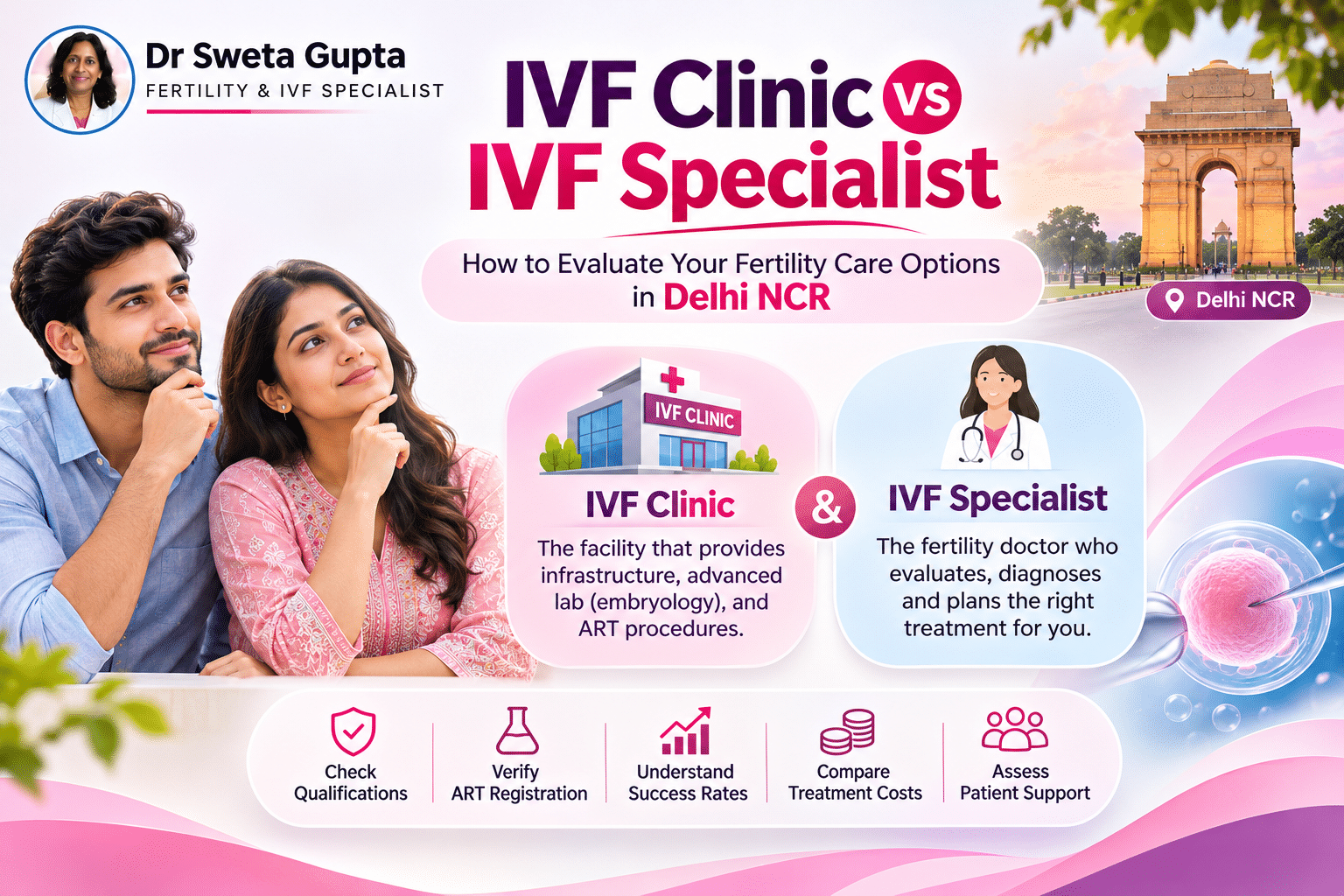
The important thing to understand is that an IVF clinic and an IVF specialist perform different but complementary roles. An IVF specialist is the medical professional who evaluates infertility, diagnoses possible causes, recommends treatment and guides your fertility journey. An IVF clinic is the healthcare facility that provides the infrastructure, laboratory services, medical team and assisted reproductive technology procedures.
Choosing the right fertility care means evaluating both the doctor and the facility where your treatment will take place.
For couples considering IVF treatment in Delhi, Noida, Greater Noida, Ghaziabad, Gurugram or Faridabad, it is important to check the doctor’s qualifications, clinical experience, ART clinic registration, embryology laboratory standards, treatment transparency and patient communication.
Dr. Sweta Gupta is an internationally trained fertility specialist with qualifications including MD in Obstetrics and Gynaecology, MRCOG, FRCOG, DFSRH, MSc in Reproduction and Development from the University of Bristol, UK, and fellowship training in Reproductive Medicine and Assisted Reproductive Technology in London.
This guide explains the difference between an IVF clinic and an IVF specialist, what to check before choosing fertility care, and how to make a more informed decision.
Quick answer: An IVF specialist evaluates your fertility condition and recommends treatment, while an IVF clinic provides the medical infrastructure and laboratory facilities needed for assisted reproduction. Before starting IVF, evaluate the doctor’s qualifications and treatment approach as well as the registration, laboratory standards, safety practices and transparency of the facility performing the procedure.
What Is the Difference Between an IVF Clinic and an IVF Specialist?
Although the terms are often used together, an IVF clinic and an IVF specialist are not the same.
An IVF specialist is a qualified medical professional who evaluates and manages fertility-related conditions. An IVF clinic is an institution that provides fertility services and, where appropriately registered and equipped, assisted reproductive technology procedures.
| Comparison | IVF specialist | IVF clinic |
|---|---|---|
| Meaning | Fertility doctor with relevant medical training and expertise | Healthcare facility providing fertility and ART services |
| Main responsibility | Diagnosis, treatment planning and medical supervision | Clinical infrastructure, laboratory and treatment facilities |
| Patient evaluation | Reviews medical history and fertility reports | Coordinates investigations and treatment services |
| IVF planning | Recommends an appropriate treatment protocol | Supports treatment through its clinical and laboratory teams |
| Medical monitoring | Reviews treatment response and patient progress | Provides monitoring facilities and clinical support |
| Laboratory services | Works with embryologists and laboratory teams | Provides or coordinates embryology laboratory services |
| Patient relationship | Guides medical decisions and counselling | Coordinates appointments, procedures and follow-up services |
Which one is more important: the doctor or the clinic?
Both are important.
An experienced fertility specialist can help identify the underlying cause of infertility and recommend appropriate treatment. However, IVF also depends on laboratory processes, equipment, embryology expertise, infection-control measures and coordinated clinical care.
A well-equipped clinic also needs qualified medical professionals who can make appropriate treatment decisions.
The best approach is to choose a qualified fertility specialist who works with a properly registered and suitable ART facility.
What Does an IVF Specialist Actually Do?
An IVF specialist plays a central role in evaluating infertility and guiding patients through different fertility treatment options.
The doctor’s responsibilities may include:
1. Identifying the cause of infertility
Infertility can result from several factors, including:
- Ovulation disorders such as PCOS.
- Reduced ovarian reserve.
- Age-related fertility changes.
- Blocked or damaged fallopian tubes.
- Endometriosis.
- Male-factor infertility.
- Uterine abnormalities.
- Unexplained infertility.
- Combined male and female fertility factors.
The specialist evaluates both partners rather than automatically assuming that the problem lies with the woman.
2. Reviewing fertility investigations
Depending on the patient’s history, investigations may include:
- AMH testing.
- Antral follicle count through ultrasound.
- FSH and other relevant hormone tests.
- Pelvic ultrasound.
- Semen analysis.
- Tubal assessment where indicated.
- Uterine cavity evaluation when required.
- Selected infection screening and other pre-treatment tests.
Not every patient needs every investigation. The doctor decides which tests are appropriate.
3. Recommending suitable fertility treatment
IVF is not automatically the first treatment for every couple.
Depending on the diagnosis, the specialist may discuss:
- Natural conception with appropriate guidance.
- Ovulation induction.
- Intrauterine insemination (IUI).
- In vitro fertilisation (IVF).
- IVF with intracytoplasmic sperm injection (ICSI).
- Fertility preservation.
- Other medically appropriate options.
4. Monitoring the treatment cycle
During IVF, the doctor supervises ovarian stimulation, reviews ultrasound and blood-test findings, determines when egg retrieval should take place and coordinates subsequent treatment decisions.
5. Explaining results and next steps
The specialist should explain egg retrieval results, fertilisation, embryo development, transfer planning and pregnancy testing.
If a cycle is unsuccessful, the doctor should review the findings and discuss whether any changes to the treatment plan are medically justified.
What Does an IVF Clinic Provide?
An IVF clinic provides the healthcare environment and services required for fertility assessment and treatment.
The services available vary between facilities. Some centres offer consultation and diagnostic services, while others provide complete ART procedures.
Important facilities and services may include:
1. Fertility consultation and diagnostic services
These help evaluate the reproductive health of both partners and identify possible causes of infertility.
2. Ultrasound and monitoring facilities
Ultrasound monitoring helps assess follicular development and other reproductive structures during fertility treatment.
3. Embryology laboratory
The embryology laboratory is a critical part of IVF. Depending on the treatment offered, laboratory procedures may include:
- Egg identification and assessment.
- Sperm preparation.
- Conventional fertilisation.
- ICSI when indicated.
- Embryo culture and monitoring.
- Embryo freezing and storage.
- Preparation for embryo transfer.
4. Qualified embryology professionals
Embryologists are responsible for specialised laboratory procedures and embryo handling. Ask about the qualifications, experience and availability of the embryology team.
5. Egg retrieval and embryo transfer facilities
An ART facility should have appropriate arrangements for procedures, anaesthesia or sedation where required, recovery and patient monitoring.
6. Patient counselling and support
Fertility treatment can involve emotional, physical and financial challenges. Clear communication and access to appropriate counselling are important parts of patient care.
How to Choose the Right IVF Specialist in Delhi NCR
Selecting an IVF specialist should involve more than checking advertisements, social media reviews or claims of high success rates.
Consider the following factors before making your decision.
1. Check the doctor’s medical qualifications
Look for a recognised medical qualification in obstetrics and gynaecology and relevant training or experience in reproductive medicine and infertility management.
Useful questions include:
- What are the doctor’s medical qualifications?
- Does the doctor have relevant fertility or reproductive medicine training?
- Is the doctor registered with the appropriate medical council?
- Does the doctor regularly manage the fertility conditions relevant to your case?
Qualifications and professional registration can help establish whether the doctor has the appropriate medical background.
2. Evaluate relevant clinical experience
Experience should be relevant to the fertility condition being treated.
For example, a patient with low AMH may need counselling about ovarian reserve and expected ovarian response. A couple with severe male-factor infertility may need evaluation involving an andrology team and discussion of ICSI where appropriate.
Ask whether the doctor regularly manages your particular fertility concern.
3. Look for individualised treatment planning
Every fertility case is different.
A responsible specialist should consider:
- Age of the woman.
- Ovarian reserve.
- Menstrual and ovulation history.
- Sperm health.
- Uterine and tubal conditions.
- Previous pregnancies.
- Previous IUI or IVF treatment.
- Relevant medical conditions.
Be cautious if the same IVF protocol is recommended to every patient without reviewing individual reports.
4. Evaluate communication and accessibility
Fertility treatment involves several stages and decisions. Your doctor should be able to explain investigations, medication, possible risks, treatment alternatives and expected timelines in language you understand.
You should feel comfortable asking questions and discussing concerns.
5. Ask who will supervise your treatment
Some clinics have multiple doctors, rotating consultants or separate teams for consultation and procedures.
Before beginning treatment, clarify:
- Who will review your reports?
- Who will decide the stimulation protocol?
- Who will monitor your treatment?
- Who will perform or supervise egg retrieval and embryo transfer?
- Who will explain the laboratory results?
Understanding the care team helps avoid confusion during the treatment cycle.
How to Choose the Right IVF Clinic in Delhi NCR
Once you have shortlisted a fertility specialist, evaluate the facility where your treatment will be performed.
1. Verify ART clinic registration
This is one of the most important checks in India.
Under the Assisted Reproductive Technology (Regulation) Act, 2021, ART clinics and ART banks must be registered under the applicable regulatory framework.
The National ART and Surrogacy Registry, maintained under the Department of Health Research, Ministry of Health and Family Welfare, provides a public record of ART clinics and banks.
Before starting IVF, ask the facility for:
- Its ART registration certificate.
- Its registration number.
- Its registered address.
- The level of ART facility, where applicable.
- Confirmation that the registration covers the services being offered.
You can check the official registry here:
https://registry.artsurrogacy.gov.in/
A consultation clinic and an ART facility performing IVF procedures may not be the same establishment. If your doctor refers you to another registered ART centre for procedures, ask for the name, address and registration details of that centre.
2. Understand the embryology laboratory facilities
Ask about the laboratory where fertilisation and embryo culture will take place.
Important considerations include:
- Laboratory infrastructure and environmental controls.
- Embryo culture and monitoring systems.
- Equipment maintenance and quality-control procedures.
- Embryo identification and traceability.
- Cryopreservation and storage arrangements.
- Laboratory staffing and embryologist qualifications.
You do not need to evaluate technical equipment yourself, but the clinic should be able to explain its laboratory processes clearly.
3. Check emergency and safety arrangements
IVF involves medication, monitoring and medical procedures. The facility should have suitable arrangements for managing complications and referring patients for additional medical care when needed.
Ask about:
- Anaesthesia or sedation arrangements.
- Emergency medical support.
- Management of ovarian hyperstimulation syndrome (OHSS).
- Infection prevention.
- Post-procedure observation.
- Emergency contact arrangements.
4. Ask about the complete treatment cost
A low advertised IVF package may not include every required service.
Request a written estimate that explains whether the following are included:
- Initial consultation.
- Diagnostic investigations.
- Stimulation medication.
- Ultrasound and blood-test monitoring.
- Egg retrieval.
- Anaesthesia or sedation.
- Laboratory fertilisation.
- ICSI, if medically indicated.
- Embryo culture.
- Embryo transfer.
- Embryo freezing and storage.
- Frozen embryo transfer.
- Additional procedures, if required.
Ask what happens financially if a cycle is cancelled, fewer eggs are retrieved or another transfer becomes necessary.
5. Review patient counselling and transparency
A good fertility centre should explain the proposed treatment, expected limitations, risks and alternatives before asking you to proceed.
Be cautious if you experience pressure to purchase a package immediately or are promised guaranteed pregnancy.
IVF Clinic vs IVF Specialist: Which Should You Choose First?
The answer depends on your current stage in the fertility journey.
| Your situation | Recommended starting point |
|---|---|
| You have been trying to conceive without success | Fertility specialist consultation |
| You have a low AMH report | Fertility specialist for ovarian reserve assessment |
| Your partner has abnormal semen analysis | Fertility specialist with appropriate male-factor evaluation |
| You have already undergone unsuccessful IVF | Specialist review of previous treatment records |
| You want to compare IVF centres | Verify ART registration, laboratory facilities and treatment transparency |
| You are considering IVF for the first time | Consult a specialist and understand where the actual ART procedures will be performed |
| You need a second opinion | Seek an independent review of reports and the proposed treatment plan |
Practical recommendation: Start with a qualified fertility specialist who can evaluate both partners and explain whether IVF is appropriate. Then assess the ART facility where the procedures will take place.
What IVF Success Rate Should You Ask About?
One of the most common mistakes when comparing IVF clinics is comparing success percentages without understanding what those numbers represent.
A clinic may advertise a high pregnancy rate, but that figure may not represent the chance of taking home a baby.
Ask the clinic to explain the following:
Clinical pregnancy rate
This generally refers to pregnancies confirmed by ultrasound, according to the clinic’s reporting definition.
Live-birth rate
This measures the proportion of treatment cycles or patients resulting in a live birth, according to the stated denominator.
Success per embryo transfer
This measures outcomes among transfers that actually took place. It does not include patients whose cycles were cancelled or who did not reach embryo transfer.
Cumulative success rate
This may include outcomes from more than one embryo transfer arising from a treatment cycle or egg retrieval. Ask exactly how it is calculated and over what time period.
Why does age matter when comparing IVF success rates?
Age, especially the age of the person providing the eggs, is an important factor in reproductive outcomes.
Other factors include:
- Ovarian reserve and response.
- Embryo development.
- Sperm-related factors.
- Uterine health.
- Previous fertility treatment.
- Medical history.
- Laboratory and clinical practices.
A meaningful comparison should use similar patient age groups, treatment types and outcome definitions.
Do not rely on a single success percentage without understanding the underlying data.
What Are the Warning Signs When Selecting an IVF Clinic?
Be cautious if a clinic or service provider:
- Guarantees pregnancy or a baby.
- Refuses to explain its ART registration details.
- Does not clearly identify the doctor responsible for treatment.
- Recommends IVF without an appropriate fertility assessment.
- Does not explain the role of male-factor infertility.
- Advertises success rates without explaining the measurement.
- Does not provide a clear cost breakdown.
- Pressures patients to pay for immediate treatment.
- Recommends additional procedures without explaining the medical indication.
- Avoids discussing treatment risks or possible cycle cancellation.
These are reasons to ask further questions or seek another professional opinion.
What Questions Should You Ask During Your First IVF Consultation?
Preparing questions before your appointment can help you understand the treatment plan.
| Question | Why it matters |
|---|---|
| What could be causing our infertility? | Helps identify the likely diagnosis |
| Do both partners need testing? | Ensures male and female factors are considered |
| Is IVF necessary in our case? | Helps understand alternatives |
| What treatment options are available? | Allows informed comparison |
| Who will monitor my IVF cycle? | Clarifies medical responsibility |
| Where will egg retrieval and embryo transfer take place? | Identifies the actual ART facility |
| Is the ART centre registered? | Helps verify regulatory compliance |
| How is the IVF success rate calculated? | Makes outcome comparisons more meaningful |
| What is included in the treatment cost? | Reduces unexpected expenses |
| What are the possible risks? | Supports informed consent |
| What happens if the first cycle is unsuccessful? | Helps prepare for possible next steps |
IVF Treatment in Delhi NCR: What Should Patients Consider?
Delhi NCR includes several locations with fertility consultation and ART services, including:
- Delhi.
- Noida.
- Greater Noida.
- Ghaziabad.
- Gurugram.
- Faridabad.
When selecting a fertility specialist or clinic, location and travel convenience matter, particularly because IVF treatment involves repeated appointments for ultrasound monitoring, blood tests, medication reviews and procedures.
However, convenience should not be the only selection factor.
Consider:
- Whether the doctor is accessible during the treatment cycle.
- How far you need to travel for monitoring.
- Whether procedures take place at the consultation location or another ART centre.
- Whether emergency support is available.
- Whether the facility provides clear appointment and follow-up arrangements.
A clinic closer to home may be convenient, but the qualifications of the doctor, ART registration, laboratory quality and patient safety should remain important priorities.
Why Consider Dr. Sweta Gupta for Fertility Consultation?
Dr. Sweta Gupta is an internationally trained fertility specialist with academic qualifications and professional training in obstetrics and gynaecology, reproductive health and assisted reproductive technology.
Her qualifications include:
- MD (Obstetrics and Gynaecology), Delhi
- MRCOG (London)
- FRCOG (London)
- DFSRH (UK)
- MSc in Reproduction and Development, University of Bristol, UK
- Fellowship in Reproductive Medicine and Assisted Reproductive Technology, London
Her training provides a foundation for evaluating reproductive health concerns and discussing fertility treatment options based on individual medical findings.
For patients searching for an IVF specialist in Delhi NCR, Dr. Sweta Gupta can help review fertility reports, understand possible causes of infertility, discuss relevant investigations and explain suitable treatment options.
A fertility consultation may be useful for patients concerned about:
- Low AMH and reduced ovarian reserve.
- PCOS and ovulation problems.
- Age-related fertility changes.
- Recurrent pregnancy loss.
- Male-factor infertility.
- Blocked fallopian tubes.
- Unexplained infertility.
- Previous unsuccessful fertility treatment.
- IVF and ICSI treatment options.
The appropriate treatment depends on the patient’s complete clinical assessment.
Where can you consult Dr. Sweta Gupta?
Clinic: SG Clinic
Address: 3D-5L, Wave City Center, Sector 32, Noida, Uttar Pradesh 201301
Appointment contact:
- 8130140007
- 9009004709
Patients should confirm current appointment availability and the location where any recommended ART procedures will be performed before beginning treatment.
Frequently Asked Questions About IVF Clinics and IVF Specialists
1. What is the difference between an IVF clinic and an IVF specialist?
An IVF specialist is a medical professional who evaluates infertility and recommends treatment. An IVF clinic is a healthcare facility providing fertility services and, where registered and equipped, ART procedures such as IVF, ICSI, embryo culture and embryo transfer.
2. Should I choose an IVF doctor or an IVF clinic first?
Start with a qualified fertility specialist who can evaluate both partners and explain the available treatment options. Then verify the ART facility where the actual procedures will take place. Both the doctor and the facility are important.
3. How do I choose the best IVF specialist in Delhi NCR?
Check medical qualifications, relevant fertility training, professional registration, experience with your condition, treatment approach, communication and transparency. Avoid choosing a doctor based only on advertisements or unsupported success-rate claims.
4. How can I verify whether an IVF clinic is registered in India?
You can use the National ART and Surrogacy Registry maintained under the Department of Health Research, Ministry of Health and Family Welfare. Ask the clinic for its ART registration certificate and verify its details using the official registry.
5. Is every fertility clinic an IVF centre?
No. Some fertility clinics provide consultation, diagnosis and basic fertility services but may not have their own embryology laboratory or facilities to perform IVF. Ask where egg retrieval, fertilisation, embryo culture and embryo transfer will take place.
6. Does an IVF specialist need to work at the same clinic where IVF is performed?
Not necessarily. A fertility specialist may consult patients at one location and coordinate IVF procedures at a separate registered ART centre. Patients should know which doctor is responsible for treatment and which facility will perform the procedures.
7. How can I compare IVF success rates between clinics?
Ask whether the clinic reports clinical pregnancy, live birth, success per transfer or cumulative outcomes. Compare figures for similar age groups and treatment types, and ask about the denominator and reporting period.
8. Does a high IVF success rate guarantee pregnancy?
No. IVF outcomes vary according to age, ovarian response, embryo development, sperm health, uterine conditions and other factors. No clinic or doctor can guarantee pregnancy or live birth.
9. What qualifications should an IVF specialist have?
Look for a recognised medical qualification in obstetrics and gynaecology, appropriate professional registration and relevant training or experience in reproductive medicine and fertility management. The qualifications of the embryology and laboratory team should also be considered when assessing the ART facility.
10. Is a more expensive IVF clinic always better?
No. Higher treatment costs do not automatically indicate better clinical care. Evaluate the doctor’s qualifications, ART registration, laboratory processes, safety standards, treatment transparency and the services included in the price.
11. Can I get a second opinion before starting IVF?
Yes. A second opinion can help you understand your diagnosis, review previous reports, assess the proposed treatment plan and discuss alternatives. Bring your investigation results and previous treatment records.
12. Is an IVF consultation the same as starting IVF treatment?
No. An initial consultation usually involves reviewing medical history, discussing fertility concerns and deciding which investigations may be needed. IVF treatment begins only after the clinical evaluation, counselling, consent and treatment planning.
Final Thoughts: Choose the Right Fertility Doctor and the Right IVF Facility
Choosing between an IVF clinic and an IVF specialist should not be an either-or decision. Both contribute to the quality and safety of fertility care.
The doctor helps identify the cause of infertility, evaluates both partners and recommends a treatment plan. The registered ART facility provides the infrastructure, laboratory services and clinical support required to perform assisted reproductive procedures.
Before starting IVF treatment in Delhi NCR, verify the doctor’s qualifications, ask about the actual ART centre, check its registration, understand laboratory and safety arrangements, review the cost breakdown and ask how success rates are calculated.
Most importantly, choose a fertility team that explains your condition honestly, respects your decisions and recommends treatment based on your individual medical needs.
If you are planning pregnancy or considering IVF, consult a qualified fertility specialist to understand your options and take the next step with informed guidance.