

Infertility treatment has evolved significantly over the last two decades. Today, couples undergoing IVF have access to advanced technologies that help fertility specialists make more informed decisions and improve treatment outcomes. One such advancement is Preimplantation Genetic Testing (PGT).
Many couples considering IVF often wonder whether genetic testing can increase their chances of achieving a healthy pregnancy. While PGT is not necessary for every IVF cycle, it can be particularly beneficial for selected patients, especially those with recurrent IVF failures, recurrent miscarriages, advanced maternal age, or a known risk of genetic disorders.
As an experienced IVF Specialist in Noida, Dr. Sweta Gupta frequently counsels couples regarding the role of PGT in modern fertility treatment and how it may contribute to better embryo selection and improved reproductive outcomes.
This comprehensive guide explains how PGT works, who may benefit from it, and how it may improve IVF success rates for selected couples.
What is PGT in IVF?
PGT stands for Preimplantation Genetic Testing.
It is an advanced laboratory procedure performed during an IVF cycle to analyze embryos before they are transferred into the uterus.
The purpose of PGT is to identify embryos with specific genetic characteristics, allowing fertility specialists to make more informed embryo selection decisions.
Types of PGT
There are three primary forms of genetic testing used in IVF:
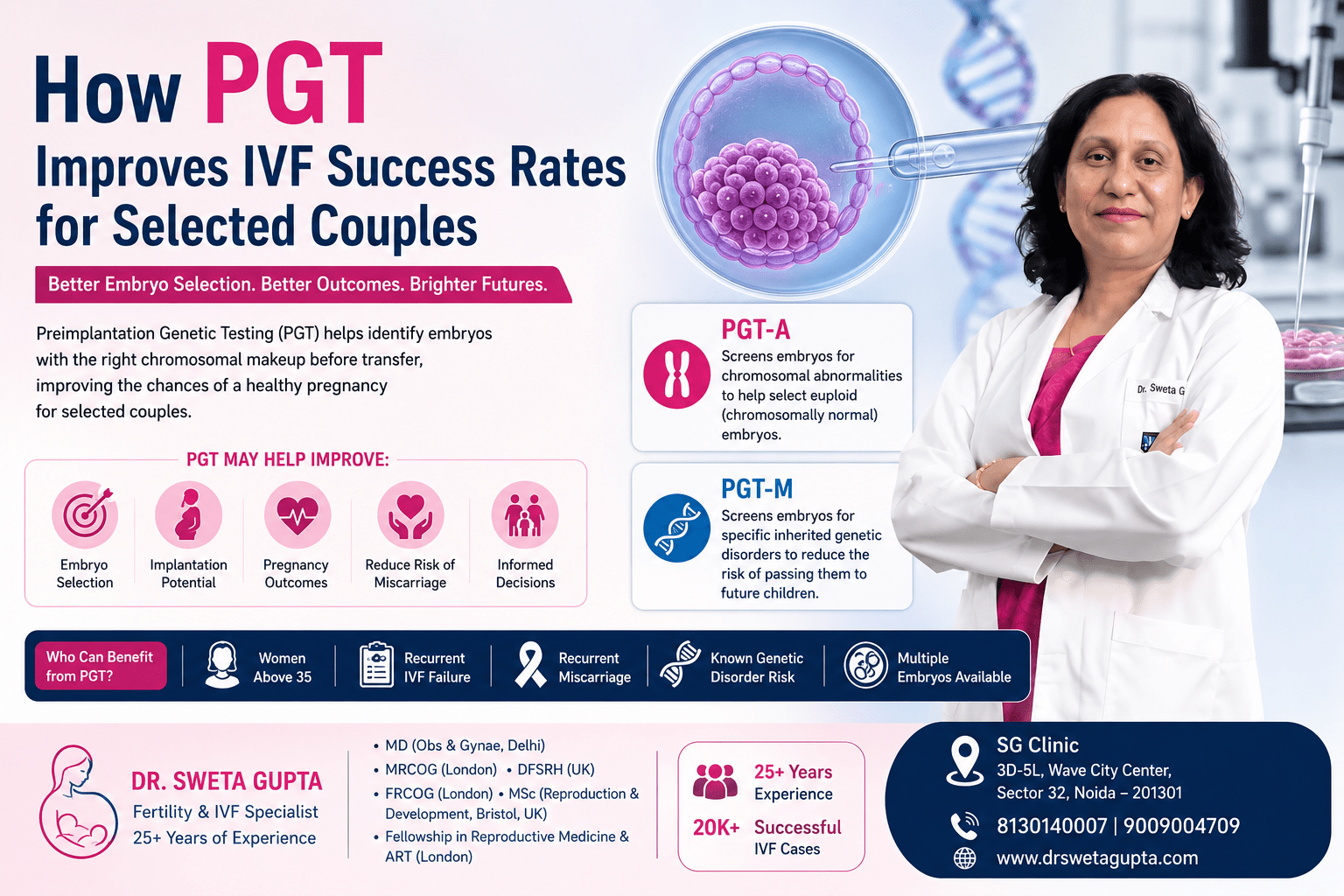
PGT-A
Preimplantation Genetic Testing for Aneuploidy
This test screens embryos for chromosomal abnormalities.
PGT-M
Preimplantation Genetic Testing for Monogenic Disorders
This test identifies specific inherited genetic diseases.
PGT-SR
Preimplantation Genetic Testing for Structural Rearrangements
This test evaluates chromosomal structural abnormalities.
Among these, PGT-A is the most commonly discussed in relation to IVF success rates.
Understanding Chromosomes and Embryo Health
To understand the value of PGT, it is important to understand chromosomes.
Every healthy human cell typically contains 46 chromosomes.
These chromosomes contain the genetic instructions that influence growth, development, and overall health.
When an embryo has too many or too few chromosomes, it is called an aneuploid embryo.
Chromosomal abnormalities can result in:
- Failed implantation
- Early miscarriage
- Recurrent pregnancy loss
- IVF failure
- Genetic disorders
PGT-A helps identify these abnormalities before embryo transfer.
Why IVF Success Rates Vary Among Couples
Many factors influence IVF outcomes.
Female Age
Age remains one of the most important factors affecting fertility.
As women age, the proportion of chromosomally abnormal eggs increases.
Egg Quality
Healthy eggs contribute to healthy embryos.
Sperm Quality
Male fertility factors also influence embryo development.
Uterine Environment
Successful implantation depends on a receptive uterine lining.
Embryo Genetics
Even visually healthy embryos may carry chromosomal abnormalities that cannot be detected through standard microscopy.
This is where genetic testing may offer additional insights.
How PGT Works During an IVF Cycle
Step 1: Ovarian Stimulation
The ovaries are stimulated to produce multiple mature eggs.
Step 2: Egg Retrieval
Eggs are collected through a minimally invasive procedure.
Step 3: Fertilization
Eggs are fertilized using IVF or ICSI.
Step 4: Blastocyst Development
Embryos are cultured until Day 5 or Day 6.
Step 5: Embryo Biopsy
A few cells are removed from the embryo’s outer layer.
Step 6: Genetic Analysis
The cells are tested in a specialized laboratory.
Step 7: Embryo Selection
Results help identify embryos suitable for transfer based on genetic findings.
Step 8: Frozen Embryo Transfer
Most PGT-tested embryos are frozen and transferred later during a carefully prepared cycle.
How PGT Improves IVF Success Rates for Selected Couples
The primary benefit of PGT is improved embryo selection.
Instead of choosing embryos solely based on appearance, fertility specialists receive additional genetic information.
Improved Identification of Chromosomally Normal Embryos
Embryos may appear healthy under a microscope but still contain chromosomal abnormalities.
PGT helps identify embryos with the correct chromosome number.
Reduced Risk of Implantation Failure
Chromosomal abnormalities are a common cause of failed implantation.
By identifying embryos without these abnormalities, PGT may improve the efficiency of embryo transfer decisions.
Reduced Risk of Miscarriage
A significant percentage of miscarriages are associated with chromosomal abnormalities.
PGT can help identify embryos less likely to carry these abnormalities.
Better Use of Available Embryos
When multiple embryos are available, genetic testing can provide valuable information regarding embryo selection.
Improved Confidence During Treatment
Many couples appreciate having additional information about embryo genetics before proceeding with transfer.
Which Couples May Benefit Most from PGT?
PGT is not recommended for every IVF patient.
However, certain groups may benefit more than others.
Women Above 35 Years
The likelihood of chromosomal abnormalities increases with maternal age.
PGT may assist in embryo selection for women in advanced reproductive age groups.
Recurrent IVF Failure
Couples who have experienced multiple unsuccessful IVF cycles may discuss PGT as part of their treatment strategy.
Recurrent Miscarriage
Repeated pregnancy loss may sometimes be linked to chromosomal abnormalities.
PGT can provide additional information about embryo genetics.
Known Genetic Disease Risk
Couples with inherited genetic conditions may benefit from PGT-M.
Multiple Embryos Available
When several embryos are available, genetic testing can assist in selecting embryos for transfer.
PGT and Advanced Maternal Age
One of the most common reasons couples consider PGT is maternal age.
Fertility Decline After 35
As women age:
- Egg quantity declines
- Egg quality decreases
- Chromosomal abnormalities increase
This is a natural biological process.
Impact on IVF Outcomes
Age-related chromosomal abnormalities can contribute to:
- Lower implantation rates
- Higher miscarriage rates
- Reduced live birth rates
PGT provides additional information that may assist in embryo selection for older patients.
PGT and Recurrent Pregnancy Loss
Experiencing multiple miscarriages can be emotionally devastating.
In many cases, embryo chromosomal abnormalities may contribute to pregnancy loss.
How PGT Helps
PGT-A allows embryos to be screened for chromosomal abnormalities before transfer.
This information may help fertility specialists better understand potential contributing factors in recurrent miscarriage cases.
PGT and Recurrent IVF Failure
Repeated IVF failures can be emotionally, physically, and financially challenging for couples.
When good-quality embryos repeatedly fail to implant, fertility specialists often investigate multiple factors including:
- Embryo quality
- Chromosomal abnormalities
- Endometrial receptivity
- Hormonal disorders
- Immune factors
- Male fertility factors
The Role of PGT in Recurrent IVF Failure
In selected patients, PGT-A may provide additional information regarding embryo chromosomal status.
Even embryos that appear healthy under a microscope may contain chromosomal abnormalities that affect implantation potential.
By identifying embryos with normal chromosome numbers, fertility specialists can make more informed transfer decisions.
PGT vs Conventional IVF: What Is the Difference?
Many couples ask whether PGT changes the IVF process.
The answer is that the initial stages remain largely the same.
Conventional IVF
Embryos are selected primarily based on:
- Appearance
- Growth pattern
- Blastocyst quality
IVF with PGT
Embryos are evaluated based on:
- Appearance
- Development
- Genetic findings
This additional layer of information may help guide embryo selection in selected cases.
Comparison Table
| Feature | Conventional IVF | IVF with PGT |
|---|---|---|
| Embryo Selection | Morphology | Morphology + Genetics |
| Chromosome Screening | No | Yes |
| Genetic Disease Screening | No | Yes (PGT-M) |
| Additional Embryo Information | Limited | More Detailed |
| Recommended For | Most IVF Patients | Selected IVF Patients |
Understanding Euploid and Aneuploid Embryos
One of the most important concepts in genetic testing is understanding embryo chromosome status.
What Is a Euploid Embryo?
A euploid embryo contains the expected number of chromosomes.
These embryos generally have:
- Better implantation potential
- Lower miscarriage risk
- Greater chance of progressing to pregnancy
What Is an Aneuploid Embryo?
An aneuploid embryo contains:
- Missing chromosomes
- Extra chromosomes
These abnormalities may contribute to:
- Failed implantation
- Miscarriage
- Genetic disorders
PGT-A helps identify these chromosomal differences.
Mosaic Embryos Explained
One of the more advanced concepts in IVF genetics is embryo mosaicism.
What Is a Mosaic Embryo?
A mosaic embryo contains a mixture of:
- Normal cells
- Abnormal cells
This means the embryo is neither fully euploid nor completely aneuploid.
Why Mosaic Results Can Be Challenging
Mosaic findings often require detailed counseling because outcomes can vary significantly.
Factors that influence decision-making include:
- Degree of mosaicism
- Chromosomes involved
- Number of embryos available
- Individual fertility circumstances
Can Mosaic Embryos Lead to Healthy Babies?
In some situations, mosaic embryos have resulted in healthy pregnancies and healthy babies.
However, treatment decisions should always be individualized and guided by experienced fertility specialists and genetic counselors.
Benefits of PGT for Selected IVF Patients
Better Embryo Selection
One of the biggest advantages of PGT is the ability to identify chromosomally normal embryos.
Potential Reduction in Miscarriage Risk
Many pregnancy losses occur due to chromosomal abnormalities.
Improved Transfer Planning
Genetic testing provides additional information that may assist in treatment decisions.
Increased Confidence
Many patients appreciate receiving more detailed information about embryo health.
Personalized Fertility Treatment
PGT allows fertility specialists to tailor treatment recommendations more precisely.
Limitations of PGT That Every Couple Should Understand
While PGT offers significant benefits, it is important to understand its limitations.
PGT Does Not Guarantee Pregnancy
A genetically normal embryo still requires:
- Successful implantation
- Healthy uterine environment
- Proper hormonal support
- Normal pregnancy progression
Not Every Embryo Can Be Tested Successfully
Occasionally, test results may be inconclusive.
Genetic Testing Has Limits
PGT cannot detect every possible medical condition.
Cost Considerations
Genetic testing adds additional expenses to IVF treatment.
Results Require Expert Interpretation
Proper counseling is essential to understand findings accurately.
Common Genetic Conditions Identified Through PGT-M
PGT-M is specifically designed for families at risk of inherited genetic disorders.
Thalassemia
A common inherited blood disorder in India.
Sickle Cell Disease
A genetic blood condition affecting hemoglobin.
Cystic Fibrosis
An inherited disorder affecting lungs and digestion.
Muscular Dystrophy
A group of genetic conditions affecting muscles.
Fragile X Syndrome
A genetic condition affecting development and cognition.
Huntington Disease
A progressive inherited neurological disorder.
Couples with known genetic risks should discuss PGT-M with their fertility specialist.
Is PGT Recommended for Every IVF Patient?
The simple answer is no.
PGT is not universally recommended for every IVF cycle.
Patients Who May Benefit Most
- Women above 35 years
- Recurrent miscarriage patients
- Recurrent IVF failure patients
- Couples with known genetic disorders
- Couples carrying inherited genetic conditions
- Patients producing multiple embryos
Patients Who May Not Need PGT
Some younger patients with good prognosis and no genetic risk factors may achieve excellent outcomes without genetic testing.
Treatment recommendations should always be individualized.
How Dr. Sweta Gupta Evaluates Candidates for PGT
At SG Clinic, every fertility treatment plan is personalized.
Dr. Sweta Gupta evaluates:
Age of the Patient
Maternal age remains one of the strongest factors influencing embryo chromosomal health.
Medical History
Past fertility treatments and reproductive history are carefully reviewed.
Family History
Genetic risks may influence testing recommendations.
Previous Pregnancy Outcomes
Miscarriages and prior IVF experiences are important considerations.
Fertility Goals
Each couple’s reproductive goals are unique.
This individualized approach helps determine whether PGT is appropriate.
The Future of Genetic Testing in IVF
Reproductive genetics continues to evolve rapidly.
Emerging technologies are improving:
Embryo Assessment
Advanced laboratory techniques provide increasingly detailed information.
Artificial Intelligence in IVF
AI-assisted embryo analysis may enhance embryo selection in the future.
Expanded Genetic Screening
Genetic testing capabilities continue to expand.
Personalized Reproductive Medicine
Future fertility treatments are expected to become increasingly individualized.
These advancements aim to improve reproductive outcomes while supporting informed patient decisions.
Why Choose Dr. Sweta Gupta for Advanced IVF Treatment in Noida?
Choosing the right fertility specialist is one of the most important decisions in your parenthood journey.
25+ Years of Experience
Extensive expertise in fertility treatment, IVF, and reproductive medicine.
International Qualifications
- MD (Obs & Gynae, Delhi)
- MRCOG (London)
- DFSRH (UK)
- FRCOG (London)
- MSc (Reproduction & Development, Bristol, UK)
- Fellowship in Reproductive Medicine & ART (London)
Expertise in Advanced IVF Technologies
Including:
- IVF
- ICSI
- PGT-A
- PGT-M
- Fertility Preservation
- Recurrent IVF Failure Management
- Recurrent Miscarriage Treatment
Patient-Centered Care
Every treatment plan is personalized to maximize reproductive potential and support informed decision-making.
Frequently Asked Questions About PGT and IVF
What does PGT stand for?
PGT stands for Preimplantation Genetic Testing.
Does PGT improve IVF success rates?
For selected patients, PGT may assist in identifying embryos with normal chromosome numbers.
Is PGT-A the same as PGT-M?
No. PGT-A screens for chromosomal abnormalities, while PGT-M screens for specific inherited genetic diseases.
Is embryo biopsy safe?
Modern embryo biopsy techniques are routinely performed in experienced IVF laboratories.
Can PGT prevent miscarriage?
PGT may reduce miscarriage risk associated with chromosomal abnormalities, but it cannot eliminate all causes of miscarriage.
Does every IVF patient need PGT?
No. Recommendations depend on age, fertility history, and genetic risk factors.
Can PGT identify gender?
Chromosomal information may reveal sex chromosomes, but regulations vary regarding disclosure and use.
Is PGT accurate?
Modern genetic testing is highly advanced, though no medical test is 100% perfect.
Can younger women benefit from PGT?
In selected cases, yes. Individual assessment is essential.
What is the biggest advantage of PGT?
The ability to obtain additional information regarding embryo genetics before transfer.
Book Your Fertility Consultation Today
If you are considering IVF and would like to understand whether PGT-A or PGT-M may be beneficial in your fertility journey, consult Dr. Sweta Gupta for personalized guidance.
Dr. Sweta Gupta
Best IVF Specialist in Noida & Delhi NCR
SG Clinic
3D-5L, Wave City Center,
Sector 32, Noida – 201301
📞 8130140007
📞 9009004709
Final Thoughts
Preimplantation Genetic Testing represents one of the most important advancements in modern reproductive medicine. While PGT is not necessary for every IVF patient, it can provide valuable genetic information for selected couples, helping fertility specialists make more informed embryo selection decisions. By understanding the benefits, limitations, and appropriate indications for PGT, couples can work with their fertility specialist to determine the most suitable path toward achieving a healthy pregnancy.