

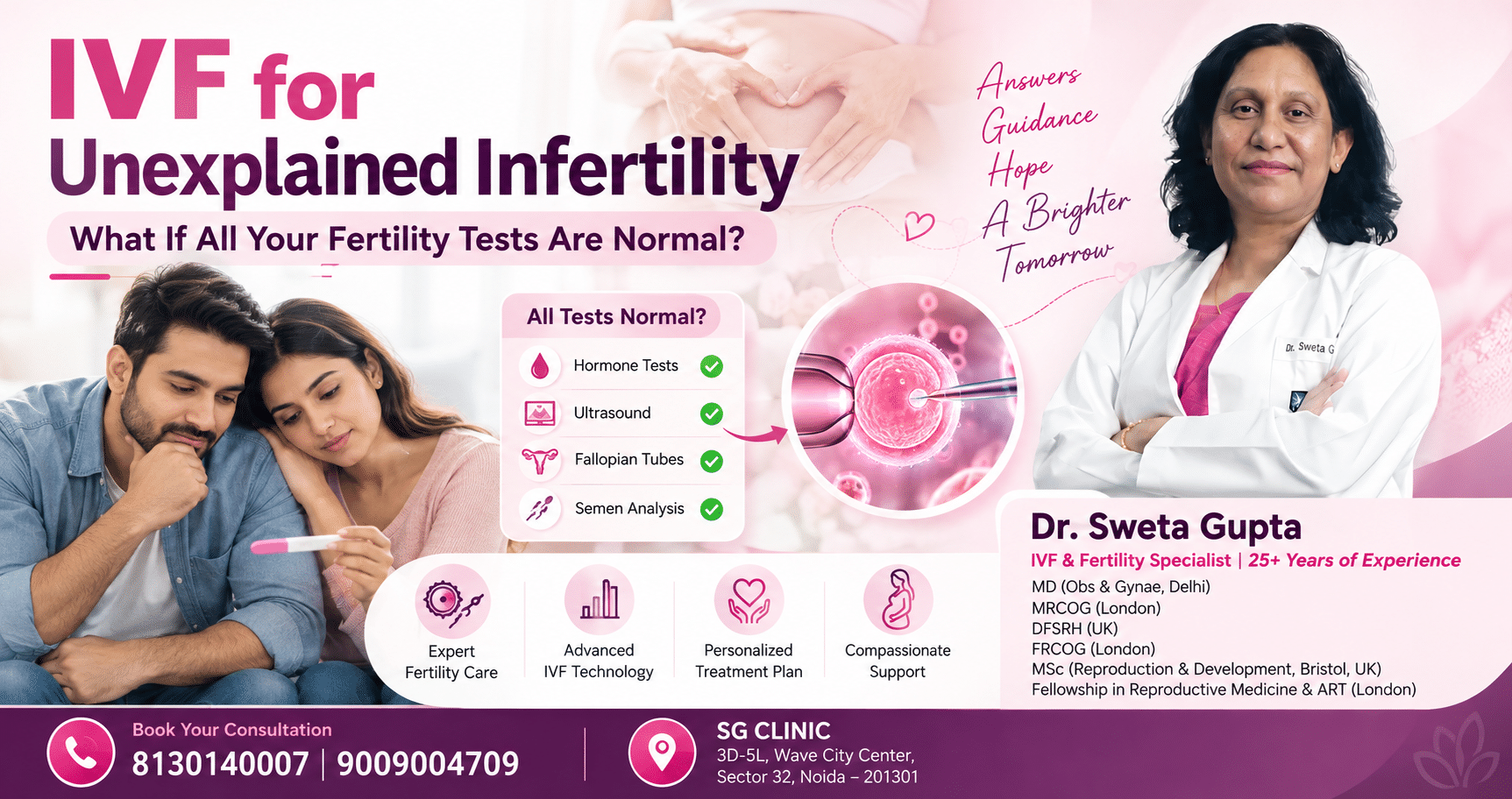
You have been trying to conceive for months or even years. Your periods are regular. Ovulation appears normal. Your ultrasound looks fine. Your fallopian tubes are open, and your partner’s semen analysis is within the expected range.
Yet, pregnancy is not happening.
This situation can be confusing and emotionally exhausting. When standard fertility tests do not identify a clear reason for infertility, doctors may diagnose the couple with “unexplained infertility.”
The good news is that unexplained infertility does not mean there is no chance of pregnancy. It means that current routine tests have not identified a specific cause.
For many couples, treatment options such as timed treatment, ovarian stimulation with IUI, or IVF can still provide a path toward pregnancy. The right approach depends on factors such as female age, duration of infertility, previous treatment, ovarian reserve, reproductive history and individual prognosis.
What Is Unexplained Infertility?
Unexplained infertility is a diagnosis made when a standard fertility evaluation does not reveal an obvious cause of difficulty conceiving.
A typical evaluation looks at:
- Ovulation
- Ovarian function and reserve
- Uterus and reproductive anatomy
- Fallopian tube patency
- Semen analysis
- Relevant medical and reproductive history
ASRM notes that unexplained infertility may be diagnosed when ovulation is documented, at least one fallopian tube is open, and the semen analysis provides adequate numbers of motile sperm, yet pregnancy has not occurred.
Importantly, “unexplained” does not mean “imaginary” or “nothing is wrong.” It means that currently available routine investigations have not identified the specific factor preventing conception.
How Common Is Unexplained Infertility?
Unexplained infertility is relatively common. The American Society for Reproductive Medicine reports that up to about 30% of couples experiencing infertility may receive a diagnosis of unexplained infertility after standard evaluation.
This can happen because conception is a complex biological process involving multiple steps:
- Development of a healthy egg
- Ovulation
- Sperm reaching the egg
- Fertilization
- Early embryo development
- Movement of the embryo toward the uterus
- Implantation
- Continued embryo development
Routine fertility tests cannot measure every one of these processes directly.
If All My Fertility Tests Are Normal, Why Am I Not Getting Pregnant?
This is one of the most common questions couples with unexplained infertility ask.
A normal test result is reassuring, but it does not guarantee that every stage of conception is functioning perfectly.
For example, routine testing may not be able to completely assess:
- The biological quality of an individual egg
- Whether fertilization occurs naturally in every cycle
- The developmental potential of an embryo
- The precise interaction between sperm and egg
- Every aspect of embryo implantation
- Subtle reproductive factors that are not detectable through standard testing
Therefore, normal fertility tests do not necessarily mean that pregnancy should happen immediately.
Female age remains an especially important factor because fertility declines with increasing age, and age is considered the single most important predictor of fecundity.
When Should You See a Fertility Specialist?
Do not wait indefinitely if you have been trying without success.
According to ASRM guidance:
- Under 35: evaluation is generally recommended after 12 months of regular, unprotected intercourse.
- Age 35 or older: evaluation is generally recommended after 6 months.
- Over 40: more immediate evaluation and treatment may be appropriate.
Evaluation may also need to begin earlier when there is a known or suspected fertility-related condition.
Early specialist consultation can be particularly important when age, previous fertility treatment, reduced ovarian reserve, previous pregnancy loss, endometriosis or other reproductive factors may affect the treatment plan.
What Fertility Tests Are Usually Done?
A fertility specialist may review or perform several investigations depending on your individual history.
1. Ovulation Assessment
The doctor may assess whether ovulation is occurring regularly.
Women with regular menstrual cycles between 21 and 35 days generally do not require additional testing to confirm ovulation unless there are specific clinical indications.
2. Ovarian Reserve Assessment
Depending on the situation, tests such as AMH and antral follicle count (AFC) may help assess ovarian reserve.
However, ovarian reserve testing is an adjunct to infertility evaluation rather than a simple test that predicts whether a woman can or cannot become pregnant.
3. Fallopian Tube Evaluation
Tests such as HSG or sonohysterography (SHG) may be used to evaluate tubal patency.
4. Uterine Evaluation
Ultrasound and, when clinically indicated, additional evaluation may assess the uterus for structural abnormalities that could affect fertility or pregnancy.
5. Semen Analysis
A fertility evaluation should include assessment of the male partner rather than focusing exclusively on the woman.
Semen analysis helps evaluate sperm concentration, movement and other standard parameters.
Should You Keep Doing More and More Fertility Tests?
Not necessarily.
One of the biggest misconceptions about unexplained infertility is that every couple needs increasingly advanced tests before treatment can begin.
More testing does not always mean better diagnosis or better pregnancy outcomes.
ASRM states that several investigations—including routine laparoscopy for unexplained infertility, advanced sperm-function testing, postcoital testing, immunologic testing, thrombophilia testing and endometrial biopsy—should not routinely be performed without specific clinical indications.
The better approach is to discuss:
Which test could actually change my treatment plan?
A fertility specialist should individualize testing according to your history, age, previous treatment and clinical findings.
What Are the Treatment Options for Unexplained Infertility?
There is no single treatment that is right for every couple.
Treatment may include:
1. Expectant Management
For couples with a favorable prognosis, a doctor may recommend continuing to try naturally for a period of time.
ESHRE notes that expectant management may involve regular intercourse every two to three days during the fertile period, with treatment decisions individualized according to the couple’s prognosis.
2. Ovulation Stimulation + IUI
Ovarian stimulation with intrauterine insemination (IUI) is an established treatment option for unexplained infertility.
Medication is used to stimulate development of follicles, while prepared sperm is placed directly into the uterus around ovulation.
This approach attempts to increase the opportunity for fertilization while remaining less invasive than IVF.
Both ASRM and ESHRE recognize stimulated IUI as an important treatment option for unexplained infertility.
3. IVF for Unexplained Infertility
In vitro fertilization (IVF) may be recommended when:
- IUI treatments have not resulted in pregnancy
- The woman is older and time is an important consideration
- The couple has been trying for a significant period
- Previous fertility treatments have failed
- The couple prefers a more direct treatment approach after discussing alternatives
- Individual clinical factors make IVF more appropriate
During IVF, eggs are collected and fertilized with sperm in the laboratory. An embryo can then be transferred into the uterus.
IVF can bypass some of the steps involved in natural conception, which is one reason it may be considered when standard testing has not identified the cause.
Is IVF the First Treatment for Unexplained Infertility?
Not necessarily.
This is an important point.
There is no universal rule that every couple diagnosed with unexplained infertility should immediately undergo IVF.
ASRM’s guideline recommends that, for many couples, a typical initial approach is 3–4 cycles of ovarian stimulation with oral medication plus IUI, followed by IVF if those treatments are unsuccessful.
ESHRE similarly recommends ovarian stimulation with IUI as a first-line treatment for many couples, while emphasizing that the decision to move toward IVF should be individualized according to factors such as age, duration of infertility, previous treatment and previous pregnancy.
However, age matters.
For some women, particularly those in an older age group, delaying IVF for multiple rounds of less effective treatment may not be the best strategy.
ASRM reports evidence that women aged 38 years and older may benefit from an IVF strategy in terms of pregnancy rate and shorter time to pregnancy compared with strategies involving IUI before IVF.
Therefore, the right question is not simply “IUI or IVF?”
It is:
“Which treatment gives us the best balance between success, time, cost, medical risk and our personal goals?”
What Can IVF Tell Us in Unexplained Infertility?
IVF can provide information that natural conception cannot easily provide.
During IVF, doctors can observe certain stages such as:
Egg retrieval → Fertilization → Embryo development → Embryo transfer
If fertilization occurs and embryos develop, some information becomes available that could not be obtained from routine fertility testing.
However, IVF is not a diagnostic test alone and cannot identify every possible reason for infertility.
It is primarily a treatment designed to help achieve pregnancy.
IVF and ICSI: Is ICSI Always Needed for Unexplained Infertility?
Not necessarily.
For unexplained infertility, IVF may be performed using conventional fertilization or ICSI depending on the clinical situation.
ASRM’s guideline notes that, in unexplained infertility, evidence has not shown a clear difference in clinical pregnancy or live-birth outcomes between conventional IVF fertilization and ICSI, although ICSI can reduce the risk of complete fertilization failure and may improve fertilization rates in some circumstances.
The decision should therefore be individualized rather than assuming that ICSI is automatically required.
Can Unexplained Infertility Still Result in Natural Pregnancy?
Yes.
An unexplained infertility diagnosis does not mean natural conception is impossible.
Some couples conceive naturally, while others require treatment.
The likelihood depends on factors including:
- Female age
- Duration of infertility
- Previous pregnancy
- Ovarian reserve
- Sperm parameters
- Frequency and timing of intercourse
- Overall reproductive history
This is why a fertility specialist should assess the whole clinical picture, rather than focusing on one “normal” test.
Does Unexplained Infertility Mean IVF Will Not Work?
No.
Unexplained infertility does not automatically predict poor IVF outcomes.
In fact, IVF is an established treatment option for unexplained infertility, particularly when less invasive treatments have not worked or when individual circumstances favor moving directly to IVF.
However, no fertility treatment can guarantee pregnancy or a live birth.
Success depends on multiple factors, especially age and embryo-related factors.
A responsible fertility consultation should explain realistic expectations rather than promise a specific outcome.
What Should You Do If You’ve Had “Normal” Fertility Tests but Still Cannot Conceive?
If you have already undergone fertility testing and everything appears normal, consider discussing these questions with your fertility specialist:
Your fertility consultation checklist
1. Have both partners been evaluated?
Infertility is a couple’s issue, and male-factor evaluation should occur alongside female evaluation when appropriate.
2. Is my age changing the recommended treatment?
Age can significantly influence reproductive potential and treatment decisions.
3. How long have we been trying?
Duration of infertility helps determine whether continued expectant management is reasonable.
4. Is IUI appropriate for us?
Some couples may benefit from a limited number of stimulated IUI cycles.
5. Should we consider IVF now?
For some couples, particularly when age or previous treatment changes the prognosis, moving to IVF may be reasonable.
6. Are additional tests actually necessary?
Ask whether a proposed test is likely to change the treatment plan.
Why Individualized IVF Planning Matters
Two couples can both receive a diagnosis of unexplained infertility but require completely different treatment strategies.
For example:
Couple A:
32 years old + short duration of infertility + favorable ovarian reserve + no previous treatment
Couple B:
39 years old + several years of infertility + previous failed IUI cycles
Although both may have “unexplained infertility,” their treatment plans may be very different.
This is why fertility treatment should not be based on a diagnosis alone.
Unexplained Infertility: Key Takeaways
If all your fertility tests are normal but you are still not conceiving:
- You are not alone.
- Unexplained infertility is a recognized medical diagnosis.
- Normal tests do not guarantee that every step of conception is working perfectly.
- Both partners should be appropriately evaluated.
- Age and duration of infertility are important when selecting treatment.
- Stimulated IUI may be an appropriate first treatment for many couples.
- IVF may be recommended after unsuccessful IUI or sooner when individual circumstances justify it.
- More tests are not automatically better.
- There is no treatment that guarantees pregnancy.
- A personalized fertility plan is more appropriate than following a one-size-fits-all protocol.
Frequently Asked Questions About IVF for Unexplained Infertility
1. What is unexplained infertility?
Unexplained infertility means that standard fertility evaluation has not identified a clear reason why pregnancy has not occurred. The evaluation generally considers ovulation, reproductive anatomy/tubal patency and semen parameters.
2. Can unexplained infertility be treated with IVF?
Yes. IVF is an established treatment option for unexplained infertility. Depending on age, duration of infertility and previous treatments, IVF may be considered after IUI or earlier in the treatment journey.
3. Should I try IUI before IVF for unexplained infertility?
For many couples, yes. ASRM recommends typically 3–4 cycles of ovarian stimulation with oral medication and IUI before moving to IVF when those cycles are unsuccessful. However, treatment should be individualized.
4. Can I get pregnant naturally with unexplained infertility?
Yes. Unexplained infertility does not mean natural pregnancy is impossible. Your individual chance depends on factors such as age, duration of infertility and reproductive history.
5. Does unexplained infertility mean my eggs are poor quality?
No. A diagnosis of unexplained infertility does not automatically mean poor egg quality. Egg quality is influenced strongly by age, but routine fertility tests cannot directly determine the complete developmental potential of an individual egg.
6. Does unexplained infertility mean my partner’s sperm is abnormal?
Not necessarily. If the standard semen analysis is within the expected range, male-factor infertility may not be identified through routine testing. Additional sperm testing should generally be considered only when clinically indicated.
7. Is ICSI required for unexplained infertility?
Not automatically. Conventional IVF and ICSI are different fertilization approaches, and ICSI is not universally required simply because infertility is unexplained. The choice should be based on the couple’s clinical circumstances.
8. How many IVF cycles are needed for unexplained infertility?
There is no fixed number of IVF cycles that applies to everyone. The decision depends on age, ovarian response, embryo development, previous IVF results and the couple’s reproductive goals.
9. Should I have every possible fertility test before IVF?
No. Some advanced investigations are not routinely recommended without specific clinical indications. Your doctor should recommend additional testing only when the result could meaningfully change management.
10. At what age should I see a fertility specialist?
Generally, fertility evaluation is recommended after 12 months of trying if the woman is under 35, after 6 months at age 35 or older, and more promptly when the woman is over 40 or there are known fertility concerns.
11. Can IVF identify the cause of unexplained infertility?
IVF can provide information about some stages of fertilization and embryo development, but it cannot identify every possible cause of infertility. It should primarily be viewed as a treatment rather than a comprehensive diagnostic test.
12. What is the best treatment for unexplained infertility?
There is no single best treatment for every couple. Depending on age, duration of infertility, previous pregnancy, ovarian reserve and previous treatment, options may include expectant management, stimulated IUI or IVF.
Consult Dr. Sweta Gupta for Unexplained Infertility in Noida
If you have been trying to conceive despite apparently normal fertility reports, a personalized fertility consultation can help you understand what your reports actually mean and whether continuing naturally, trying IUI, or considering IVF makes sense for you.
Dr. Sweta Gupta
IVF & Fertility Specialist | 25+ Years of Experience
Qualifications:
MD (Obs & Gynae, Delhi)
MRCOG (London)
DFSRH (UK)
FRCOG (London)
MSc (Reproduction & Development), Bristol, UK
Fellowship in Reproductive Medicine & ART, London
SG Clinic
3D-5L, Wave City Center, Sector 32, Noida – 201301
📞 Appointments: 8130140007 | 9009004709
If your fertility tests are normal but pregnancy is not happening, don’t assume that there are no options. A personalized fertility evaluation can help determine the next appropriate step.