

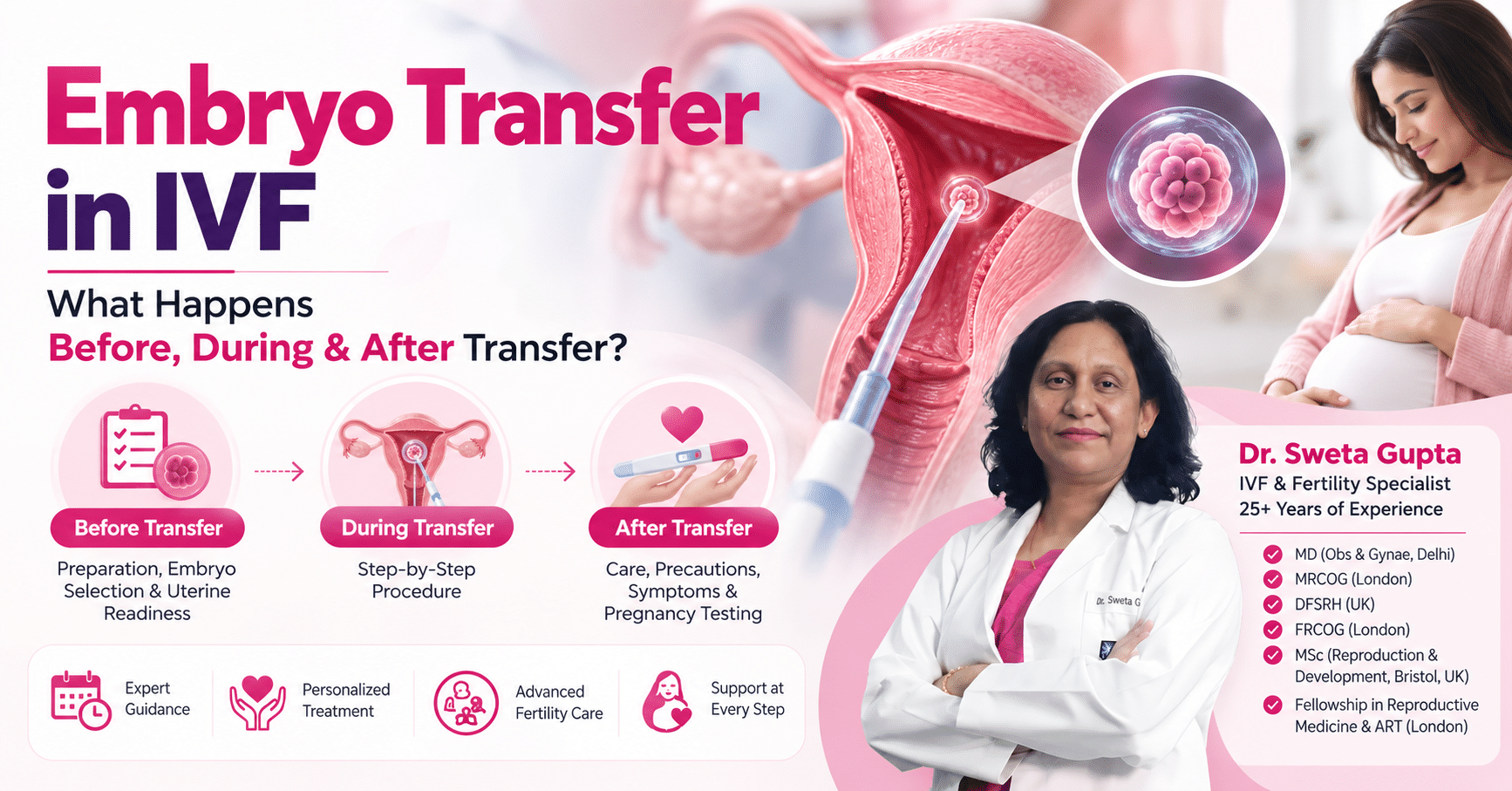
Embryo transfer is one of the most important steps in an IVF journey. It is the stage when a selected embryo is placed inside the uterus with the goal of implantation and pregnancy. For many couples, the embryo transfer day brings excitement, hope and several questions: What should I do before embryo transfer? Is the procedure painful? Can I walk after IVF transfer? What happens after embryo transfer? When should I take a pregnancy test?
This comprehensive guide explains embryo transfer in IVF, including preparation, the actual procedure, post-transfer care, medications, implantation, common symptoms, precautions and frequently asked questions.
Medical note: IVF treatment is individualized. Your fertility specialist may recommend a different protocol depending on your age, medical history, embryo development, uterine lining and whether you are undergoing a fresh or frozen embryo transfer.
What Is Embryo Transfer in IVF?
Embryo transfer is the procedure of placing an IVF embryo into the uterus. After eggs are collected and fertilized in the laboratory, embryos are monitored as they develop. Depending on the treatment plan, an embryo may be transferred at an appropriate developmental stage, commonly around the blastocyst stage.
The embryo is loaded into a thin, soft catheter, which is gently passed through the cervix into the uterus. The embryo is then released into the uterine cavity.
The transfer itself is generally a short procedure and usually does not require general anesthesia.
Quick answer: What happens during embryo transfer?
A fertility specialist gently places a selected embryo into the uterus using a thin catheter, often with ultrasound guidance. The procedure is usually brief, and patients can generally return to normal light activities afterward unless their doctor advises otherwise. Evidence does not support routine bed rest after embryo transfer.
Embryo Transfer in IVF: Step-by-Step
The embryo transfer process can be divided into three stages:
- Before embryo transfer
- During embryo transfer
- After embryo transfer
Understanding each stage can help reduce anxiety and help you follow your fertility team’s instructions confidently.
1. What Happens Before Embryo Transfer?
Preparation begins well before the actual transfer day.
A. Embryo development is monitored
After egg retrieval and fertilization, embryos are monitored in the IVF laboratory. The embryology team evaluates their development and quality.
Your fertility team may recommend transferring an embryo at a particular developmental stage based on factors such as:
- Embryo development
- Embryo quality
- Number of available embryos
- Previous IVF history
- Age and fertility factors
- Whether genetic testing has been performed
- Fresh or frozen embryo transfer
- Individual treatment strategy
There is no single embryo-transfer plan that is appropriate for every patient.
B. The uterine lining is prepared
The uterus needs a suitable endometrial environment for implantation.
Depending on the IVF protocol, your doctor may monitor:
- Endometrial thickness
- Hormonal levels
- Ovulation timing
- Uterine health
- Overall cycle development
In a frozen embryo transfer cycle, the uterine lining may be prepared using medication or a natural/modified natural cycle, depending on the patient’s circumstances.
C. Your doctor decides which embryo to transfer
Embryo selection is an important part of IVF treatment.
Your fertility team considers the available information about embryo development and quality when deciding which embryo should be transferred.
In appropriate patients, single embryo transfer may be recommended to reduce the risks associated with multiple pregnancy. The number of embryos transferred should be decided individually with the fertility team. ESHRE guidelines emphasize considering clinical and non-clinical factors when deciding the number of embryos to transfer.
D. Follow your medication schedule
Your fertility specialist may prescribe medications such as progesterone or other hormonal support depending on the type of IVF cycle.
Do not stop or change fertility medication without speaking with your doctor.
Medication schedules can be an important part of supporting the uterine lining during the period surrounding embryo transfer.
2. What Happens During Embryo Transfer?
Many patients are surprised by how quick the actual procedure can be.
Step 1: You are positioned comfortably
You will generally lie in a position similar to a routine gynecological examination.
Step 2: The cervix is accessed
A speculum may be used to gently visualize the cervix.
Step 3: The embryo is loaded into the catheter
The selected embryo is carefully loaded into a thin, soft embryo-transfer catheter.
Step 4: The catheter is guided into the uterus
The catheter is gently passed through the cervix into the uterine cavity.
Ultrasound guidance may be used to help position the catheter appropriately. Evidence reviewed by ASRM supports ultrasound-guided embryo transfer as an approach that can improve clinical pregnancy and live-birth outcomes.
Step 5: The embryo is released
The embryo is gently deposited into the uterine cavity.
Step 6: The catheter is removed
The catheter is withdrawn carefully and the procedure is completed.
Is Embryo Transfer Painful?
For most patients, embryo transfer is not considered a painful procedure, although some women may experience:
- Mild cramping
- Pelvic pressure
- Discomfort during speculum placement
- Temporary spotting
The experience varies from person to person.
If you have previously experienced difficult cervical procedures or have specific concerns about discomfort, discuss them with your fertility specialist before the procedure.
3. What Happens After Embryo Transfer?
After the embryo transfer, the waiting period begins.
This period is often called the “two-week wait,” although the exact timing of pregnancy testing varies according to the treatment protocol.
During this period, the embryo may continue developing and, if implantation occurs, pregnancy begins to establish.
Can I walk after embryo transfer?
Yes, in general, patients do not need prolonged bed rest after embryo transfer.
Evidence reviewed by ASRM found no benefit from bed rest after embryo transfer and supports immediate ambulation after the procedure.
This means that walking or standing normally does not cause the embryo to “fall out.”
However, your doctor may give individualized instructions based on your medical situation.
What Should You Do After Embryo Transfer?
After transfer, focus on following your fertility team’s instructions rather than trying to control every aspect of implantation.
Recommended approach
- Take prescribed medications exactly as directed.
- Continue normal light daily activities unless advised otherwise.
- Stay hydrated.
- Eat a balanced diet.
- Get adequate sleep.
- Avoid smoking and recreational drugs.
- Avoid medications or supplements that have not been approved by your doctor.
- Attend scheduled follow-up appointments.
- Contact your clinic if you develop concerning symptoms.
Do you need complete bed rest?
Usually, no.
Prolonged bed rest has not been shown to improve IVF outcomes after embryo transfer.
What Happens to the Embryo After Transfer?
After the embryo is placed inside the uterus, the next stages depend on embryo development and implantation.
A simplified sequence is:
Embryo transfer → continued embryo development → implantation (if successful) → early pregnancy development → pregnancy test
The exact timing varies depending on whether a cleavage-stage embryo or blastocyst was transferred and the individual treatment cycle.
Importantly, symptoms alone cannot confirm whether implantation has occurred.
When Does Implantation Happen After Embryo Transfer?
Implantation does not necessarily happen immediately when the embryo is transferred.
For a blastocyst transfer, the embryo may continue the process of hatching and implantation after transfer. The exact timing varies between individuals and embryos.
This is why your fertility clinic usually gives you a specific date for pregnancy testing rather than recommending that you judge success based on symptoms.
Symptoms After Embryo Transfer
Some patients experience symptoms after transfer, while others feel completely normal.
Possible symptoms include:
- Mild abdominal or pelvic cramps
- Light spotting
- Breast tenderness
- Bloating
- Fatigue
- Mood changes
- Increased vaginal discharge
However, these symptoms do not necessarily mean that implantation has occurred.
Many symptoms can also result from progesterone or other medications used during IVF.
Therefore, the absence of symptoms does not mean that IVF has failed, and the presence of symptoms does not confirm pregnancy.
Is Spotting Normal After Embryo Transfer?
Light spotting can occur after embryo transfer, but it should not automatically be interpreted as implantation or pregnancy.
Contact your fertility clinic if you experience:
- Heavy bleeding
- Severe abdominal or pelvic pain
- Fainting or significant dizziness
- Fever
- Difficulty breathing
- Severe abdominal swelling
- Any symptom that concerns you
Your fertility team can determine whether further evaluation is required.
When Should You Take a Pregnancy Test After Embryo Transfer?
One of the most common questions is:
“How many days after embryo transfer should I take a pregnancy test?”
Follow the pregnancy-testing date provided by your fertility clinic.
Testing too early can create unnecessary confusion. Depending on the treatment and medication protocol, an early test may not accurately reflect the final outcome.
A fertility clinic may recommend a blood beta-hCG test at a specific interval after embryo transfer.
HFEA also advises patients to follow the clinic’s designated pregnancy-test date rather than testing too early, because an early result can be misleading.
Fresh Embryo Transfer vs Frozen Embryo Transfer
Embryo transfer can occur as part of different IVF strategies.
Fresh Embryo Transfer
A fresh transfer generally occurs during the same IVF treatment cycle in which the eggs are retrieved and embryos are created.
Frozen Embryo Transfer (FET)
In a frozen embryo transfer, an embryo that was previously cryopreserved is thawed and transferred during a later cycle.
Frozen embryos may be used when:
- Additional embryos remain after an IVF cycle.
- A fresh transfer is not appropriate.
- Embryo testing has been performed.
- The fertility specialist recommends delaying transfer.
- A patient wishes to use a stored embryo in the future.
Good-quality embryos remaining after IVF can be frozen for future treatment in appropriate circumstances.
What Can Affect IVF Embryo Transfer Success?
Embryo transfer is an important part of IVF, but pregnancy and live birth depend on multiple factors.
These can include:
1. Age
Female age is an important factor affecting fertility and IVF outcomes.
2. Embryo factors
Embryo development and quality influence the chance of successful implantation and pregnancy.
3. Uterine and endometrial factors
The condition of the uterus and endometrial environment can be relevant to treatment planning.
4. Underlying fertility conditions
Conditions affecting the ovaries, uterus, fallopian tubes or sperm can influence IVF outcomes.
5. Treatment protocol
The type of IVF cycle, embryo transfer strategy and hormonal support are individualized.
6. Overall reproductive health
Your fertility specialist considers your complete medical and reproductive history rather than relying on a single factor.
No fertility clinic can guarantee IVF success, and an unsuccessful transfer does not necessarily mean that future treatment cannot work.
Does Walking Cause the Embryo to Come Out?
No.
This is one of the most common IVF myths.
Once the embryo has been transferred into the uterus, ordinary walking does not cause it to fall out. Evidence does not support bed rest after embryo transfer. In fact, ASRM’s evidence review supports immediate ambulation after the procedure.
You should still follow your fertility specialist’s personalized activity recommendations.
Can You Go to Work After Embryo Transfer?
Many patients can return to normal light activities after embryo transfer.
Whether you should work on the same day depends on:
- Your occupation
- Physical workload
- Travel requirements
- How you feel after the procedure
- Your doctor’s recommendations
If your work involves heavy lifting or strenuous physical activity, discuss your individual situation with your fertility specialist.
What Should You Avoid After Embryo Transfer?
Rather than following a long list of internet-based restrictions, follow the specific instructions provided by your IVF team.
Generally, patients should avoid:
- Smoking
- Recreational drugs
- Unapproved medications
- Excessive or strenuous activity if advised against by the clinic
- Alcohol during the period when pregnancy may be developing
- Making medication changes without consulting the fertility team
There is no evidence that prolonged bed rest improves embryo transfer outcomes.
What If the Embryo Transfer Does Not Result in Pregnancy?
An unsuccessful embryo transfer can be emotionally difficult, but it does not necessarily mean that IVF cannot work in the future.
Your fertility specialist may review:
- Embryo development and quality
- Endometrial preparation
- Hormonal factors
- Uterine findings
- Previous IVF history
- Age-related factors
- Other relevant fertility factors
Depending on your circumstances, your doctor may recommend another transfer, additional investigations or a change in the treatment approach.
Every IVF cycle should be assessed individually rather than assuming that one outcome predicts the next.
Why Choose an Experienced Fertility Specialist for IVF?
Embryo transfer is technically a short procedure, but careful planning surrounds it.
An experienced fertility specialist can help evaluate:
- Which embryo may be appropriate for transfer
- The timing of transfer
- Endometrial preparation
- Medication support
- Fresh versus frozen transfer strategy
- Number of embryos to transfer
- Follow-up and pregnancy testing
The goal is not simply to perform an embryo transfer but to develop a treatment plan appropriate for the individual patient.
Embryo Transfer in IVF: Key Takeaways
| Stage | What happens? |
|---|---|
| Before transfer | Embryos develop in the laboratory and the uterine lining is prepared |
| Embryo selection | The fertility team determines the appropriate embryo/embryos for transfer |
| Transfer day | A thin catheter is used to place the embryo into the uterus |
| Immediately after | Prolonged bed rest is generally not required |
| Following days | Continue prescribed medication and normal light activities as advised |
| Waiting period | Implantation may occur if the embryo successfully attaches to the uterine lining |
| Pregnancy test | Test on the date recommended by your fertility clinic |
Frequently Asked Questions About Embryo Transfer
1. What is embryo transfer in IVF?
Embryo transfer is the IVF procedure in which a selected embryo is placed into the uterus using a thin catheter. It is one of the final clinical steps of an IVF treatment cycle.
2. Is embryo transfer painful?
Most patients tolerate embryo transfer well. Some may experience mild cramping, pelvic pressure or temporary discomfort.
3. How long does embryo transfer take?
The actual transfer procedure is generally short, although the total time at the clinic may be longer because of preparation and monitoring.
4. Can I walk immediately after embryo transfer?
Yes. Routine walking after embryo transfer is generally considered safe, and evidence does not support prolonged bed rest.
5. Can the embryo fall out after transfer?
No. Normal movement, standing or walking does not cause the embryo to fall out of the uterus.
6. Should I take complete bed rest after IVF transfer?
Usually not. Evidence reviewed by ASRM does not support bed rest after embryo transfer.
7. When does implantation happen after embryo transfer?
Implantation occurs after the embryo continues developing and attaches to the uterine lining. The exact timing depends on embryo developmental stage and individual circumstances.
8. What symptoms are normal after embryo transfer?
Some patients experience mild cramps, spotting, bloating, breast tenderness or fatigue, while others have no symptoms. Symptoms alone cannot confirm pregnancy.
9. When should I take a pregnancy test after embryo transfer?
Take the pregnancy test on the date provided by your IVF clinic. Testing too early can produce misleading results.
10. Can I go to work after embryo transfer?
Many patients can return to light routine activities, but recommendations may vary depending on your occupation, symptoms and treatment plan.
11. Can I climb stairs after embryo transfer?
Normal stair climbing is generally not considered a reason for the embryo to fall out. However, follow your fertility specialist’s advice if you have been given specific activity restrictions.
12. Is spotting after embryo transfer normal?
Light spotting can occur, but bleeding should not automatically be interpreted as implantation. Heavy bleeding or significant pain should be discussed with your fertility clinic.
13. Does embryo quality affect IVF success?
Embryo characteristics are one of several factors associated with IVF outcomes. Age, uterine factors, reproductive health and the treatment protocol also matter.
14. How many embryos are transferred during IVF?
The number depends on individual clinical circumstances and applicable guidance. In suitable cases, single embryo transfer can reduce the risks associated with multiple pregnancy.
15. What happens to extra embryos after IVF?
Suitable embryos that are not transferred may be cryopreserved for potential future treatment, depending on the patient’s circumstances, consent and applicable regulations.
16. What happens if my first embryo transfer fails?
Your fertility specialist may review the previous cycle, embryo development, uterine and endometrial factors and other relevant clinical information before recommending the next step.
Consult Dr. Sweta Gupta for IVF & Fertility Care in Noida
If you are considering IVF, have questions about embryo transfer or have experienced an unsuccessful IVF cycle, an individualized consultation can help you understand your treatment options.
Dr. Sweta Gupta
IVF & Fertility Specialist | 25+ Years of Experience
Qualifications:
- MD (Obs & Gynae, Delhi)
- MRCOG (London)
- DFSRH (UK)
- FRCOG (London)
- MSc (Reproduction & Development), Bristol, UK
- Fellowship in Reproductive Medicine & ART, London
SG Clinic
3D-5L, Wave City Center, Sector 32, Noida – 201301
📞 8130140007 | 9009004709
Book a fertility consultation with Dr. Sweta Gupta to discuss your IVF journey, embryo transfer and individualized treatment options.