

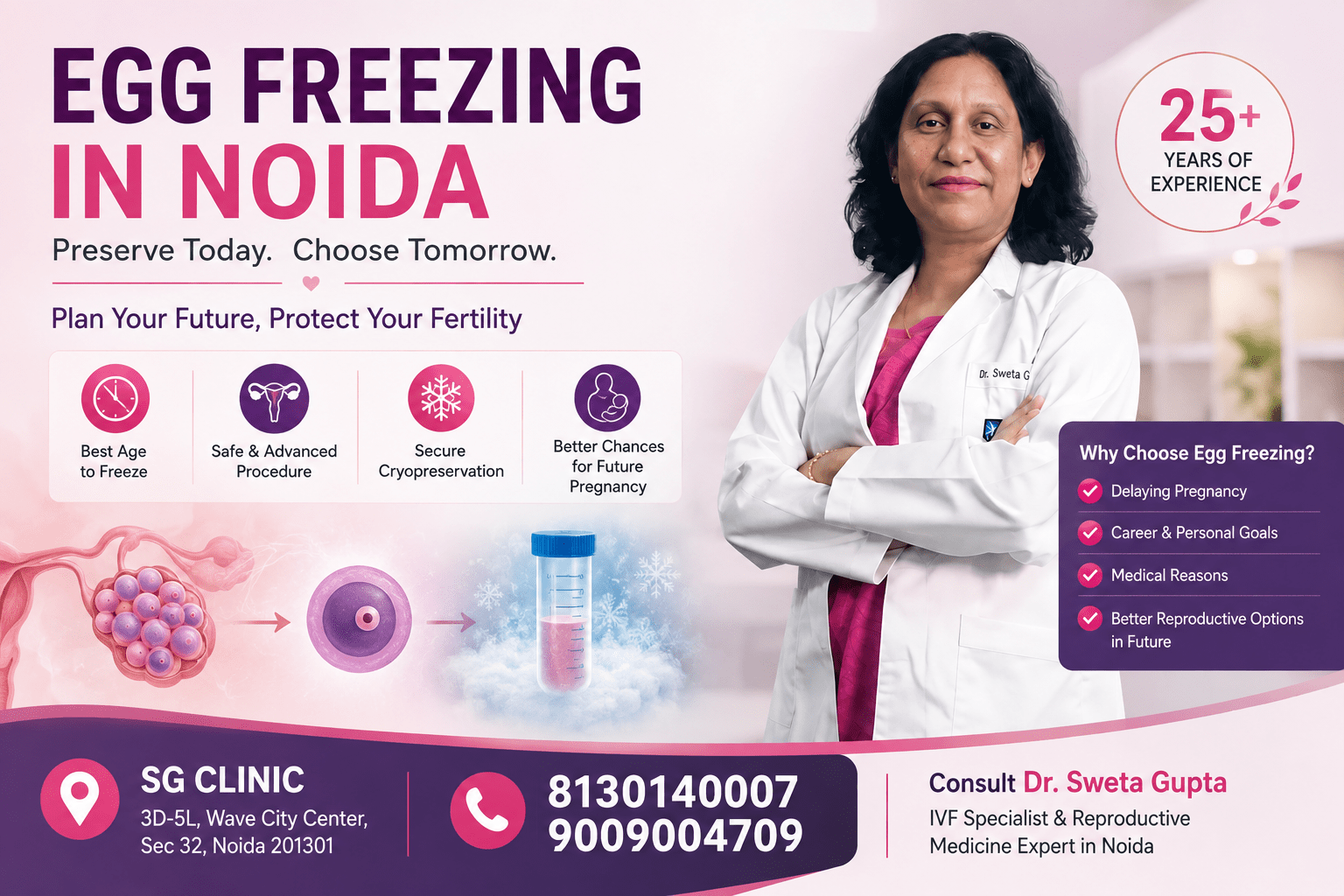
Egg freezing, medically known as oocyte cryopreservation, has become an important option for women who want to preserve their reproductive potential for the future. Whether the reason is career planning, delayed marriage, personal circumstances, medical treatment, reduced ovarian reserve, or simply wanting more flexibility around family planning, egg freezing can provide an additional reproductive option.
However, egg freezing is not a guarantee of future pregnancy. The age at which eggs are frozen, ovarian reserve, number of mature eggs obtained, laboratory quality, sperm quality when the eggs are eventually used, embryo development, uterine health, and several other factors influence the eventual chance of pregnancy and live birth.
If you are considering egg freezing in Noida, it is therefore important to understand not only the procedure and cost but also what egg freezing can—and cannot—do for your future fertility.
At SG Clinic, Noida, Dr. Sweta Gupta provides fertility and reproductive medicine consultations for women considering fertility preservation and other fertility options. Dr. Sweta Gupta has extensive experience in Obstetrics & Gynaecology and Reproductive Medicine, with qualifications including MD (Obs & Gynae, Delhi), MRCOG (London), DFSRH (UK), FRCOG (London), MSc in Reproduction & Development from Bristol, UK, and Fellowship in Reproductive Medicine & ART (London).
This comprehensive guide explains the best age for egg freezing, egg freezing procedure, tests required, number of eggs, egg freezing cost in Noida, possible risks, storage, thawing, IVF, and future pregnancy chances.
Quick Answer: What Is the Best Age for Egg Freezing?
There is no single age that is medically perfect for every woman. In general, egg freezing is more likely to preserve better reproductive potential when eggs are frozen at a younger age, because both egg quantity and egg quality tend to decline with increasing age.
The American Society for Reproductive Medicine (ASRM) states that available evidence is limited for planned egg freezing, but outcomes appear better when oocyte cryopreservation is performed at younger rather than older ages. Importantly, ASRM does not define one universally applicable “perfect age” for planned egg freezing.
For many women considering elective fertility preservation, an early consultation in the late 20s or early 30s can provide useful information about ovarian reserve and the potential benefits and limitations of freezing eggs at that point. Women in their mid-30s may still be candidates, but individual assessment becomes increasingly important.
Women aged 35 or older should not assume that egg freezing is no longer useful. However, because reproductive ageing continues, discussing fertility preservation sooner rather than later can be valuable.
The right decision depends on:
- Your current age
- AMH and other ovarian reserve indicators
- Antral follicle count
- Menstrual and reproductive history
- Previous ovarian surgery
- Endometriosis or other conditions
- Family-building plans
- Whether you expect to delay pregnancy for several years
- Whether one or more egg-freezing cycles may be appropriate
What Is Egg Freezing?
Egg freezing is a fertility preservation technique in which mature eggs are collected from the ovaries and rapidly frozen for possible use at a later stage.
The medical term is oocyte cryopreservation.
Unlike embryo freezing, eggs are frozen without fertilization. When you decide to attempt pregnancy in the future, the eggs can be thawed, fertilized—usually using an IVF laboratory technique such as ICSI—and the resulting embryo may be transferred into the uterus.
The basic pathway is:
Ovarian stimulation → Egg retrieval → Mature egg identification → Vitrification → Cryostorage → Future thawing → Fertilization → Embryo development → Embryo transfer
Modern vitrification uses rapid cooling to minimize ice-crystal formation and has substantially improved egg survival after warming compared with older freezing approaches. ASRM identifies vitrification as the standard rapid-freezing approach used in contemporary oocyte cryopreservation.
Why Are Women Choosing Egg Freezing?
Egg freezing can be considered for several different reasons.
1. Delaying Pregnancy
Some women are not ready to have children at the time when their fertility is relatively higher.
Reasons can include:
- Career development
- Higher education
- Personal goals
- Delayed marriage
- Not yet having a suitable partner
- Financial planning
- Desire to have more time before starting a family
Egg freezing may allow a woman to preserve eggs obtained at a younger age for possible future use.
However, it should be viewed as fertility preservation rather than fertility insurance. There is no technology that can guarantee a future baby. ACOG also emphasizes that fertility preservation techniques cannot guarantee future fertility.
2. Before Cancer Treatment
Chemotherapy, radiation and certain cancer treatments can damage ovarian function.
Women who are diagnosed with cancer and may need fertility-affecting treatment may be referred for fertility preservation before treatment begins, when medically feasible.
In such situations, timing can be particularly important because fertility preservation may need to be coordinated quickly with the cancer treatment plan.
3. Reduced Ovarian Reserve
Some women may be found to have a lower-than-expected ovarian reserve.
This does not automatically mean that pregnancy is impossible. However, if future pregnancy is being postponed, discussing fertility preservation with an IVF specialist in Noida may be appropriate.
The number of eggs that can potentially be collected depends partly on ovarian response and reserve.
4. Endometriosis or Previous Ovarian Surgery
Endometriosis and some ovarian conditions can affect ovarian reserve. Surgery involving the ovaries may also affect the number of eggs remaining.
Women with these concerns may benefit from discussing fertility preservation earlier rather than waiting until ovarian reserve has declined further.
5. Family-Planning Flexibility
Some women simply want to preserve an additional reproductive option while they make decisions about their future.
This is a personal decision and should be made after understanding both the potential benefits and limitations.
Egg Freezing vs Embryo Freezing
Egg freezing and embryo freezing are related but different fertility preservation approaches.
Egg Freezing
Eggs are retrieved and frozen unfertilized.
Advantages:
- No sperm is required at the time of freezing
- Allows future reproductive decision-making
- Preserves eggs from the age at which they were collected
- Can be useful when a woman is not currently ready to choose a sperm source or partner
Embryo Freezing
Eggs are retrieved, fertilized with sperm, developed in the laboratory and then frozen as embryos.
Embryo freezing may provide additional information about how the eggs perform through fertilization and embryo development at the time of treatment.
Which option is appropriate depends on personal circumstances, reproductive plans, medical factors and clinical advice.
How Does Egg Freezing Work?
Egg freezing generally involves several stages.
Step 1: Fertility Consultation
The process begins with a detailed consultation.
An IVF doctor in Noida may discuss:
- Age
- Menstrual cycle
- Previous pregnancies
- Previous fertility treatment
- Medical history
- Surgical history
- Family history
- Medications
- Previous ovarian problems
- Fertility goals
- Expected timing of future pregnancy
The purpose is not simply to determine whether eggs can be frozen, but to understand whether egg freezing is likely to be meaningful for your individual situation.
Step 2: Ovarian Reserve Assessment
Your fertility specialist may recommend tests to understand ovarian reserve and estimate how the ovaries may respond to stimulation.
These can include:
AMH Test
Anti-Müllerian hormone, or AMH, is commonly used as one indicator of ovarian reserve.
Antral Follicle Count
An ultrasound examination can count small developing follicles in the ovaries.
Other Hormonal Tests
Depending on the clinical situation, the doctor may recommend additional hormone testing.
It is important to understand that ovarian reserve tests are primarily useful for estimating egg quantity or expected ovarian response. They cannot perfectly predict whether an individual woman will eventually have a baby using frozen eggs.
ASRM notes that ovarian reserve tests can help estimate anticipated oocyte yield, but evidence is insufficient to use ovarian reserve testing alone to predict live birth after planned egg freezing independently of age.
Step 3: Ovarian Stimulation
Normally, one dominant follicle develops during a menstrual cycle.
For egg freezing, fertility medicines are used to stimulate the ovaries so that several follicles can develop during the same cycle.
The objective is to obtain multiple mature eggs rather than relying on a single naturally selected egg.
The stimulation period is commonly around 10–14 days, although the exact duration varies according to ovarian response and the treatment protocol.
During this period, the fertility team monitors follicular growth using ultrasound and, where appropriate, blood tests.
Medication doses may be adjusted according to the response.
Step 4: Trigger Injection
When the follicles have developed adequately, a trigger medication is administered.
The trigger helps complete the final maturation process of the eggs and prepares them for retrieval.
Correct timing is extremely important.
The egg retrieval procedure is scheduled according to the timing of the trigger.
Step 5: Egg Retrieval
Egg retrieval, also called oocyte retrieval, is performed using ultrasound guidance.
A fine needle is passed through the vaginal wall toward the ovaries, allowing the follicular fluid containing eggs to be aspirated.
The procedure is generally performed under sedation or anaesthesia according to the clinic’s protocol and the patient’s needs.
The retrieved fluid is immediately transferred to the embryology laboratory.
Step 6: Identifying Mature Eggs
The embryology team examines the retrieved material under a microscope.
Not every follicle necessarily contains an egg, and not every retrieved egg is mature.
Only suitable mature oocytes are generally selected for vitrification.
This is one reason why the number of follicles seen on ultrasound and the number of eggs ultimately frozen may not be identical.
Step 7: Vitrification
The mature eggs are rapidly frozen using a process called vitrification.
Vitrification is different from conventional slow freezing.
The objective is to minimize ice-crystal formation that can damage cellular structures.
The frozen eggs are stored in specialized cryogenic storage systems.
Step 8: Long-Term Storage
Once frozen, the eggs can remain stored until the woman decides whether she wants to use them.
Storage arrangements and applicable legal requirements should be discussed with the fertility clinic.
In India, assisted reproductive technology is regulated under the Assisted Reproductive Technology (Regulation) Act, 2021, which includes provisions concerning cryopreservation and consent for reproductive material.
The exact documentation, consent and storage arrangements should therefore be confirmed directly with the clinic.
How Long Does Egg Freezing Take?
The active egg-freezing cycle is usually completed over approximately 2–3 weeks, although the exact timeline varies.
A typical pathway may look like:
| Stage | Approximate timeline |
|---|---|
| Initial consultation | 1 visit |
| Ovarian reserve assessment | 1–several days |
| Stimulation | Around 10–14 days |
| Monitoring | Throughout stimulation |
| Trigger | According to follicular development |
| Egg retrieval | Usually one procedure |
| Vitrification | Usually on retrieval day |
| Storage | Long term |
The complete schedule depends on the woman’s menstrual cycle, test results, stimulation response and clinic protocol.
What Is the Best Age for Egg Freezing?
This is one of the most common questions asked during fertility consultations.
The answer requires understanding egg quantity and egg quality.
As women age, ovarian reserve generally declines and the proportion of eggs with chromosomal abnormalities tends to increase.
This means that eggs frozen at a younger age may have better reproductive potential than eggs frozen later.
ASRM’s evidence review found that, based on limited data, ongoing pregnancy and live birth outcomes appear better when oocyte cryopreservation is performed at younger ages. However, the organization also states that evidence is insufficient to define one universal optimal age for planned egg freezing.
Egg Freezing in Your 20s
Women in their 20s generally have age-related fertility advantages.
However, not every woman in her 20s needs to freeze eggs.
The decision should consider:
- Whether pregnancy is likely to be postponed
- Ovarian reserve
- Personal reproductive plans
- Medical conditions
- Cost
- The likelihood of actually using the frozen eggs
Egg Freezing Around 30–34
For women considering elective fertility preservation, the early 30s can be an important period to discuss the option.
If you know that pregnancy is likely to be delayed for several years, an early consultation with an IVF specialist in Noida can help you understand your individual ovarian reserve and possible treatment response.
Egg Freezing Around 35–37
Egg freezing may still be an option.
However, because reproductive ageing continues, the expected number and quality of eggs may be different compared with freezing at a younger age.
A personalized assessment becomes particularly important.
Egg Freezing After 38
Egg freezing after 38 may still be considered in selected women, but expectations need to be realistic.
The number of eggs retrieved may be lower, and egg quality is affected by age.
ASRM data reviewed in its guideline found lower estimated egg efficiency with increasing age, although the evidence was limited and insufficient to provide an exact number of eggs guaranteeing a live birth.
Therefore, women approaching or above 38 who are considering fertility preservation should preferably consult an experienced fertility specialist rather than making the decision based solely on an online age chart.
Is 30 a Good Age to Freeze Eggs?
For some women, yes.
At 30, egg freezing may preserve eggs obtained at an age when reproductive potential is generally better than at later ages.
But the decision should not be based on age alone.
A 30-year-old with significantly reduced ovarian reserve may have a very different situation from another 30-year-old with a higher ovarian reserve.
The best approach is:
Age + ovarian reserve + reproductive plans + medical history + realistic expectations
Is 35 Too Late to Freeze Eggs?
No, 35 is not automatically “too late.”
However, the potential benefit of freezing eggs tends to be greater when eggs are frozen younger.
Women aged 35 and above should have an individualized consultation to understand:
- Expected egg yield
- Whether one or multiple cycles may be required
- Potential age-related reduction in egg quality
- Expected future use
- Cost
- Alternatives such as trying for pregnancy sooner or embryo freezing
How Many Eggs Should You Freeze?
There is no universal number of eggs that guarantees a baby.
This is extremely important.
Many online articles provide fixed targets such as “freeze 10 eggs” or “freeze 20 eggs,” but such numbers can create false reassurance.
The potential benefit of a particular number depends on:
- Age at egg retrieval
- Number of mature eggs
- Egg survival after warming
- Fertilization
- Embryo development
- Sperm factors
- Uterine factors
- Embryo transfer outcomes
ASRM specifically states that available evidence is insufficient to recommend one absolute number of oocytes that guarantees a reasonable probability of live birth for every age group.
Your fertility specialist may nevertheless discuss a target range based on your age, ovarian reserve and family-building goals.
Does Egg Freezing Guarantee Future Pregnancy?
No.
This is perhaps the most important message for anyone considering egg freezing.
Egg freezing preserves the eggs available at the time of retrieval. It does not guarantee:
- Egg survival after thawing
- Successful fertilization
- Normal embryo development
- Implantation
- Pregnancy
- Live birth
ACOG states that there is currently no fertility preservation technique that can guarantee fertility preservation.
HFEA similarly emphasizes that egg freezing should not be considered a guarantee of having a baby in the future.
What Are the Chances of Pregnancy With Frozen Eggs?
There is no single percentage that applies to every woman.
The most important variable is often age at the time the eggs were frozen.
A younger egg generally has a better chance of producing a chromosomally competent embryo than an egg retrieved at a substantially older age.
But success rates reported online should be interpreted carefully.
ASRM notes that there is still insufficient evidence to accurately predict live birth rates following planned oocyte cryopreservation for every individual.
Therefore, instead of asking only:
“What is the success rate of egg freezing?”
it is more useful to ask:
“Based on my age, ovarian reserve and expected number of mature eggs, what might my realistic future reproductive options be?”
What Happens When You Want to Use Your Frozen Eggs?
Years later, when you are ready to try for pregnancy, the frozen eggs can be thawed.
The process generally involves:
1. Thawing
Frozen eggs are warmed under controlled laboratory conditions.
2. Fertilization
Because eggs are being used after cryopreservation, ICSI may be used to introduce sperm directly into the egg.
3. Embryo Culture
The fertilized egg develops in the laboratory.
Embryologists monitor embryo development.
4. Embryo Selection
If appropriate, an embryo may be selected for transfer according to the treatment plan.
5. Preparing the Uterus
The uterus is prepared for embryo transfer using an appropriate natural or medicated protocol.
6. Embryo Transfer
The embryo is transferred into the uterus.
7. Pregnancy Testing
A blood pregnancy test is performed after the appropriate interval.
Does Egg Quality Stay the Same After Freezing?
Egg freezing essentially preserves the biological age of the egg at the time it is frozen.
This is one of the major reasons women consider fertility preservation.
For example, if a woman freezes eggs at 30 and uses them at 39, the eggs were obtained when she was 30.
However, this does not mean the woman herself is biologically 30 when she becomes pregnant.
Her age at pregnancy still matters.
Pregnancy at an older age may carry increased risks such as:
- Hypertension
- Gestational diabetes
- Miscarriage
- Placental complications
- Caesarean delivery
- Other pregnancy-related complications
HFEA specifically notes that increasing maternal age is associated with greater pregnancy-related risks.
Therefore, egg freezing can preserve younger eggs but does not eliminate age-related pregnancy risks.
Egg Freezing Cost in Noida
One of the most frequently searched questions is:
“What is the egg freezing cost in Noida?”
There is no single fixed price.
The total cost can vary significantly according to:
- Fertility clinic
- Doctor’s consultation
- Ovarian reserve
- Medication dosage
- Number of monitoring visits
- Egg retrieval charges
- Anaesthesia or sedation
- Embryology laboratory charges
- Vitrification
- Storage
- Number of cycles
- Additional investigations
Current publicly available Noida and Delhi-NCR clinic estimates show substantial variation. For example, one Noida fertility provider currently lists approximately ₹1.35 lakh for one egg-freezing cycle, while other Delhi-NCR fertility providers publish ranges extending to approximately ₹1.5–₹2.5 lakh or more depending on what is included.
Therefore, patients should compare itemized treatment estimates rather than choosing a clinic solely on the lowest advertised price.
Typical Cost Components
| Component | What it may include |
| Consultation | Fertility specialist evaluation |
| Testing | AMH, ultrasound and other tests |
| Medicines | Ovarian stimulation injections |
| Monitoring | Ultrasound and blood tests |
| Egg retrieval | Procedure and sedation/anaesthesia |
| Laboratory | Egg identification and preparation |
| Vitrification | Freezing of mature eggs |
| Storage | Cryostorage charges |
| Future treatment | Thawing, ICSI, embryo culture and transfer |
Some clinics bundle several components into one package, while others charge separately.
Is Egg Freezing Costly?
Egg freezing can be a significant financial investment.
The initial treatment is only one part of the overall cost.
If the eggs are eventually used, additional expenses may include:
- Thawing
- ICSI
- Embryo culture
- Embryo transfer
- Medications
- Additional investigations
- Pregnancy-related care
Therefore, ask your fertility clinic for two estimates:
1. Cost of freezing and storing the eggs
2. Estimated future cost of using the frozen eggs
This provides a more realistic picture of the total financial commitment.
How Much Does Egg Freezing Cost in Noida in 2026?
As of 2026, published estimates for egg freezing in Noida/Delhi-NCR vary considerably. A reasonable broad planning range is approximately ₹1.2 lakh to ₹2.5 lakh or more per stimulation cycle, depending on medication requirements, clinic facilities, laboratory technology, retrieval, vitrification and storage.
Some providers advertise lower base prices, but those figures may exclude medicines, monitoring, storage or other components. Other centres may quote higher package prices that include more services.
Important: These are indicative market ranges, not a guaranteed price from SG Clinic. Your actual cost should be confirmed after consultation and evaluation.
Why Can Two Women Have Different Egg Freezing Costs?
Suppose one woman produces an adequate number of mature eggs using a relatively low medication dose.
Another woman may require higher doses or more than one stimulation cycle.
Their final costs can therefore be very different.
The number of cycles is particularly important.
Women with lower ovarian reserve or older reproductive age may sometimes require additional cycles to bank an adequate number of eggs, although this is determined individually.
Is Egg Freezing Covered by Insurance?
Coverage depends on the specific health insurance policy and the indication for fertility preservation.
Elective egg freezing is often not routinely covered, while fertility preservation related to medically necessary treatments may be treated differently under certain policies or programs.
Patients should check their policy wording and confirm directly with the insurer.
What Are the Risks of Egg Freezing?
Egg freezing is generally an established fertility preservation procedure, but no medical procedure is completely risk-free.
Potential concerns include:
Ovarian Hyperstimulation Syndrome
Some women can develop an excessive response to stimulation medicines.
Modern protocols are designed to reduce this risk, and fertility specialists monitor patients throughout treatment.
Bleeding or Infection
Egg retrieval is a minimally invasive procedure, but complications such as bleeding or infection can occur rarely.
Ovarian Torsion
Ovarian enlargement during stimulation can rarely increase the risk of ovarian torsion.
Medication Side Effects
Stimulation medicines may cause:
- Bloating
- Abdominal discomfort
- Breast tenderness
- Mood changes
- Headache
- Injection-site discomfort
Emotional Stress
Fertility preservation can also be emotionally demanding, particularly when expectations about future pregnancy are high.
A good fertility consultation should address both the medical and emotional aspects of the decision.
Is Egg Freezing Safe?
Egg freezing using modern vitrification is an established fertility preservation technique.
ASRM states that the technology has improved substantially, with vitrification becoming a standard approach for oocyte cryopreservation. Available evidence also suggests neonatal outcomes after use of cryopreserved oocytes appear similar to those after fresh oocytes, although the organization emphasizes limitations in the evidence and the need for additional long-term data.
However, “safe” does not mean “guaranteed.”
A woman’s overall health, pregnancy age and obstetric risks still need to be considered when the eggs are eventually used.
How Long Can Frozen Eggs Be Stored?
Frozen eggs can be maintained in cryogenic storage for extended periods.
The practical storage period and consent requirements depend on applicable regulations and clinic policies.
In India, the Assisted Reproductive Technology (Regulation) Act, 2021 regulates assisted reproductive technology practices, including cryopreservation and consent requirements.
Your clinic should explain:
- Storage duration
- Renewal of consent
- Storage charges
- Documentation
- What happens if you change clinics
- What happens if you decide not to use the eggs
Does Long-Term Storage Damage Eggs?
Evidence from cryopreservation programs is reassuring regarding storage duration when appropriate cryogenic conditions are maintained.
The critical factors include:
- Proper vitrification
- Appropriate cryostorage
- Monitoring of storage systems
- Correct labeling and documentation
- Laboratory quality-control procedures
The duration of storage should still be discussed with the fertility clinic because legal and administrative requirements may apply.
Egg Freezing and IVF: What Is the Connection?
Egg freezing and IVF are closely connected.
Egg freezing itself does not involve fertilization.
When you later decide to use the frozen eggs, they generally enter an IVF laboratory process.
The eggs are thawed and fertilized, often through ICSI, followed by embryo culture.
Therefore, choosing egg freezing also means choosing a fertility laboratory with appropriate experience in:
- Vitrification
- Oocyte warming
- ICSI
- Embryo culture
- Cryopreservation
- Embryo transfer
When searching for an IVF doctor in Noida, ask not only about the doctor’s experience but also about the embryology laboratory and its egg-freezing and warming protocols.
Egg Freezing vs Trying to Conceive Now
This is an important conversation.
Egg freezing should not automatically replace trying to conceive.
For a woman who is ready to have a child now, attempting pregnancy may be a more direct route.
Egg freezing becomes more relevant when pregnancy is likely to be delayed and preserving younger eggs is considered worthwhile.
The decision should take into account:
- Current age
- Relationship status
- Pregnancy plans
- Ovarian reserve
- Medical history
- Financial considerations
- Number of children desired
- Expected delay before pregnancy
A fertility specialist can help put these factors together rather than focusing on one test result.
Can Egg Freezing Prevent Infertility?
No.
Egg freezing does not prevent all forms of infertility.
It primarily preserves eggs.
Future fertility can still be affected by:
- Uterine conditions
- Fibroids
- Endometriosis
- Tubal factors
- Sperm factors
- Medical conditions
- Pregnancy-related risks
- Age-related changes in the uterus
- Embryo development
Therefore, frozen eggs should be understood as an additional reproductive option, not a complete solution to every cause of infertility.
Egg Freezing for Women With Low AMH
A low AMH result can be concerning, but it does not by itself mean pregnancy is impossible.
AMH primarily provides information about ovarian reserve and anticipated response to stimulation.
Women with low AMH may produce fewer eggs during a stimulation cycle.
If future pregnancy is important and pregnancy is likely to be delayed, an early consultation with an IVF specialist in Noida may be appropriate.
Depending on age and ovarian response, the specialist may discuss:
- Egg freezing
- Embryo freezing
- Trying to conceive sooner
- Repeat stimulation
- Other fertility preservation strategies
The correct recommendation depends on the complete clinical picture.
Egg Freezing for Women With PCOS
Women with PCOS may have a relatively high number of follicles but can also be more sensitive to ovarian stimulation.
This means stimulation needs to be carefully individualized.
The objective is to obtain mature eggs while minimizing complications such as excessive ovarian response.
Women with PCOS considering egg freezing should therefore undergo appropriate medical assessment rather than using a standard stimulation protocol based solely on age.
Egg Freezing With Endometriosis
Endometriosis can affect fertility and, in some cases, ovarian reserve.
Previous ovarian surgery can also influence ovarian reserve.
For a woman with endometriosis who expects to delay pregnancy, discussing fertility preservation early can be valuable.
The fertility specialist may consider:
- Age
- AMH
- Antral follicle count
- Endometrioma size and location
- Previous surgery
- Symptoms
- Pregnancy plans
Treatment should always be individualized.
What Should You Ask an IVF Doctor Before Egg Freezing?
Before starting treatment, consider asking:
- What is my current ovarian reserve?
- How many eggs might I reasonably expect from one cycle?
- How many mature eggs are likely to be frozen?
- Is one cycle enough for my goals?
- What are the medication costs?
- What does the package include?
- Is first-year storage included?
- What are the annual storage charges?
- What happens when I decide to use the eggs?
- What are the thawing and ICSI costs?
- What laboratory technique is used?
- What are the clinic’s age-specific outcomes?
- What are the possible risks?
- Would embryo freezing be a better option for me?
- How might my age affect future pregnancy?
- What happens if I need more than one cycle?
These questions can make the consultation much more useful.
How to Choose the Best Egg Freezing Clinic in Noida
When searching online for egg freezing in Noida, do not choose a clinic solely because it uses phrases such as “best,” “highest success rate” or “guaranteed success.”
Instead, evaluate:
1. Fertility Specialist Experience
Look for a doctor with appropriate training in reproductive medicine and fertility treatment.
2. Embryology Laboratory
Egg freezing is heavily dependent on laboratory quality.
Ask about:
- Vitrification technology
- Oocyte warming
- Embryology expertise
- Cryostorage systems
- Quality-control processes
3. Transparent Pricing
Ask for a written cost estimate covering:
- Consultation
- Tests
- Medicines
- Monitoring
- Retrieval
- Anaesthesia
- Vitrification
- Storage
4. Personalized Treatment
A standardized package may not be appropriate for every woman.
5. Honest Counselling
A trustworthy fertility specialist should explain both benefits and limitations.
Why Consult Dr. Sweta Gupta for Fertility Preservation in Noida?
Dr. Sweta Gupta is an experienced Obstetrician, Gynaecologist and Reproductive Medicine specialist practicing in Noida.
Her qualifications include:
- MD (Obstetrics & Gynaecology), Delhi
- MRCOG (London)
- DFSRH (UK)
- FRCOG (London)
- MSc in Reproduction & Development, Bristol, UK
- Fellowship in Reproductive Medicine & ART, London
With extensive experience in women’s reproductive health and fertility care, Dr. Sweta Gupta can evaluate your individual circumstances and discuss whether fertility preservation may be appropriate for you.
If you are searching for an IVF specialist in Noida to discuss egg freezing, fertility preservation, delayed pregnancy planning or IVF options, a personalized consultation can help you understand your choices before starting treatment.
When Should You Consult an IVF Specialist in Noida About Egg Freezing?
Consider arranging a fertility consultation if:
- You expect to delay pregnancy for several years
- You are approaching your mid-30s and want to understand your options
- You have a low AMH or concerns about ovarian reserve
- You have endometriosis
- You have undergone ovarian surgery
- You are preparing for cancer treatment
- You have a medical condition that may affect fertility
- You want to understand egg freezing before making a decision
- You are unsure whether egg or embryo freezing is more appropriate
Early consultation does not mean you have to proceed with egg freezing.
It simply gives you information to make a better decision.
What Makes Egg Freezing Different From Natural Fertility?
A woman is born with a finite number of eggs, and both egg quantity and quality change over time.
Egg freezing does not create new eggs.
Instead, it allows some eggs available at the time of treatment to be preserved for possible future use.
This is why timing matters.
If a woman freezes eggs at a younger age, the frozen eggs retain the characteristics associated with the age at which they were retrieved.
But the eventual pregnancy will still occur at the woman’s age at that future time.
Can Frozen Eggs Be Used Years Later?
Yes, frozen eggs can be thawed later and used as part of IVF treatment.
However, whether they result in a pregnancy depends on the entire reproductive process.
The journey can be summarized as:
Frozen egg → warming → fertilization → embryo → embryo transfer → implantation → pregnancy → live birth
There are several steps between an egg and a baby.
This is why responsible fertility counselling should never describe egg freezing as a guaranteed pregnancy.
What Happens if Frozen Eggs Do Not Result in Pregnancy?
If the first attempt does not result in pregnancy, the fertility specialist may review:
- Number of eggs remaining
- Egg survival after warming
- Fertilization results
- Embryo quality
- Uterine factors
- Sperm factors
- Previous transfer outcome
Depending on the situation, additional frozen eggs may be used or another fertility strategy may be discussed.
This is another reason why the number of eggs frozen and age at freezing are important components of planning.
Common Myths About Egg Freezing
Myth 1: Egg freezing guarantees a baby.
Fact: It does not. It preserves an opportunity for future treatment but cannot guarantee pregnancy or live birth.
Myth 2: I can freeze eggs at any age with the same success.
Fact: Age at egg retrieval is an important factor. Available evidence suggests better outcomes when eggs are frozen at younger ages.
Myth 3: AMH tells me whether I will have a baby.
Fact: AMH is useful for estimating ovarian reserve and expected response but cannot independently guarantee future live birth.
Myth 4: Frozen eggs become biologically older while stored.
Fact: Cryopreservation is designed to preserve the eggs in their frozen state. The important biological age is primarily the age at which the eggs were retrieved.
Myth 5: More eggs always guarantee success.
Fact: A larger number can provide more opportunities, but there is no universally guaranteed egg number for a live birth.
Myth 6: Egg freezing eliminates pregnancy risks at an older age.
Fact: Frozen eggs may preserve younger eggs, but pregnancy occurs at the woman’s age when she becomes pregnant, and age-related obstetric risks still need to be considered.
Frequently Asked Questions About Egg Freezing in Noida
1. What is egg freezing?
Egg freezing, or oocyte cryopreservation, is a fertility preservation technique in which mature eggs are collected from the ovaries, rapidly frozen using vitrification and stored for possible future IVF treatment.
2. What is the best age for egg freezing?
There is no universally defined perfect age. Generally, younger age at egg retrieval is associated with better reproductive potential. An individual assessment of age, ovarian reserve and family-building plans is more useful than relying on one fixed age.
3. Is 30 a good age for egg freezing?
For some women, yes. Women who anticipate delaying pregnancy may benefit from discussing fertility preservation around this age. However, egg freezing is not automatically necessary for every woman at 30.
4. Is 35 too late for egg freezing?
No. Women aged 35 or older may still consider egg freezing, but age-related changes in egg quality and quantity should be discussed realistically with a fertility specialist.
5. Can I freeze eggs after 40?
Egg freezing may be technically possible in selected women after 40, but the expected number and quality of eggs may be lower. A personalized fertility assessment is essential.
6. How many eggs should I freeze?
There is no universal number that guarantees a baby. The appropriate target depends on age, ovarian reserve, response to stimulation and reproductive goals. ASRM states that evidence is insufficient to recommend one absolute number of eggs for a guaranteed or predictable live birth.
7. How long does egg freezing take?
The active stimulation and retrieval process generally takes around two to three weeks, although the exact timeline varies.
8. Is egg freezing painful?
Stimulation injections can cause mild discomfort, while egg retrieval is generally performed with sedation or anaesthesia. Temporary bloating or abdominal discomfort can occur.
9. Is egg retrieval a surgery?
Egg retrieval is a minimally invasive procedure performed under ultrasound guidance. It does not usually require a prolonged hospital stay.
10. What is vitrification?
Vitrification is a rapid-freezing method used to preserve eggs while minimizing ice-crystal formation.
11. How much does egg freezing cost in Noida?
The cost varies by clinic and treatment plan. Current published Noida/Delhi-NCR prices can range from approximately ₹1.2 lakh to ₹2.5 lakh or more per cycle, depending on what is included, medication requirements, laboratory charges and storage.
12. Does the egg freezing cost include medicines?
Not always. Some packages include stimulation medicines while others charge them separately. Always request an itemized quotation.
13. Is storage included in the egg freezing package?
It depends on the clinic. Some packages include a defined period of storage, while others charge storage separately.
14. How much does egg storage cost?
Storage charges vary between fertility centres and according to the storage period. Ask the clinic for the annual storage fee and whether the first year is included.
15. Can frozen eggs be used after many years?
Yes, they can be stored for future use subject to applicable legal requirements, consent and clinic policies.
16. Will my eggs age while they are frozen?
The purpose of cryopreservation is to preserve the eggs at the time they were frozen. However, pregnancy at a later age still carries the pregnancy-related considerations associated with the woman’s age at that time.
17. Can I get pregnant naturally after freezing my eggs?
Yes. Egg freezing does not prevent you from attempting natural conception later. The frozen eggs are an additional option and are not necessarily required.
18. Is egg freezing better than embryo freezing?
Neither is universally better. The appropriate option depends on whether sperm is available, relationship circumstances, reproductive plans and medical factors.
19. Can women with low AMH freeze eggs?
Some women with low AMH can undergo egg freezing, although they may produce fewer eggs during stimulation. An individualized assessment is required.
20. Can women with PCOS freeze eggs?
Yes, women with PCOS may be candidates for egg freezing. Because ovarian response can be high in some women with PCOS, stimulation needs careful monitoring.
21. Can women with endometriosis freeze eggs?
Some women with endometriosis may benefit from fertility preservation. The decision depends on ovarian reserve, endometriosis severity, previous surgery, age and pregnancy plans.
22. What happens when I want to use my frozen eggs?
The eggs are thawed and generally fertilized through an IVF laboratory process, often using ICSI. Embryos are then cultured and may be transferred into the uterus.
23. Does egg freezing guarantee a successful IVF cycle?
No. Egg freezing does not guarantee fertilization, embryo formation, implantation, pregnancy or live birth.
24. Does the age when I use my eggs matter?
Yes. The age at egg retrieval is important for the biological age of the frozen eggs, but the age at pregnancy also matters because pregnancy risks can increase with maternal age.
25. Is egg freezing safe for the baby?
Available evidence is reassuring regarding neonatal outcomes after use of cryopreserved eggs, but long-term evidence continues to develop. ASRM describes neonatal outcomes as appearing similar in the available evidence while also noting limitations in the data.
26. Should I freeze eggs if I am 25?
Not necessarily. Egg freezing should be based on personal reproductive plans and medical circumstances, not age alone.
27. Should I freeze eggs if I am 32?
It may be worth discussing if you expect to postpone pregnancy substantially. A fertility assessment can help you understand whether egg freezing is appropriate.
28. Should I freeze eggs if I am 37?
A consultation is advisable because age becomes increasingly important. Your specialist can discuss expected ovarian response and whether one or more cycles may be useful.
29. Can I freeze eggs before cancer treatment?
Fertility preservation may be recommended for women whose medical treatment could affect ovarian function. The decision should be coordinated with the treating oncology team and fertility specialist.
30. How do I choose an IVF specialist in Noida for egg freezing?
Look for appropriate reproductive medicine experience, a qualified embryology laboratory, transparent pricing, individualized treatment plans, clear counselling and realistic discussion of success rates.
Final Takeaway: Is Egg Freezing Right for You?
Egg freezing can be an important fertility preservation option, particularly for women who expect to delay pregnancy or who may face medical treatment that could affect fertility.
The key message is simple:
Egg freezing preserves reproductive options; it does not guarantee a future baby.
Age at egg retrieval matters because egg quality and quantity change with reproductive ageing. At the same time, there is no single “perfect age” or guaranteed number of eggs that applies to every woman.
If you are considering egg freezing in Noida, start with an individualized fertility assessment rather than choosing treatment based only on an online cost or success-rate claim.
An experienced IVF specialist in Noida can evaluate your age, ovarian reserve, medical history and reproductive plans and explain whether egg freezing, embryo freezing, trying for pregnancy sooner, or another approach may be appropriate.
Consult Dr. Sweta Gupta for Egg Freezing & Fertility Preservation in Noida
Dr. Sweta Gupta
Obstetrician, Gynaecologist & Reproductive Medicine Specialist
Qualifications:
- MD (Obs & Gynae, Delhi)
- MRCOG (London)
- DFSRH (UK)
- FRCOG (London)
- MSc (Reproduction & Development), Bristol, UK
- Fellowship in Reproductive Medicine & ART, London
Clinic:
SG Clinic
3D-5L, Wave City Center, Sector 32, Noida – 201301
For consultation:
8130140007 | 9009004709
If you are looking for an IVF doctor in Noida to discuss egg freezing, fertility preservation, IVF or future pregnancy planning, schedule a personalized consultation to understand your options.