

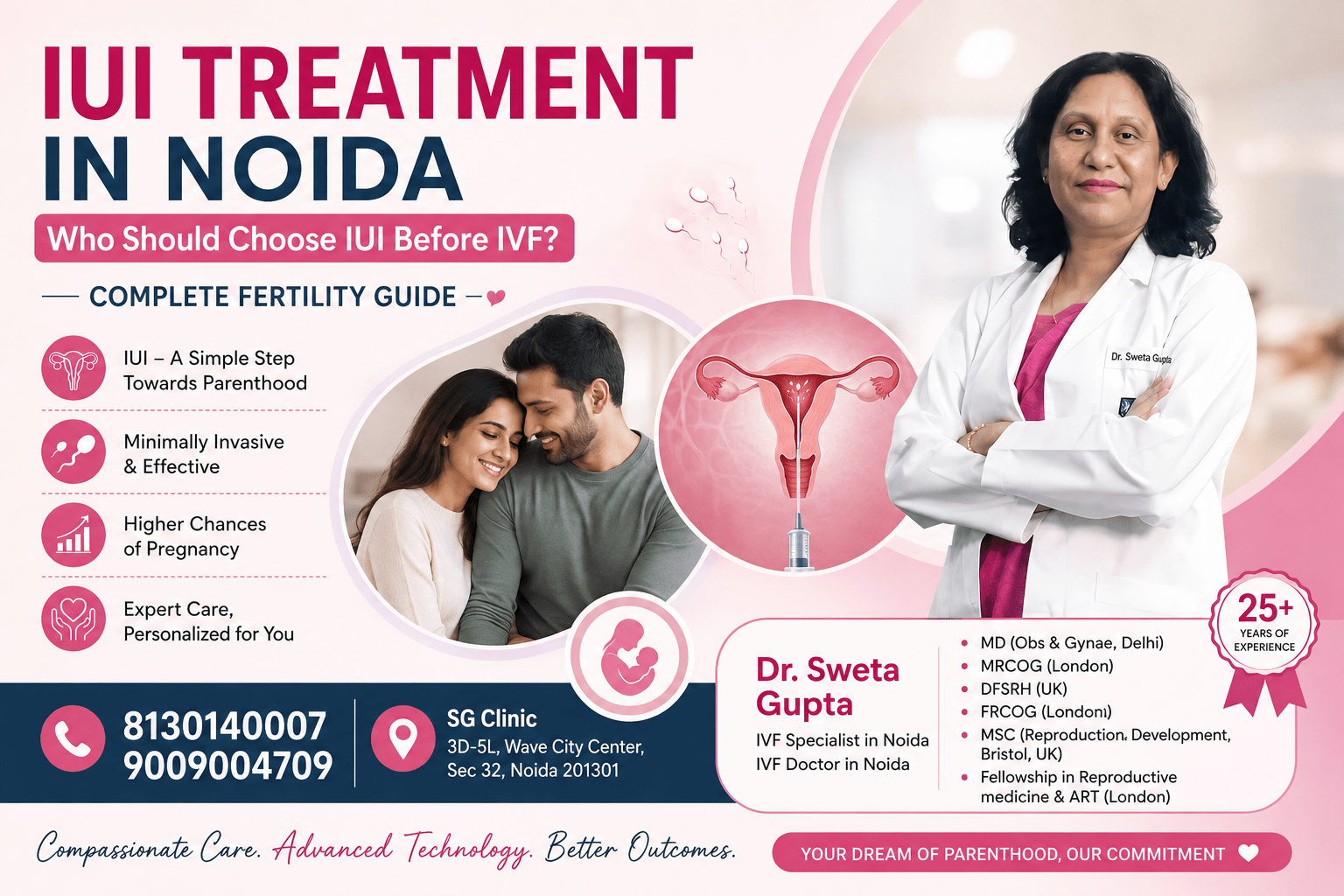
IUI treatment in Noida is often recommended for couples with unexplained infertility, mild male factor infertility, ovulation problems such as PCOS, or cervical factor infertility. Many fertility specialists advise trying 3–4 well-monitored IUI cycles before IVF in women under 35 with good ovarian reserve and open fallopian tubes. However, IVF may be a better first option for women with blocked tubes, severe endometriosis, low AMH, significant sperm abnormalities, or age above 38. Consulting an experienced IVF specialist in Noida helps determine the most effective treatment based on age, fertility history, ovarian reserve, and sperm quality.
In this complete fertility guide, Dr. Sweta Gupta, a leading IVF doctor in Noida, explains who should choose IUI before IVF, how IUI is performed, expected success rates, treatment costs, risks, lifestyle factors that improve conception, and when to move from IUI to IVF for better pregnancy outcomes.
Quick Answer
-
Choose IUI first if: You are under 35, have open tubes, regular or treatable ovulation, and mild fertility issues.
-
Consider IVF directly if: You have blocked tubes, severe male infertility, poor ovarian reserve, repeated failed IUI cycles, or are above 38 years.
Table of Contents
- Introduction to IUI Treatment
- Understanding Fertility: Why Pregnancy May Not Happen Naturally
- Difference Between IUI and IVF
- How IUI Treatment Is Performed
- Who Should Choose IUI Before IVF?
- Who Should Avoid IUI and Consider IVF Directly?
- IUI Success Rates in Noida
- How Many IUI Cycles Should Be Tried Before IVF?
- Cost of IUI Treatment in Noida
- Emotional Advantages of Trying IUI First
- Common Myths About IUI
- Lifestyle Changes That Improve IUI Success
- Role of Age in Deciding Between IUI and IVF
- PCOS: Should Women with PCOS Try IUI First?
- Endometriosis and IUI
- Male Fertility and IUI
- Investigations Before Starting IUI
- What Happens If IUI Fails?
- When IVF Is a Better Investment Than Repeated IUI
- Choosing the Right Fertility Clinic in Noida
- Why Early Consultation Matters
- IUI and IVF: A Stepwise Fertility Approach
- Expert Perspective by Dr. Sweta Gupta
- Conclusion
- Frequently Asked Questions (FAQs)
Infertility is a deeply emotional and often confusing journey for couples who dream of becoming parents. In a rapidly growing city like Noida, access to modern fertility treatments has improved significantly, yet many couples remain unsure about one important question: Should we try IUI before IVF? Understanding the difference between IUI and IVF, and knowing who is an ideal candidate for IUI, can help couples make informed decisions, save time, and avoid unnecessary treatment costs.
This comprehensive fertility guide is written to help couples in Noida understand when Intrauterine Insemination (IUI) is recommended, when In Vitro Fertilization (IVF) may be a better option, and how an experienced IVF specialist in Noida can personalize treatment based on age, fertility history, and medical condition. The goal is to provide evidence-based, patient-friendly information that is also optimized for Google and AI search visibility.
Introduction to IUI Treatment
IUI, or Intrauterine Insemination, is a fertility treatment in which specially prepared sperm are placed directly inside the uterus around the time of ovulation. The procedure increases the number of motile sperm reaching the fallopian tubes and improves the chance of fertilization.
IUI is considered one of the least invasive and most affordable fertility treatments. It is often recommended before IVF for selected couples, especially when the woman is younger and fertility problems are mild.
Key Features of IUI
- Minimally invasive procedure
- Usually performed in the clinic without anesthesia
- Lower cost compared with IVF
- Short treatment duration
- Can be combined with ovulation-inducing medications
- Suitable for certain types of infertility
An experienced IVF doctor in Noida will evaluate whether IUI is likely to provide a reasonable chance of pregnancy before proceeding to IVF.
Understanding Fertility: Why Pregnancy May Not Happen Naturally
For pregnancy to occur naturally, several steps must happen correctly:
- Regular ovulation
- Healthy eggs
- Open fallopian tubes
- Adequate sperm count and motility
- Proper timing of intercourse
- Healthy uterine lining
A problem in any of these areas can reduce the chance of conception. Fertility specialists usually recommend evaluation if:
- The woman is under 35 and has not conceived after 12 months of trying.
- The woman is 35 or older and has not conceived after 6 months.
- Menstrual cycles are irregular.
- There is known male factor infertility.
- There is a history of miscarriage, endometriosis, pelvic infection, or surgery.
What Is the Difference Between IUI and IVF?
Understanding the distinction between these treatments is crucial.
| Feature | IUI | IVF |
|---|---|---|
| Fertilization occurs | Inside the body | In the laboratory |
| Procedure invasiveness | Minimal | More invasive |
| Anesthesia required | No | Usually yes during egg retrieval |
| Cost | Lower | Higher |
| Success rate per cycle | Lower | Higher |
| Best for | Mild infertility | Moderate to severe infertility |
| Number of clinic visits | Fewer | More |
IUI is often the first-line treatment, while IVF is usually recommended when IUI is unlikely to succeed.
How IUI Treatment Is Performed
Step 1: Fertility Assessment
The fertility specialist performs:
- Ultrasound scan
- Hormonal tests (AMH, FSH, LH, TSH, prolactin)
- Ovulation assessment
- Semen analysis
- Tubal patency test (HSG or SSG)
Step 2: Ovulation Stimulation
Some women receive medications such as letrozole or clomiphene citrate to stimulate egg development.
Step 3: Monitoring
Ultrasound monitoring tracks follicle growth. When the follicle reaches an appropriate size, an ovulation trigger injection may be given.
Step 4: Semen Preparation
The semen sample is processed in the laboratory to concentrate healthy motile sperm.
Step 5: Insemination
A thin catheter is used to place the prepared sperm directly into the uterus. The procedure takes only a few minutes.
Step 6: Pregnancy Test
A blood pregnancy test is usually done about two weeks later.
Who Should Choose IUI Before IVF?
This is the most important question for many couples.
1. Women Under 35 with Good Ovarian Reserve
Women below 35 generally have better egg quality and higher IUI success rates.
2. Unexplained Infertility
When all tests are normal but pregnancy has not occurred, IUI combined with ovulation induction is often recommended.
3. Mild Male Factor Infertility
IUI may help when sperm count or motility is mildly reduced.
4. Ovulation Disorders
Women with PCOS or irregular ovulation who respond well to medications may benefit from IUI.
5. Cervical Factor Infertility
IUI bypasses cervical mucus problems.
6. Couples Unable to Have Timed Intercourse
IUI ensures sperm are placed in the uterus at the optimal time.
7. Donor Sperm Cycles
IUI is commonly used with donor sperm.
A qualified IVF specialist in Noida will determine whether these indications apply in your case.
Who Should Avoid IUI and Consider IVF Directly?
IUI may not be effective in the following situations:
- Both fallopian tubes blocked
- Severe male factor infertility
- Advanced maternal age (especially above 38–40)
- Very low AMH or poor ovarian reserve
- Moderate to severe endometriosis
- Repeated failed IUI cycles
- Significant tubal damage
- Need for genetic testing
In such cases, consulting an experienced IVF doctor in Noida can prevent delays in treatment.
IUI Success Rates in Noida
Success depends on age, diagnosis, ovarian reserve, sperm quality, and treatment protocol.
| Age Group | Approximate Pregnancy Rate per Cycle |
| Under 30 | 15–25% |
| 30–34 | 12–20% |
| 35–37 | 10–15% |
| 38–40 | 5–10% |
| Above 40 | Less than 5% |
These are approximate ranges and vary between clinics and patients.
How Many IUI Cycles Should Be Tried Before IVF?
Most fertility specialists recommend:
- 3–4 well-monitored IUI cycles for women under 35.
- 2–3 cycles for women 35–37.
- Consider IVF earlier for women above 38.
Continuing ineffective IUI cycles may reduce overall chances because fertility declines with age.
Cost of IUI Treatment in Noida
IUI is significantly less expensive than IVF.
Typical Cost Components
- Consultation
- Ultrasound monitoring
- Fertility medications
- Trigger injection
- Semen preparation
- IUI procedure
- Pregnancy test
Actual costs vary by clinic and medication requirements.
Emotional Advantages of Trying IUI First
Many couples prefer IUI initially because:
- It feels closer to natural conception.
- It involves less physical stress.
- It requires fewer injections.
- It is less expensive.
- It may reduce anxiety for first-time fertility patients.
However, emotional well-being also requires realistic expectations. A compassionate IVF specialist in Noida can help couples balance hope with evidence-based guidance.
Common Myths About IUI
Myth 1: IUI guarantees pregnancy
Fact: IUI increases the chance of pregnancy but does not guarantee success.
Myth 2: IUI is painful
Fact: Most women experience little or no pain.
Myth 3: Bed rest is necessary afterward
Fact: Normal daily activities can usually be resumed the same day.
Myth 4: IVF is always better
Fact: IVF is more effective for many conditions, but IUI may be appropriate for selected patients.
Myth 5: IUI causes twins
Fact: Multiple pregnancy risk mainly depends on ovarian stimulation medications.
Lifestyle Changes That Improve IUI Success
- Maintain healthy weight
- Stop smoking
- Avoid alcohol and recreational drugs
- Sleep 7–8 hours
- Exercise moderately
- Reduce stress
- Take folic acid
- Manage thyroid and diabetes
- Limit excessive caffeine
These measures are important whether undergoing IUI or IVF.
The Role of Age in Deciding Between IUI and IVF
Under 35
IUI is often reasonable.
35–37
Limited IUI attempts may be considered.
38–40
IVF is often recommended sooner.
Above 40
IVF usually offers better chances than IUI.
Age is one of the strongest predictors of fertility treatment success.
PCOS: Should Women with PCOS Try IUI First?
Women with PCOS often respond well to ovulation induction. IUI may be considered when:
- Tubes are open.
- Sperm parameters are adequate.
- Ovulation can be achieved.
If multiple ovulation induction cycles fail, IVF may be advised.
Endometriosis and IUI
- Minimal or mild endometriosis: IUI may be attempted.
- Moderate or severe endometriosis: IVF generally offers better results.
A fertility specialist can assess the stage of disease and ovarian reserve.
Male Fertility and IUI
Important semen parameters include:
- Sperm concentration
- Motility
- Morphology
- Total motile sperm count
IUI works best when post-wash motile sperm count is adequate. Severe abnormalities usually require IVF or ICSI.
Investigations Before Starting IUI
A thorough evaluation prevents inappropriate treatment.
Female Tests
- AMH
- FSH, LH
- Estradiol
- TSH
- Prolactin
- Ultrasound
- HSG/SSG
Male Tests
- Semen analysis
- Repeat semen test if abnormal
- Hormonal tests when indicated
What Happens If IUI Fails?
Failure of one cycle is common and does not mean pregnancy is impossible.
After failed cycles, the specialist may:
- Review ovulation response
- Change medications
- Reassess sperm quality
- Repeat tubal evaluation
- Recommend IVF
When IVF Is a Better Investment Than Repeated IUI
IVF may save time when:
- The woman is older.
- AMH is low.
- Tubes are damaged.
- Male factor is significant.
- More than three good-quality IUIs have failed.
- Fertility duration is long.
An experienced IVF doctor in Noida can calculate the cumulative probability of success and guide financially and emotionally sound decisions.
Choosing the Right Fertility Clinic in Noida
Look for:
- Qualified fertility specialist
- Transparent counseling
- Good laboratory standards
- Personalized treatment plans
- Ultrasound and andrology facilities
- Ethical practices
- Patient support services
Many couples searching online for an IVF specialist in Noida should prioritize expertise and individualized care rather than advertising claims alone.
Why Early Consultation Matters
Delaying fertility treatment can reduce success, especially after 35. Early consultation allows:
- Identification of treatable problems
- Timely use of IUI when appropriate
- Earlier transition to IVF if needed
- Better overall pregnancy outcomes
IUI and IVF: A Stepwise Fertility Approach
A practical approach is often:
- Fertility evaluation
- Lifestyle optimization
- Ovulation induction if needed
- IUI for suitable candidates
- IVF if IUI fails or prognosis is poor
This individualized pathway helps maximize success while minimizing unnecessary interventions.
Expert Perspective
A fertility expert evaluates not only test results but also the couple’s age, emotional readiness, duration of infertility, previous treatments, and family-building goals. The decision between IUI and IVF should never be based on age alone or on internet information alone.
Consulting an experienced IVF specialist in Noida ensures that treatment is tailored to your specific medical situation.
Conclusion
IUI is an excellent first-line fertility treatment for many couples with unexplained infertility, mild male factor infertility, ovulation disorders, or cervical factor infertility. It is less invasive, more affordable, and emotionally easier for many patients.
However, IUI is not suitable for everyone. Women with blocked tubes, severe endometriosis, significant male factor infertility, poor ovarian reserve, or advanced maternal age often achieve better outcomes with IVF.
The most important step is a thorough fertility evaluation by a trusted IVF doctor in Noida. Personalized treatment planning can save valuable time, reduce emotional stress, and improve the chance of a healthy pregnancy.
If you are trying to conceive and are unsure whether IUI or IVF is right for you, seek an early consultation with a qualified fertility specialist. Timely expert guidance is one of the most powerful factors in a successful fertility journey.
Frequently Asked Questions (FAQs)
1. Is IUI better than IVF?
Neither is universally better. IUI is suitable for selected mild infertility cases, while IVF is more effective for moderate to severe infertility.
2. How many IUI cycles should I try before IVF?
Usually 3–4 cycles for women under 35 and fewer cycles for women above 35.
3. Is IUI painful?
Most women feel only mild discomfort similar to a gynecological examination.
4. What is the success rate of IUI in Noida?
Success commonly ranges from about 10–20% per cycle depending on age and fertility factors.
5. Can IUI work with low sperm count?
It may work in mild male factor infertility but is less effective in severe sperm abnormalities.
6. Is bed rest required after IUI?
No. Most patients can resume normal activities immediately.
7. How soon can I test for pregnancy after IUI?
A blood pregnancy test is usually done about 14 days after insemination.
8. Does IUI increase the chance of twins?
The risk is mainly related to fertility medications that stimulate multiple follicles.
9. Can women with PCOS conceive with IUI?
Yes, many women with PCOS conceive with ovulation induction and IUI when tubes are open.
10. Should I choose IVF directly at age 38?
Many specialists discuss IVF early at 38 because fertility declines significantly with age.
11. Is IUI suitable if one tube is blocked?
It may be considered if the other tube is healthy and ovulation occurs on that side.
12. How long does the IUI procedure take?
The actual insemination usually takes only a few minutes.
13. What is the difference between IUI and ICSI?
IUI places sperm inside the uterus; ICSI injects a single sperm directly into the egg during IVF.
14. Can stress affect IUI success?
Severe stress may affect overall well-being; stress reduction is beneficial during fertility treatment.
15. Why should I consult an IVF specialist in Noida for IUI?
A fertility specialist can accurately assess whether IUI is appropriate and prevent delays in effective treatment.
Dr. Sweta Gupta
IVF Specialist in Noida | IVF Doctor in Noida
SG Clinic, 3D-5L, Wave City Center, Sector 32, Noida 201301
For fertility consultation and personalized treatment planning, book an appointment with Dr. Sweta Gupta.