

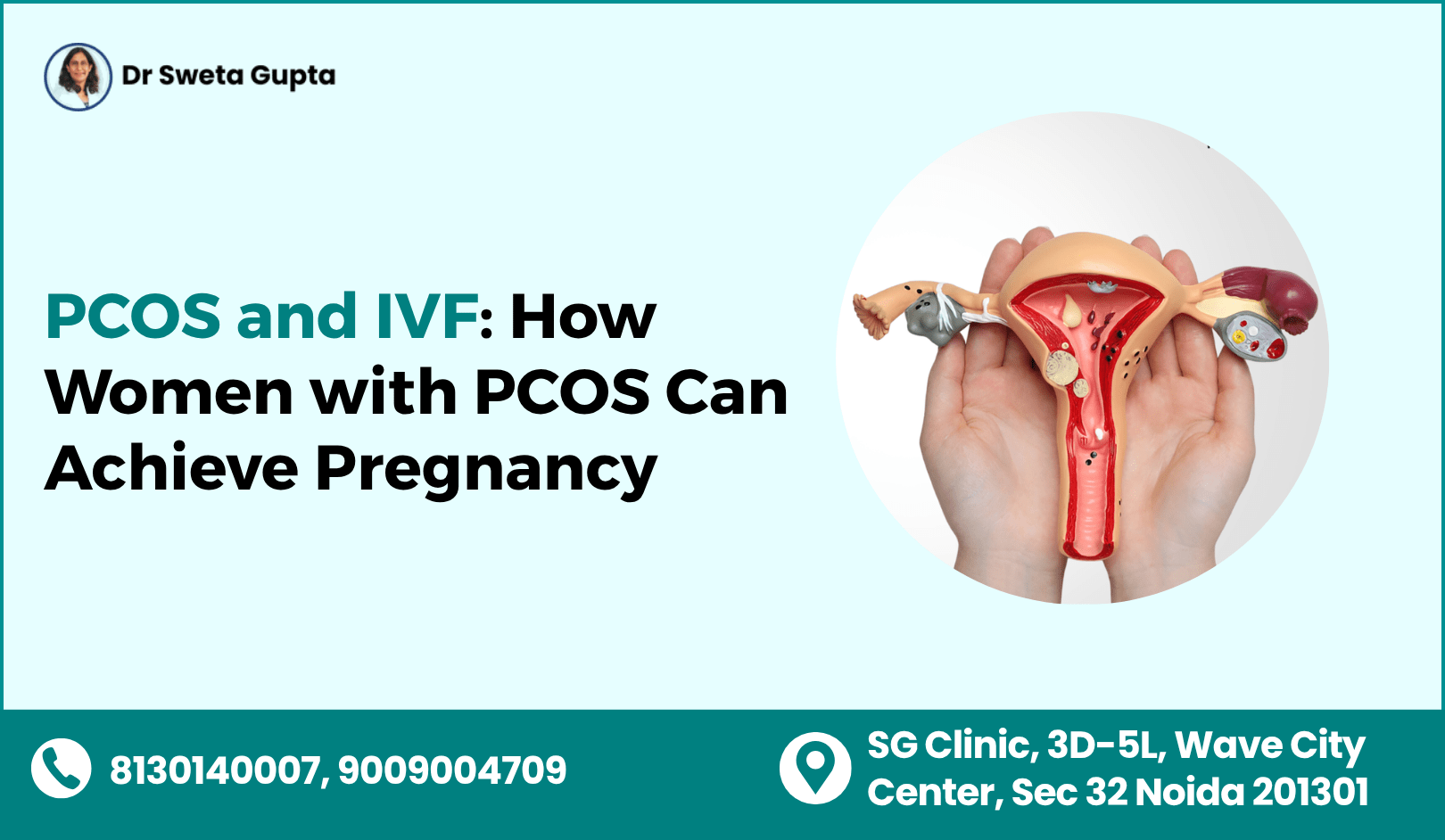
For many women, the journey to motherhood is smooth and natural. But for others, especially those diagnosed with PCOS (Polycystic Ovary Syndrome), getting pregnant can become a stressful and emotionally exhausting experience.
Irregular periods, hormonal imbalance, weight gain, acne, unwanted hair growth, and difficulty in ovulation are common symptoms of PCOS. Among all these challenges, infertility often becomes the biggest concern.
The good news is that PCOS does not mean pregnancy is impossible.
With the right fertility diagnosis, lifestyle management, medical treatment, and advanced reproductive options like IVF (In Vitro Fertilization), many women with PCOS successfully achieve healthy pregnancies.
If you are looking for expert treatment for PCOS and IVF in Noida, understanding how IVF works for PCOS patients can help you make informed decisions. Under the expert care of Dr. Sweta Gupta, a trusted IVF specialist in Noida, women receive personalized fertility treatment plans designed to improve pregnancy success.
This complete guide explains everything about PCOS, its impact on fertility, how IVF helps, treatment steps, success rates, and answers to the most common questions.
What is PCOS?
PCOS stands for Polycystic Ovary Syndrome, a common hormonal disorder that affects women of reproductive age.
In PCOS, the ovaries may produce higher-than-normal male hormones (androgens), which disrupt normal ovulation and menstrual cycles.
Many women with PCOS do not release eggs regularly, making natural conception difficult.
Common symptoms of PCOS include:
- Irregular or missed periods
- Delayed ovulation
- Weight gain
- Acne and oily skin
- Excess facial or body hair
- Hair thinning
- Difficulty getting pregnant
- Multiple small ovarian follicles seen on ultrasound
PCOS affects both reproductive health and overall hormonal balance.
How PCOS Affects Fertility
The biggest fertility issue in PCOS is:
Irregular or Absent Ovulation
Without regular ovulation, pregnancy becomes difficult because the egg is not released properly for fertilization.
Other fertility problems caused by PCOS include:
Poor Egg Quality
Hormonal imbalance can affect egg development.
Insulin Resistance
Common in PCOS and linked to hormonal disruption.
Higher Miscarriage Risk
Some PCOS patients may face increased pregnancy complications.
Obesity and Metabolic Issues
Excess weight may reduce fertility and IVF outcomes.
Endometrial Problems
Irregular periods may affect uterine lining health.
This is why early diagnosis and expert fertility planning are important.
Can Women with PCOS Get Pregnant Naturally?
Yes—many women with mild PCOS can conceive naturally with:
- Lifestyle improvement
- Weight management
- Ovulation induction medicines
- Hormonal treatment
- Timed intercourse monitoring
However, when these methods fail, fertility specialists may recommend advanced treatment like IVF.
IVF becomes especially helpful when:
- Ovulation medicines fail
- Age is increasing
- Ovarian response is poor
- Male factor infertility also exists
- Tubal issues are present
- Multiple failed IUI cycles occur
What is IVF?
IVF stands for In Vitro Fertilization.
It is one of the most effective fertility treatments where eggs are collected from the ovaries, fertilized with sperm in a lab, and the resulting embryo is transferred into the uterus.
For women with PCOS, IVF offers better control over ovulation and fertilization.
This improves pregnancy chances significantly.
Why IVF is Effective for Women with PCOS
PCOS patients often respond very well to IVF because they usually have:
- Good ovarian reserve
- Multiple follicles
- Strong egg production potential
The main goal is proper stimulation and careful monitoring to avoid complications.
IVF helps by:
- Controlling ovulation precisely
- Improving fertilization success
- Selecting healthy embryos
- Reducing repeated treatment failure
- Increasing pregnancy success rates
This makes IVF one of the strongest options for PCOS-related infertility.
Step-by-Step IVF Process for PCOS Patients
Understanding the IVF journey helps reduce anxiety and improves treatment confidence.
Step 1: Fertility Evaluation
Dr. Sweta Gupta begins with detailed fertility testing including:
- Hormonal profile
- AMH test
- Ultrasound scan
- Ovarian reserve assessment
- Thyroid and insulin evaluation
- Semen analysis (partner)
This helps create a personalized treatment plan.
Step 2: Lifestyle and Weight Optimization
Before IVF, lifestyle correction improves outcomes.
This may include:
- Healthy diet planning
- Weight management
- Exercise routine
- Insulin resistance control
- Vitamin support
Even small weight loss can improve fertility significantly.
Step 3: Controlled Ovarian Stimulation
Hormonal injections are given to stimulate the ovaries and mature multiple eggs.
PCOS patients require careful monitoring because they may over-respond to stimulation.
This helps prevent:
OHSS (Ovarian Hyperstimulation Syndrome)
A known IVF risk in PCOS patients.
Expert supervision is extremely important here.
Step 4: Egg Retrieval
Once the eggs are ready, mature eggs are collected through a short minimally invasive procedure done under anesthesia.
The procedure usually takes:
20–30 minutes
Most patients return home the same day.
Step 5: Fertilization in Lab
The collected eggs are fertilized with sperm in the IVF lab.
Healthy embryos are monitored for development.
Step 6: Embryo Transfer
The best-quality embryo is transferred into the uterus for implantation.
This is a simple and painless procedure.
Sometimes frozen embryo transfer is preferred for better outcomes.
Step 7: Pregnancy Test
Around 10–14 days after embryo transfer, a pregnancy test confirms treatment success.
This is the most awaited step for every couple.
IVF Success Rate in PCOS Patients
Many women ask:
Is IVF more successful for PCOS patients?
In many cases—yes.
Because PCOS patients often have good ovarian reserve, IVF success can be very promising when treatment is properly managed.
Success depends on:
- Age
- Egg quality
- Weight management
- Embryo quality
- Uterine health
- Hormonal balance
- IVF lab quality
- Specialist expertise
Younger women with PCOS often show strong IVF outcomes.
This makes early fertility consultation important.
PCOS and IVF Success Rate by Age
| Age Group | IVF Success Potential |
|---|---|
| Below 30 | Very High |
| 30–35 | High |
| 35–38 | Moderate |
| Above 38 | Lower but possible |
Age still remains one of the strongest fertility factors.
Risks of IVF in PCOS Patients
While IVF is highly effective, PCOS patients require careful monitoring for:
OHSS (Ovarian Hyperstimulation Syndrome)
This happens when ovaries over-respond to fertility injections.
Symptoms may include:
- Bloating
- Abdominal discomfort
- Fluid retention
- Severe ovarian swelling
Modern IVF protocols help reduce this risk significantly.
Multiple Pregnancy Risk
Proper embryo transfer planning helps prevent this.
Emotional Stress
Fertility treatment can be emotionally demanding.
This is why expert medical and emotional support matters.
Can Frozen Embryo Transfer Be Better for PCOS?
Yes.
Many fertility specialists prefer:
Freeze-All Strategy
This means embryos are frozen first and transferred later when the body is hormonally stable.
Benefits include:
- Lower OHSS risk
- Better implantation conditions
- Improved pregnancy outcomes
- Safer IVF cycle management
This approach is often highly effective for PCOS patients.
Lifestyle Tips to Improve IVF Success with PCOS
Medical treatment works best with strong lifestyle support.
Helpful fertility habits include:
Maintain Healthy Weight
Even 5–10% weight loss improves fertility.
Eat Low-Glycemic Diet
Helps manage insulin resistance.
Regular Exercise
Improves hormones and metabolism.
Sleep Management
Poor sleep affects hormonal health.
Stress Reduction
Mental wellness improves fertility balance.
Avoid Smoking and Alcohol
These reduce reproductive health quality.
Fertility treatment is stronger when the body is fully supported.
Why Choose Dr. Sweta Gupta for PCOS and IVF Treatment in Noida
Choosing the right IVF specialist makes a major difference.
Expertise in PCOS Fertility Treatment
Dr. Sweta Gupta is known for:
- Personalized fertility planning
- Advanced IVF protocols
- High-risk fertility management
- Ethical fertility care
- Compassionate patient support
Advanced IVF Monitoring
PCOS patients need precision-based IVF planning.
This includes:
- Safe ovarian stimulation
- OHSS prevention
- Better embryo selection
- Improved implantation strategy
Honest and Personalized Care
Every patient’s fertility journey is unique.
Treatment should never be one-size-fits-all.
This patient-focused approach improves both confidence and success.
Common Myths About PCOS and Pregnancy
Myth 1: PCOS Means You Can Never Get Pregnant
Reality: Many women with PCOS conceive naturally or with IVF.
Myth 2: IVF Always Means Twins
Reality: Modern IVF often uses single embryo transfer for safer outcomes.
Myth 3: Weight Does Not Affect Fertility
Reality: Weight management plays a major role in PCOS pregnancy success.
Myth 4: IVF is Always the First Step
Reality: Many women conceive with simpler treatments before IVF.
Understanding facts reduces unnecessary fear.
Emotional Side of PCOS Fertility Treatment
Infertility affects more than the body—it affects confidence, relationships, and emotional well-being.
Women with PCOS often feel:
- Frustrated
- Anxious
- Socially pressured
- Emotionally exhausted
- Fearful about future motherhood
This is why emotional support matters just as much as medical treatment.
Hope, guidance, and trust are powerful parts of fertility care.
Final Thoughts
PCOS can make pregnancy more challenging—but it does not make motherhood impossible.
With the right diagnosis, expert fertility care, lifestyle support, and advanced IVF treatment, women with PCOS can absolutely achieve healthy pregnancies.
If you are searching for trusted treatment for PCOS and IVF in Noida, consulting an experienced fertility expert like Dr. Sweta Gupta can help you move from uncertainty to confidence.
Because fertility treatment is not just about pregnancy.
It is about giving hope a real medical path.
And for many women with PCOS, that path leads successfully to motherhood.
FAQs
1. Can women with PCOS get pregnant naturally?
Yes, many women with mild PCOS can conceive naturally with lifestyle changes and ovulation support.
2. Is IVF successful for PCOS patients?
Yes, IVF often shows strong success rates in PCOS patients, especially with proper monitoring and treatment planning.
3. Why is IVF recommended for PCOS?
IVF helps control ovulation, improve fertilization, and increase pregnancy chances when simpler treatments fail.
4. What is OHSS in IVF?
OHSS stands for Ovarian Hyperstimulation Syndrome, where ovaries over-respond to fertility injections. It requires careful monitoring.
5. Is frozen embryo transfer better for PCOS?
In many cases, yes. Frozen embryo transfer may reduce OHSS risk and improve implantation success.
6. Does weight affect IVF success in PCOS?
Yes, weight management plays a major role in improving hormonal balance and IVF outcomes.
7. Can PCOS cause miscarriage?
Some PCOS patients may have a slightly higher miscarriage risk, but proper treatment improves outcomes.
8. Is IVF painful?
Most IVF procedures involve mild discomfort, but major steps like egg retrieval are done under anesthesia.
9. How many IVF cycles are needed for PCOS?
It depends on age, fertility condition, and embryo quality. Some women conceive in the first cycle.
10. Why should I consult Dr. Sweta Gupta for PCOS and IVF treatment?
Because expert diagnosis, personalized IVF planning, and advanced fertility care significantly improve pregnancy success.